

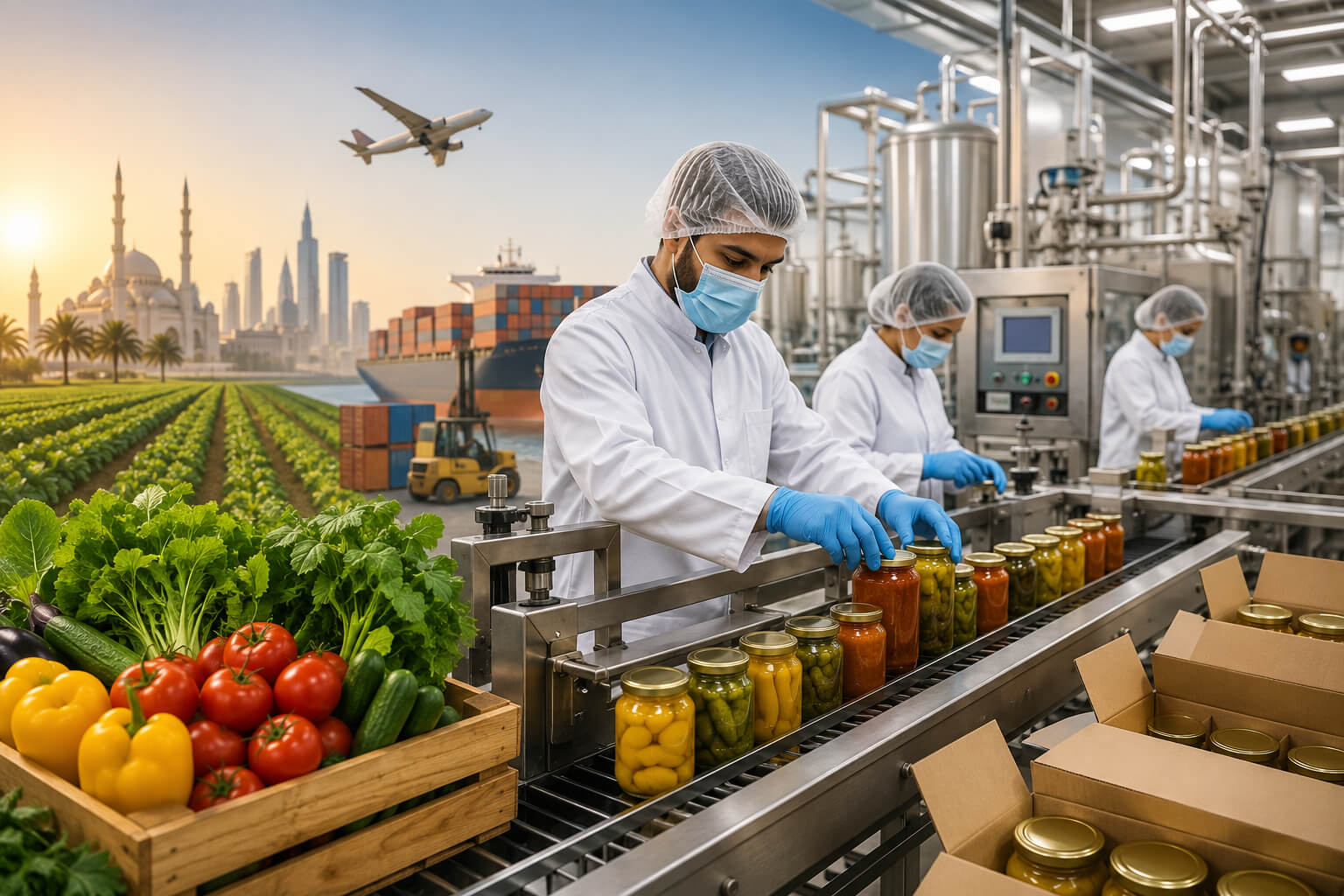
Sharjah is building a more direct bridge between its farms and the wider food market. The emirate’s planned National Food Factory will process locally grown dates, vegetables and other agricultural products instead of leaving farmers to manage manufacturing, packaging and distribution on their own.
Developed by the Sharjah Chamber of Commerce and Industry, the project is expected to handle as much as 5,000 metric tonnes of food products annually once operational. The factory will serve domestic buyers, regional markets and international customers.
The idea is fairly practical. Sharjah already produces agricultural goods. What farmers often need is the industrial layer that comes after the harvest: processing, drying, packaging, storage, branding and access to reliable logistics. That is where the new facility comes in.
Sharjah Showcases the Factory at Al Dhaid Date Festival
The Sharjah National Food Factory was presented during the tenth Al Dhaid Date Festival at Expo Al Dhaid. The four-day event brought together palm farmers, date producers, agricultural businesses, government entities and companies supplying farming technology. More than 35,000 people attended the 2026 edition, while sales exceeded AED2.5 million.
Against that backdrop, the factory was not shown as a distant industrial concept. It was positioned as something farmers and food businesses could eventually use.
The project is being developed in the Hamda area of Mleiha. According to the Sharjah Chamber, it will connect agricultural production with an industrial system capable of preparing goods for supermarkets, hospitality companies, distributors and overseas buyers.
A 5,000-Tonne Facility Built Around Food Processing
The factory’s planned annual production capacity stands at 5,000 metric tonnes. That number matters, but the range of services may prove more important.
The facility will provide date and vegetable processing, contract manufacturing, drying, industrial packaging and private-label production. Farmers or food companies could bring products into the factory and leave with goods prepared for commercial shelves rather than loose agricultural produce with limited market reach.
Private-label production adds another route into the market. Retailers, hospitality groups and distributors may be able to sell locally processed products under their own brands without building separate manufacturing operations.
For smaller producers, that removes a large upfront expense. A farmer may know how to grow high-quality dates. Running a packaging line, maintaining storage facilities and meeting export requirements is a different business entirely.
Cold Storage and Logistics Complete the Model
Food manufacturing does not stop when the product leaves the processing line. Storage conditions, inventory control and delivery schedules can decide whether agricultural products reach customers in good condition or become another source of waste.
The Sharjah National Food Factory will include refrigerated and dry warehouses supported by modern inventory management systems. It will also offer logistics services aimed at improving product movement across the supply chain.
This makes the project more than a factory in the narrow sense. It is being designed as a shared agri-industrial platform.
Processing, packing and warehousing will sit within the same operational ecosystem. That should make it easier for businesses to move products from farms to retail shelves, hotels, restaurants and export channels without dealing with several disconnected service providers.
Local Farmers Could Gain More Control Over Pricing
Raw agricultural products usually offer thinner margins than processed or branded goods. A box of dates has one value. Cleaned, graded and packaged dates sold under a recognisable label may have another. Turn those dates into paste, syrup, snacks or gift products and the commercial possibilities change again.
The National Food Factory is intended to help producers capture more of that value. Mohammad Ahmed Amin Al Awadi, director-general of the Sharjah Chamber of Commerce and Industry, said the project would connect local agricultural output with an advanced industrial ecosystem. The factory is also expected to give farmers more opportunities to improve product quality and compete in changing markets.
That does not automatically guarantee higher prices for every farmer. It does, however, create options that are difficult to access without processing infrastructure.
Food Exporters Get a New Production Base in Sharjah
Sharjah is not limiting the factory to local retail demand. The facility will prepare products for domestic and export markets, with services aimed at food manufacturers, traders, distributors, retail chains and exporters. Hospitality and catering companies are also among the intended users.
For export-focused businesses, integrated manufacturing and logistics could simplify operations. Products may be processed, packed, stored and prepared for shipment through a single facility.
That model could also attract entrepreneurs that have a food concept but lack the capital to establish their own production plant. Contract manufacturing allows a company to focus on product development, branding and sales while another operator handles the physical manufacturing process.
Sharjah gains something from that arrangement too. More agricultural products can move through formal manufacturing channels, creating opportunities around packaging, logistics, wholesale trade and food distribution.
The Project Fits Sharjah’s Wider Agri-Industrial Push
The factory arrives as Sharjah invests more heavily in linking farming with commercial food production. Mleiha has already become a visible part of the emirate’s agricultural strategy through projects covering wheat and dairy production. The National Food Factory adds another piece by concentrating on what happens after crops leave the farm.
Sharjah Chamber Chairman Abdallah Sultan Al Owais said the emirate’s approach extends beyond growing agricultural products. It also covers food manufacturing, marketing and the wider agricultural value chain.
That distinction is important. Producing more food improves local supply, but processing and distributing it efficiently creates a functioning industry. The factory could help Sharjah retain more of that economic activity inside the emirate rather than sending local produce elsewhere for packaging or manufacturing.
A Practical Opportunity for Food Businesses and Investors
Large food plants often dominate headlines, yet shared industrial facilities can have a broader impact. A single platform can serve farmers, cooperatives, small food brands, retailers and established manufacturers at the same time. Each user avoids having to recreate the same infrastructure.
For investors, the opportunity may emerge around the factory rather than only inside it. Packaging materials, transport fleets, cold-chain services, quality testing, branding and export distribution could all see additional demand as production increases.
The project may also strengthen Sharjah’s appeal to food companies looking for a base that combines agricultural supply with manufacturing and logistics. Free zones and industrial areas across the UAE already compete for food-processing businesses. A stronger local agricultural pipeline gives Sharjah another point of differentiation.
Sharjah Is Building Beyond the Harvest
The National Food Factory is not trying to replace farmers or private food manufacturers. Its role is to fill the expensive space between them. A farmer grows the product. A retailer or overseas buyer wants something graded, packaged and ready to sell. The factory is being built to handle the work in between.
With annual capacity planned at 5,000 metric tonnes, the project is not small. Still, its real test will not come from the size of the building or the number attached to its output. It will come from whether local producers can use the facility to reach more customers, build stronger brands and earn better returns from what they already grow.
Sources
- Economy Middle East – Sharjah showcases 5,000-tonne National Food Factory to boost farm exports
- Emirates News Agency – Sharjah Chamber showcases National Food Factory project
- Gulf News – Sharjah showcases National Food Factory at Al Dhaid Date Festival
- Emirates News Agency – Sharjah Chamber concludes 10th Al Dhaid Date Festival
