

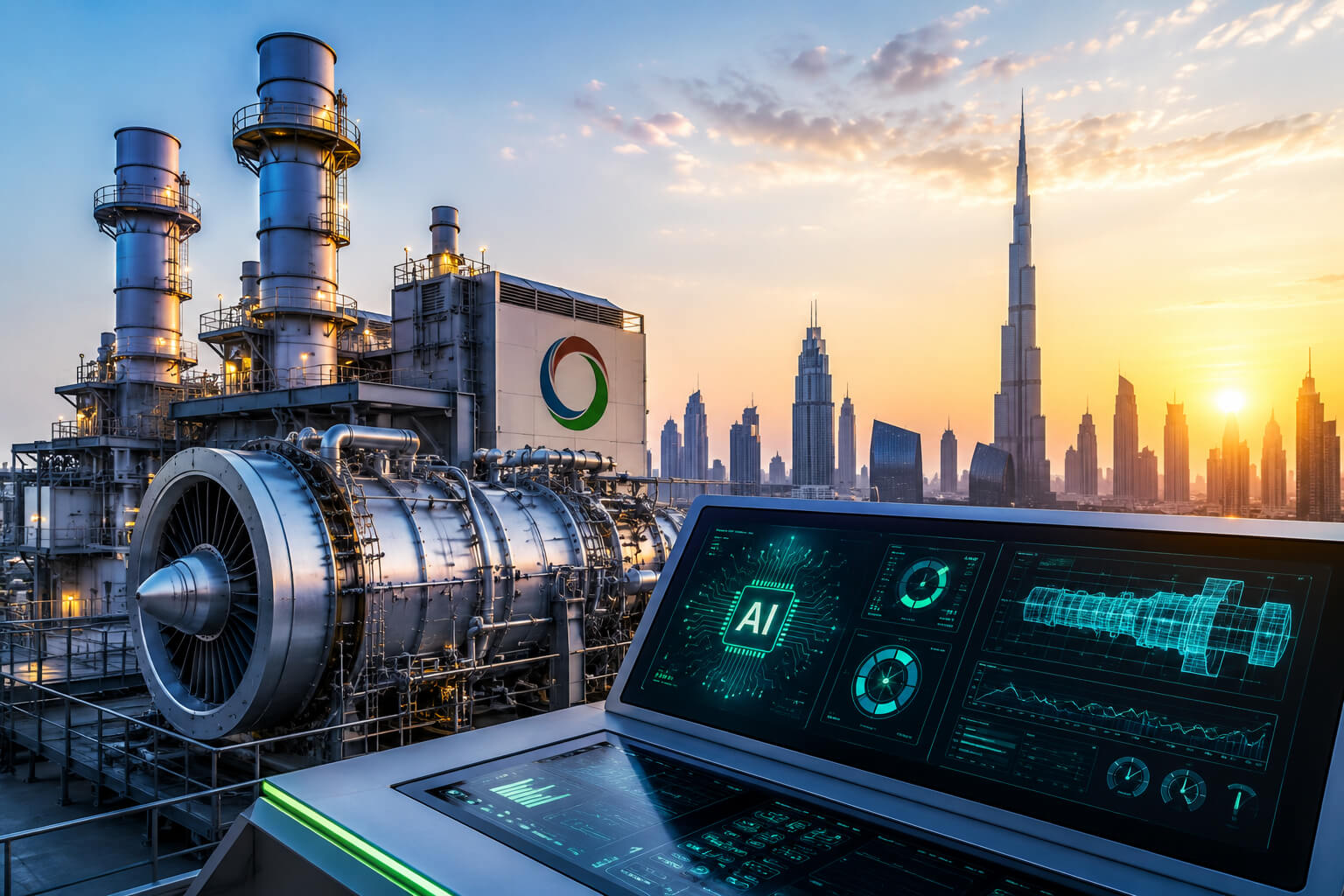
Dubai Electricity and Water Authority has managed to pull nearly 29 megawatts of additional power from equipment that was already operating at the Jebel Ali Power and Desalination Complex.
No new turbine build. No major plant expansion.
Instead, DEWA used an artificial intelligence-driven control system developed with Siemens Energy to improve how 14 existing gas turbine units perform in real time.
The project increased generation capacity by approximately 28.9 megawatts and produced estimated capital expenditure savings of AED38.95 million, equivalent to around $10.61 million.
DEWA Uses AI to Recover Lost Turbine Capacity
Gas turbines do not maintain exactly the same level of performance throughout their operating lives. Equipment degradation, changing environmental conditions and other operational factors can gradually reduce the amount of power a unit produces.
DEWA’s Gas Turbine Intelligent Controller, known as GTIC, attempts to recover some of that lost capacity.
The controller combines artificial intelligence algorithms, machine learning, digital twin technology and thermodynamic data. It continuously monitors turbine conditions and adjusts operating parameters without waiting for engineers to make every change manually.
That distinction matters. This is not simply an analytics dashboard showing plant managers what happened yesterday. The system can support autonomous, real-time control of turbine performance while maintaining combustion stability and operational reliability.
Fourteen Gas Turbines Gain 28.9 MW of Capacity
DEWA deployed the intelligent controller across 14 gas turbine units at the Jebel Ali Power and Desalination Complex.
Together, the turbines produced an additional 28.9 megawatts of generation capacity. The gain may appear modest beside the scale of a large power station, but it came from improving existing assets rather than purchasing and installing entirely new generation equipment.
DEWA estimates that the additional capacity avoided approximately AED38.95 million in capital expenditure.
The project also generated around AED8.72 million in annual operating expenditure savings through lower fuel consumption and more efficient turbine operation.
The Controller Makes Decisions in Real Time
A digital twin creates a virtual representation of a physical turbine using live and historical operational data.
DEWA’s controller compares the turbine’s actual behaviour with this digital model. AI and thermodynamic calculations then identify adjustments that could recover output, improve efficiency or stabilise combustion.
The system can respond as turbine conditions change instead of relying only on fixed operating settings.
Nasser Lootah, Executive Vice President of Generation for Power and Water at DEWA, said the technology allows more accurate operational decisions while improving the management of critical power-generation assets.
The practical result is fairly straightforward: squeeze more reliable electricity from the same machinery while consuming less fuel.
Fuel Savings Come With Lower Carbon Emissions
The financial savings are only one part of the project.
DEWA said the controller has reduced carbon emissions by approximately 28,530 tonnes each year. Annual nitrogen oxide emissions have also fallen by around 22.9 tonnes.
Gas turbines remain thermal power assets, so the controller does not eliminate their emissions. It improves the amount of electricity generated from the fuel being consumed.
That makes efficiency upgrades particularly relevant while Dubai continues expanding renewable energy capacity but still depends on conventional generation to provide stable and responsive electricity supplies.
Dubai Pushes Toward an AI-Native Utility Model
DEWA Managing Director and CEO Saeed Mohammed Al Tayer said the project supports the authority’s ambition to become what it describes as the world’s first fully AI-native utility.
That wording suggests something broader than adding individual AI tools to selected departments.
An AI-native utility would increasingly use intelligent systems across generation, grid operations, maintenance, customer services, water production and infrastructure planning. The turbine controller offers a working example inside one of the most technically demanding parts of that operation.
DEWA and Siemens Energy had already expanded their work on AI-powered plant controllers in 2025. The second phase focused on using closed-loop controls and digital twins to help power plants respond to changing grid requirements while reducing fuel consumption.
The Technology Could Extend the Life of Existing Infrastructure
Utilities usually have two broad choices when demand rises: build more generating capacity or extract more value from what they already own.
The GTIC project leans heavily toward the second option.
By recovering output lost through equipment degradation, DEWA can delay some capital spending while improving the productivity of installed turbines. It may also extend the useful operating value of assets that will remain necessary during Dubai’s wider energy transition.
This does not remove the need for new renewable projects, storage systems or grid investment. It does show that AI can play a less glamorous but financially useful role: making old infrastructure perform better.
DEWA Controller Receives Seven-Star Recognition
The Gas Turbine Intelligent Controller received a seven-star rating at the International Best Practice Competition.
Judges recognised the system as a global best-practice example of using AI and advanced technologies to improve power-plant efficiency while producing measurable financial and environmental benefits.
Awards aside, the stronger evidence sits in the operating figures. More capacity. Lower fuel costs. Fewer emissions. Less pressure to immediately fund replacement generation.
That is the kind of AI deployment infrastructure operators tend to notice.
What the Project Means for Dubai’s Business Environment
Reliable electricity infrastructure remains essential to Dubai’s free zones, industrial districts, logistics centres, data centres and advanced manufacturing operations.
Companies may never interact directly with DEWA’s turbine controller, but they depend on the grid performance it helps support.
As power demand grows alongside digital infrastructure and new business activity, improving existing generation assets can strengthen supply without placing the entire burden on new construction.
For Dubai’s broader investment environment, the project also reinforces a familiar message: the emirate wants to apply AI to physical infrastructure, not only software platforms and government services.
The turbines are still turning in Jebel Ali. They are simply being managed with considerably more intelligence.
