

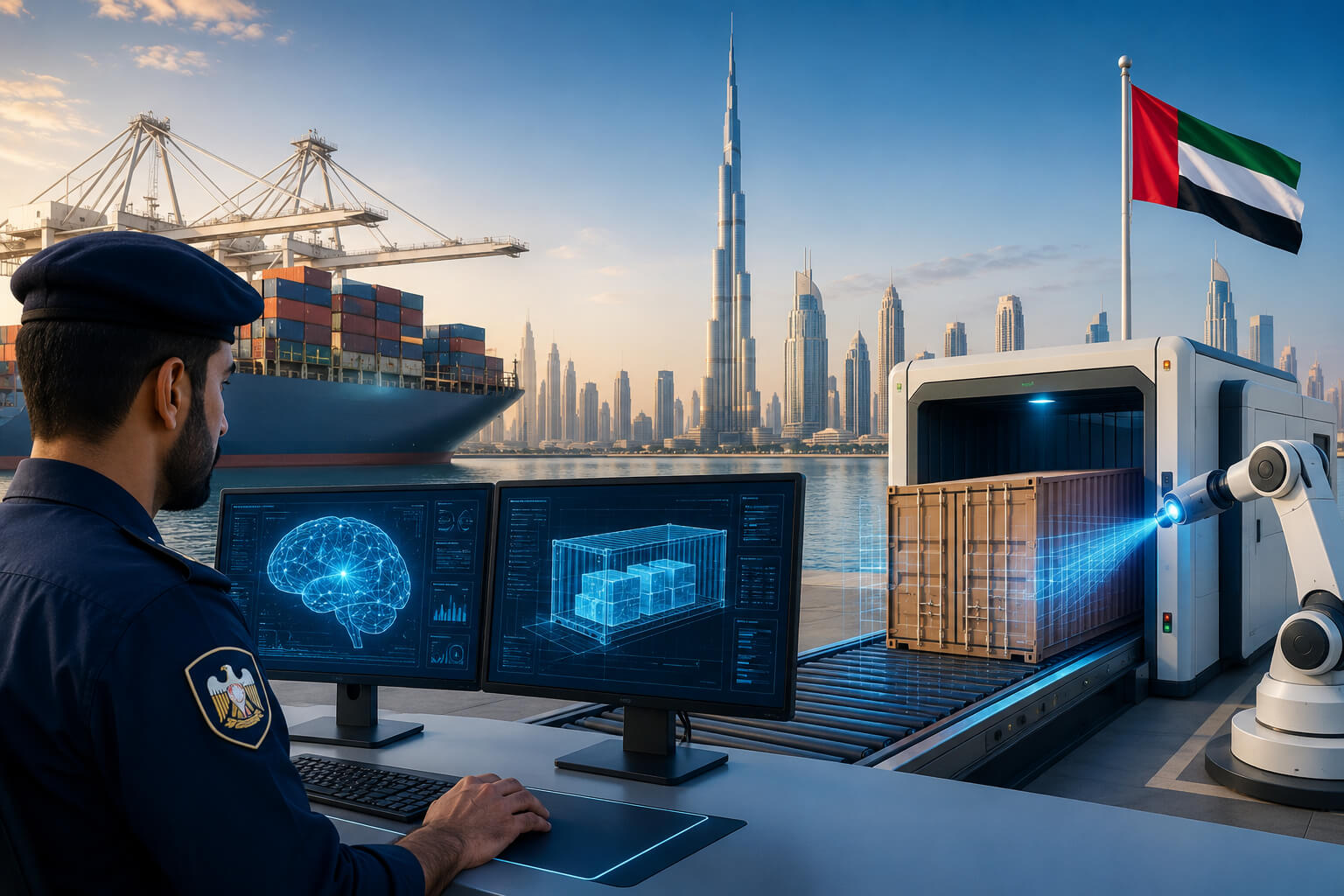
Dubai Customs is advancing with two artificial intelligence initiatives as part of their Dubai Customs AI pilot projects, pushing them beyond the presentation stage and into practical testing.
The authority is advancing pilot versions of OCTA, an enterprise intelligence platform, and the Advance Cargo Information system, better known as ACI. The two projects tackle different parts of customs work, but the goal is similar: make better decisions earlier, reduce delays for legitimate trade and give customs teams a clearer view of possible risks.
For companies operating in Dubai’s free zones, ports and logistics networks, this matters. Customs technology often stays invisible until something goes wrong. A delayed shipment, an unclear procedure or an unexpected inspection can quickly become expensive.
Dubai Customs wants more of those decisions to happen before the cargo reaches the border.
OCTA Turns Customs Information Into Practical Decisions
OCTA is being developed as an enterprise intelligence platform rather than a public-facing chatbot or another standalone digital service.
The system uses artificial intelligence and natural-language understanding to examine large volumes of institutional information. It can help employees find internal knowledge, identify patterns and generate recommendations related to policies, procedures, services and organizational performance.
That sounds administrative, but the impact could move well beyond internal reporting.
Customs authorities collect enormous amounts of information across declarations, inspections, customer interactions, regulations and cargo movements. The challenge is not simply storing that material. Someone still needs to find the relevant information, understand it and decide what to do next.
OCTA is meant to shorten that process. Instead of relying on scattered records or lengthy manual reviews, employees could receive faster access to the information needed for a decision. Dubai Customs is testing the platform before wider deployment so it can refine the system and assess how much value it delivers to employees, traders and other customers.
ACI Looks at Cargo Before It Arrives
The Advance Cargo Information system deals with a more immediate customs problem: identifying risk before a shipment physically reaches Dubai.
ACI analyzes shipment information received in advance, including cargo manifests from airports and seaports alongside existing customs data. That gives officials more time to examine a consignment, flag potential concerns and prepare the appropriate response.
The useful part is the timing.
Traditional cargo controls can become reactive when officials receive important details only after goods arrive. ACI moves part of that work earlier. Higher-risk shipments can receive closer attention, while compliant businesses and lower-risk cargo may avoid unnecessary delays or physical inspections.
Dubai Customs first presented the AI-powered system at GITEX Global 2025. The platform combined several earlier risk-classification and analytical systems into a single environment. Blockchain technology was also incorporated to protect the integrity of information received from original sources, while machine learning allows the system’s analytical capabilities to improve as it processes more data.
Faster Clearance Does Not Mean Weaker Controls
Customs authorities constantly deal with an awkward balance.
Businesses want predictable procedures, quicker clearance and fewer interruptions. Border agencies still need to detect smuggling, false declarations and suspicious cargo. Pushing every shipment through the same inspection process would create congestion. Reducing checks without better intelligence would create a different problem.
AI gives Dubai Customs another option.
By reviewing pre-arrival information and identifying unusual patterns earlier, the authority can focus its inspection resources where they are more likely to be needed. Legitimate shipments should move with less friction, at least in theory, while customs teams gain more time to evaluate cargo that appears risky.
This approach also supports the Green Corridor initiative, which uses digital integration, pre-arrival cargo information and advanced inspection systems to accelerate customs clearance without removing security controls.
Free Zone Companies Could Feel the Difference
The benefits of these projects will not depend on flashy AI features. Traders will judge them by ordinary outcomes.
Did the cargo clear faster? Were instructions easier to understand? Did customs request the right documents the first time? Were compliant shipments spared from avoidable inspections?
For free zone companies involved in imports, re-exports, manufacturing and regional distribution, even modest improvements can matter. Faster customs decisions can reduce storage charges, shorten delivery schedules and improve inventory planning. Earlier risk assessment may also make supply chains more predictable, particularly for businesses moving time-sensitive goods through Dubai.
The pilots remain under development, so companies should not assume that every customs process will change immediately. Still, OCTA and ACI show where Dubai’s customs model is heading: more pre-arrival processing, heavier use of institutional data and fewer decisions left until the cargo is already waiting.
Dubai Customs Is Building AI Into Its Wider Strategy
The two pilots are part of a broader transformation rather than isolated experiments.
Dubai Customs launched its 2030 artificial intelligence strategy in October 2025. The plan aims to integrate AI across customs operations and create a more proactive digital ecosystem. Officials have described the shift as a re-engineering of customs systems around AI, not simply adding occasional AI tools to existing processes.
Other digital platforms are already filling parts of that ecosystem.
The Shahin system tracks cargo trucks using satellite technology and electronic smart seals. Al Munasiq uses generative AI to help users identify Harmonized System codes for goods. Dubai Customs has also adopted smart risk engines, advanced container scanners and digital platforms supporting cross-border e-commerce and cargo monitoring.
OCTA and ACI connect two important layers of that work. One focuses on knowledge and institutional decision-making. The other looks directly at cargo risk before arrival.
That combination is more useful than launching another customer service assistant and calling it transformation.
Dubai Links Customs Technology With Economic Competitiveness
Dr. Abdulla Busenad, Director-General of Dubai Customs, said investment in AI should be viewed as an investment in the future of trade and Dubai’s economy rather than technology spending alone.
The authority expects the projects to support commerce, strengthen investor confidence and prepare its customs ecosystem for future trade requirements. Officials also see OCTA and ACI as part of Dubai’s wider effort to improve government efficiency under the Dubai Economic Agenda D33.
That connection is important.
Free zones can offer attractive licensing structures, infrastructure and access to international markets. Yet businesses still depend on what happens at ports, airports and border checkpoints. A competitive business environment loses some of its appeal when cargo gets trapped in slow or unpredictable procedures.
Dubai Customs is betting that AI can make those procedures more informed without making them more intrusive.
The pilots now need to prove it.
Sources
- Economy Middle East – Dubai Customs advances two AI pilots to strengthen trade and cargo security
- Dubai Customs – Dubai Customs launches 2030 artificial intelligence strategy
- Dubai Customs – Al Munasiq AI platform
- Dubai Customs – Smart Trade and Border Services
