
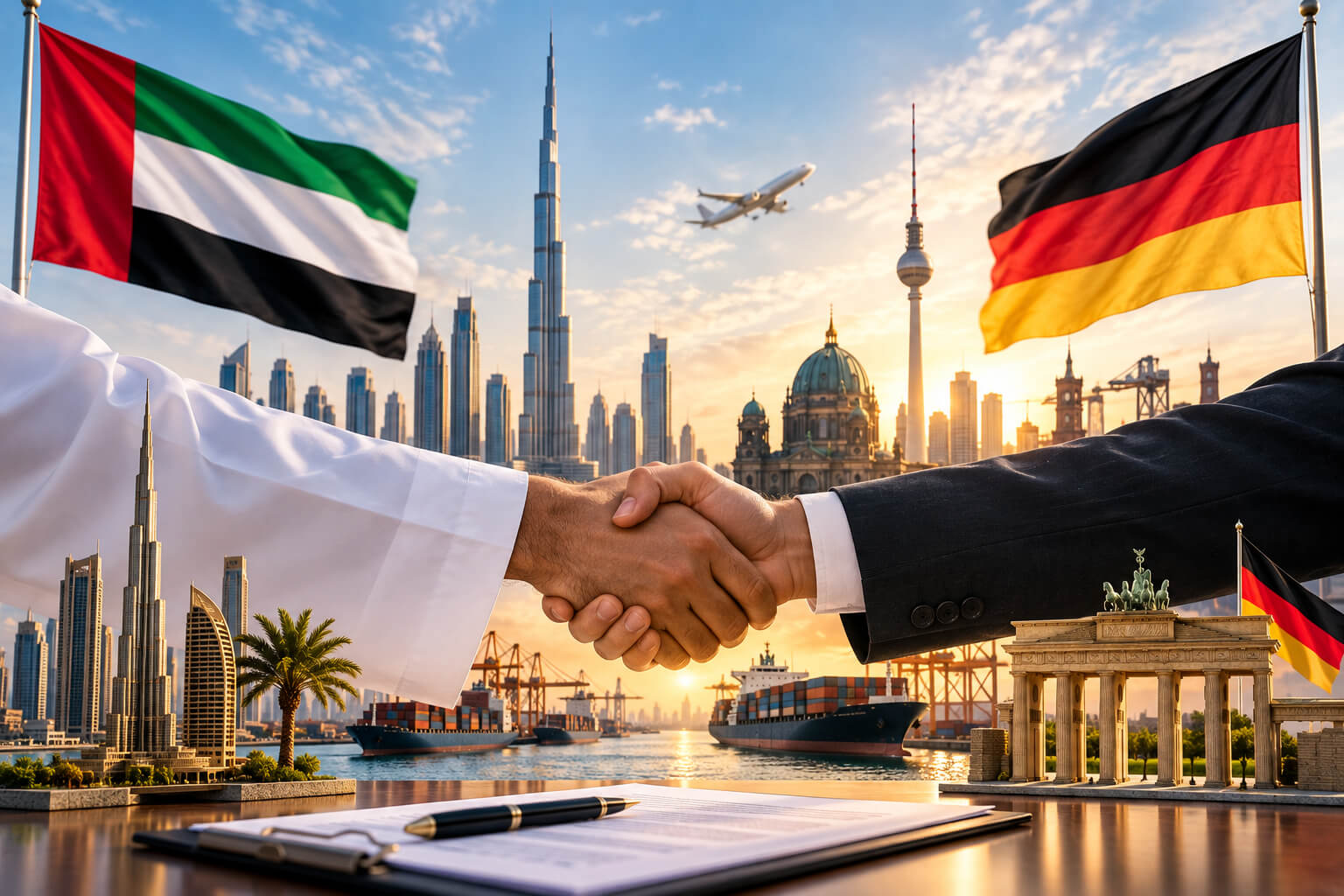
The UAE-Germany trade and investment relationship is moving into a much bigger phase, with both countries looking beyond conventional bilateral commerce toward energy, advanced industry, technology and long-term investment.
The timing matters. UAE President Sheikh Mohamed bin Zayed Al Nahyan is due to begin a state visit to Germany on September 9, where he will meet German President Frank-Walter Steinmeier and Chancellor Friedrich Merz. Economic and development cooperation will sit high on the agenda, alongside regional and international issues.
There is already plenty to build on. Bilateral trade exceeded €13.56 billion in 2025, while German imports from the UAE increased by more than 50 percent during the year. Around 2,000 German companies now operate in the Emirates, with many treating the country not simply as a local market but as their gateway into the Middle East, Africa and Asia.
UAE-Germany Trade Has Become a Bigger Economic Story
Germany is one of the UAE’s most significant European commercial partners, while the Emirates has become Germany’s most important economic partner in the Gulf. The relationship has been building for decades, with diplomatic ties dating back to 1972 and the strategic partnership established in 2004. What has changed recently is the scale and variety of the commercial activity underneath it. Non-oil bilateral trade reached approximately $15.51 billion in 2025, representing growth of more than 14 percent compared with the previous year. UAE exports to Germany also rose sharply, while re-exports continued to expand. The story is no longer limited to goods moving between two markets. Industrial investment, logistics, energy infrastructure, advanced manufacturing and technology are now becoming much larger parts of the relationship.
German Companies Are Using the UAE as a Regional Base
The presence of roughly 2,000 German companies in the UAE says a lot about where the relationship is heading. Many businesses use their UAE operations to reach customers and partners well beyond the Emirates, particularly across the Middle East, Africa and Asia. That gives the UAE an advantage that goes beyond the size of its domestic market. Its logistics networks, aviation links, business-friendly environment and international connectivity allow foreign companies to manage regional operations from one location. For UAE free zones, this is especially relevant. German businesses looking at distribution, manufacturing, technology, professional services, logistics or research operations can choose from specialised ecosystems across Dubai, Abu Dhabi, Sharjah and the Northern Emirates. Stronger German-UAE ties therefore have the potential to translate directly into more company formation, regional headquarters activity and cross-border expansion.
Private-Sector Cooperation Is Picking Up
Private-sector engagement is becoming a bigger part of the UAE-Germany economic relationship. The UAE-German Business Council was launched in Berlin in July 2025, bringing together more than 150 business leaders and corporate representatives, while the German Emirati Joint Council for Industry and Commerce already includes hundreds of German and Emirati companies. Recent discussions have stretched across advanced manufacturing, mobility, water technology, energy, digital infrastructure, space, sustainable materials and innovation. UAE representatives have also held meetings with major German companies including BMW Group, Airbus Defence and Space, RWE, Covestro, Henkel and Nemetschek Group. The focus has been fairly practical: identifying where companies can invest, manufacture, carry out research and development and use the UAE as a platform for regional expansion.
UAE Investment in Germany Is Growing Too
Capital is not flowing in only one direction. UAE companies have been building a deeper presence inside Germany itself, particularly across industry, logistics and advanced materials. Emirates Global Aluminium announced a $170 million expansion of its EGA Leichtmetall operation in Germany, while XRG, ADNOC’s international investment company, strengthened its position through its strategic partnership with German materials manufacturer Covestro. AD Ports Group has also expanded its European footprint through the acquisition of Germany-based MBS Logistics. These investments show how the relationship is changing. The UAE is not only attracting German businesses to the Gulf. Emirati companies are increasingly becoming active investors in German industrial, logistics and infrastructure assets.
Energy Remains at the Centre of UAE-Germany Cooperation
Energy has been one of the strongest links between the two countries for years, but the scope of cooperation has widened considerably. The Emirati-German Energy Partnership, established in 2017, has expanded into areas such as hydrogen, renewable energy, industrial decarbonisation, energy storage and grid connectivity. During Chancellor Friedrich Merz’s visit to the UAE in February 2026, ADNOC and Germany’s RWE agreed to explore LNG supply opportunities of up to one million tonnes per year, potentially over a period of up to 10 years. Masdar and RWE also agreed to explore battery energy storage investment in Germany. Masdar already holds a 49 percent stake in the 476MW Baltic Eagle offshore wind farm, which became fully operational in 2025. Energy security remains important, but clean technology and renewable infrastructure are now becoming just as central to the relationship.
Technology and Advanced Manufacturing Open the Next Door
Technology could become one of the more important parts of the UAE-Germany partnership over the next few years. Recent bilateral discussions have covered biotechnology, artificial intelligence, cybersecurity, advanced manufacturing and emerging technologies. The UAE Cyber Security Council and Siemens also signed an agreement in 2026 to deepen cybersecurity cooperation across critical infrastructure and industrial sectors, including plans for a joint innovation centre focused on operational technology security. The pairing makes sense. Germany brings a huge industrial base, engineering expertise and globally established manufacturers, while the UAE has been building digital infrastructure, AI capacity and investment platforms at speed. The most interesting opportunities may appear where those strengths overlap, particularly in AI-enabled manufacturing, industrial automation, smart logistics and digital infrastructure.
What Stronger UAE-Germany Ties Mean for UAE Free Zones
For the UAE free zone sector, closer economic relations with Germany could create a stronger pipeline of foreign companies and investment. German businesses entering the Gulf often need regional structures for distribution, sales, logistics, consulting, manufacturing and technology operations. UAE free zones already compete heavily for exactly these activities. Some companies may only need a straightforward commercial base, while others require warehousing, industrial land, research facilities or direct access to ports and airports. The variety of UAE free zones gives investors room to choose a jurisdiction based on the actual operating needs of the company rather than relying on a one-size-fits-all setup. As bilateral cooperation moves into specialised industries, that flexibility becomes even more important. Advanced manufacturing needs a different ecosystem from software, while logistics businesses care more about transport corridors and industrial access. This gives specialised free zones an opportunity to attract German companies with sector-specific infrastructure and incentives.
UAE-EU Trade Talks Add Another Layer
The wider European relationship could give UAE-Germany ties another boost. The UAE and European Union have been advancing discussions toward a Comprehensive Economic Partnership Agreement aimed at deepening trade and investment across strategic sectors. Germany’s size and influence within the European economy mean its relationship with the UAE could become particularly important inside that wider framework. For businesses, a deeper UAE-EU economic relationship could eventually create more opportunities around investment, market access and cross-border supply chains. It would also reinforce something already visible on the ground: international companies increasingly see the UAE as a connecting point between Europe and fast-growing markets across the Middle East, Africa and Asia.
A Partnership Moving Beyond Traditional Trade
The UAE-Germany relationship has been developing for more than five decades, but the latest phase looks noticeably different. Trade is still the foundation, yet investment, industrial projects, logistics, clean energy, AI, cybersecurity and advanced technology are now being built around it. President Sheikh Mohamed’s state visit gives both countries another opportunity to push that agenda forward. For UAE businesses and free zones, the more important question will be what happens afterwards. If stronger political ties continue to translate into German companies establishing operations in the Emirates, Emirati capital moving into Germany and more joint projects being developed, the relationship could become one of the UAE’s most commercially important partnerships in Europe.
Sources
Economy Middle East — UAE and Germany push to deepen strategic partnership amid growing trade, investment
https://economymiddleeast.com/news/uae-and-germany-push-to-deepen-strategic-partnership-amid-growing-trade-investment/
Emirates News Agency (WAM) — UAE-Germany strategic partnership expands cooperation prospects
https://www.wam.ae/en/article/17euwlj-uae-germany-strategic-partnership-expands
UAE Ministry of Foreign Affairs — UAE and Germany Explore Avenues to Expand Private Sector Cooperation Across Key Growth Sectors
https://www.mofa.gov.ae/en/MediaHub/News/2026/7/9/UAE-Germany
The National — Beyond 50 years: AI and energy investment at heart of UAE-Germany economic ties
https://www.thenationalnews.com/business/economy/2026/09/07/beyond-50-years-ai-and-energy-investment-at-heart-of-uae-germany-economic-ties/
ADNOC — UAE and Germany Deepen Energy Ties as German Chancellor Visits ADNOC HQ
https://www.adnoc.ae/en/news-and-media/press-releases/2026/uae-and-germany-deepen-energy-ties-as-german-chancellor-visits-adnoc-hq
