

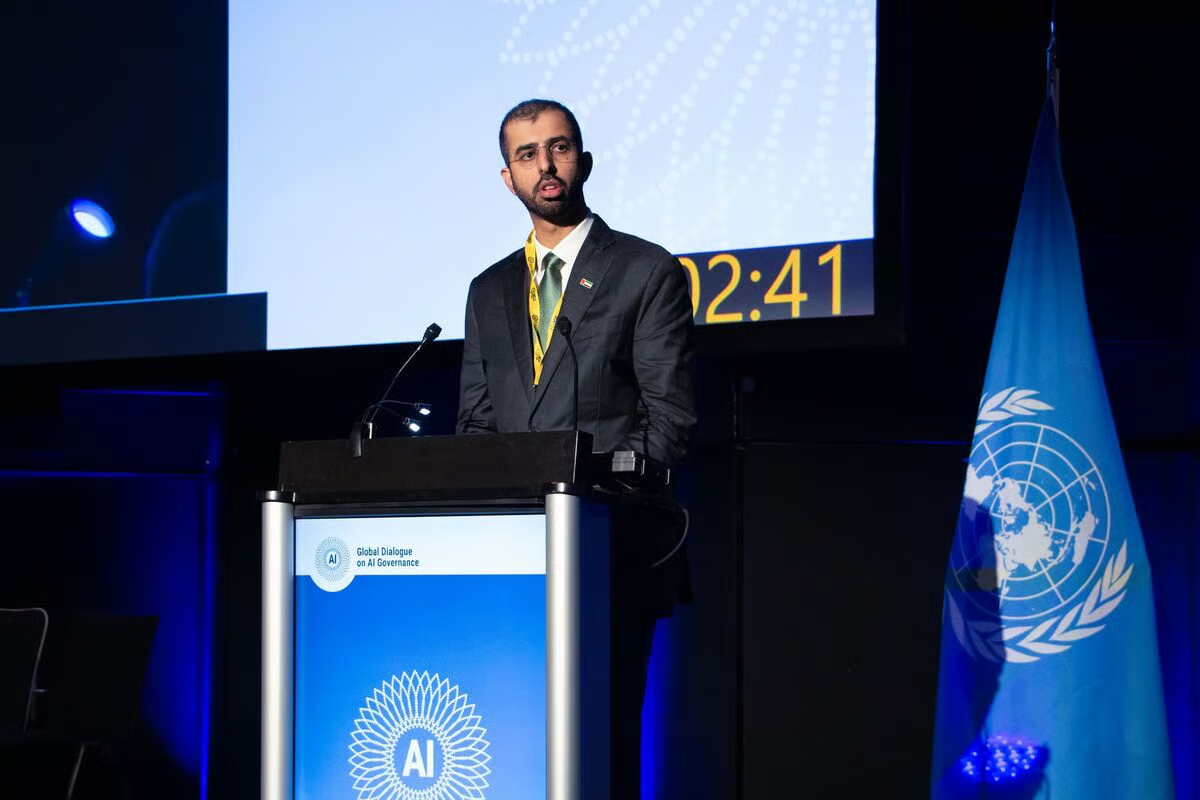
The UAE is taking its digital government story to the global stage again, this time through the United Nations Global Dialogue on AI Governance in Geneva.
The discussion is not just about artificial intelligence in theory. Not really. For the UAE, the bigger message is about how governments can actually use AI, data, and digital services in a way people can feel in daily life. Faster services. Less paperwork. Cleaner systems. More trust. That is where the country wants the conversation to go.
The UN Global Dialogue on AI Governance was created as a platform for countries and stakeholders to discuss international cooperation, share lessons, and build more open and inclusive conversations around artificial intelligence governance. The first meeting brought together governments, industry, academia, civil society, and international organizations in Geneva from July 6 to 7, 2026.
UAE Brings Its GovTech Model Into the AI Governance Debate
The UAE’s participation comes at a time when AI governance is moving from policy papers into something more urgent. Countries are no longer only asking what AI can do. They are asking who controls it, who benefits from it, how risks are managed, and how public services can use the technology without losing public confidence.
That is where the UAE wants to show its own model.
The country has been pushing digital government transformation for years, but AI has changed the pace. Government services are becoming more connected, more automated, and more focused on removing unnecessary procedures instead of simply putting old bureaucracy online.
A recent WAM report on the UAE’s GovTech vision noted that Mohamed bin Taliah emphasized the future of public services should not be about digitizing bureaucracy, but eliminating it altogether. That line matters because it explains the UAE’s direction quite clearly. The goal is not just another app. It is less friction between people, businesses, and the government.
Why This Matters for Businesses and Free Zone Investors
For companies operating in UAE free zones, digital government transformation is not a distant policy topic. It affects licensing, visas, compliance, customs, payments, banking support, and access to government platforms.
A business owner does not care much if a system sounds advanced on paper. They care if it saves time. They care if a company can be registered faster. They care if renewals are easier, approvals are clearer, and government services do not slow down expansion.
That is why the UAE’s AI governance message has a business angle too. A smarter digital government can make the country more attractive for entrepreneurs, foreign investors, startups, and multinational firms looking for a base in the region.
The UAE has also approved the establishment of an Artificial Intelligence and Data Authority, designed to bring public data, AI, and digital government capabilities into one national framework. The move is part of the country’s wider effort to prepare for a new phase of AI-powered digital transformation.
AI Governance Is Becoming a Global Competition
The UN dialogue also shows something bigger. AI governance is becoming part of global influence.
The countries that can shape responsible AI rules, build strong digital infrastructure, and deliver working public services may gain an edge. Not only in technology, but in investment, talent attraction, government efficiency, and international partnerships.
The ITU described the inaugural Global Dialogue on AI Governance as a way to ensure AI governance reflects the priorities of all nations, not only the most technologically advanced ones. That point fits well with the UAE’s broader positioning as a bridge between advanced technology markets and emerging economies.
For the UAE, the message is fairly direct: AI should not be locked inside labs, boardrooms, or big tech platforms. It should become part of government modernization, public service delivery, and economic competitiveness.
The UAE Wants AI to Be Practical, Not Just Impressive
There is a lot of noise around AI right now. Big models. Bigger data centers. Flashy product demos. But governments face a harder question: how does AI actually improve public life?
The UAE is trying to answer that through services, national data systems, government restructuring, and digital policy. It has already placed AI and digital economy development inside its national agenda, including through the Ministry of State for Artificial Intelligence, Digital Economy and Remote Work Applications.
The country also became the first in the world to appoint a Minister of State for Artificial Intelligence in 2017, a move that helped place AI inside government planning before the current global AI race became so intense.
A More Connected Government, With AI at the Center
The UAE’s digital government transformation is now moving into a more connected phase. Data, AI tools, government platforms, and service design are being treated as parts of one system rather than separate technology projects.
That sounds simple. It is not.
For AI to work properly inside government, agencies need clean data, shared standards, cybersecurity, legal clarity, and trained teams. They also need public trust. If people do not understand how automated systems are being used, even the best technology can create hesitation.
This is why AI governance matters. It is not only about limiting risks. It is about making sure governments can use AI confidently, safely, and in ways that people actually accept.
What Comes Next for UAE Digital Government Transformation
The UAE’s appearance at the UN Global Dialogue on AI Governance adds another layer to its international technology profile. The country is not only building AI infrastructure and attracting investment. It is also trying to shape the rules and public-sector models around AI use.
For free zones, investors, and digital businesses, this direction is worth watching closely. A more advanced AI-powered government could make operating in the UAE smoother, especially for companies that depend on fast approvals, digital compliance, cross-border services, and investor-friendly regulation.
The UAE has spent years branding itself as a future-ready economy. Now the test is more practical. Can AI make government services faster, simpler, and more useful without creating new risks?
That is the real story behind the Geneva dialogue. Not just AI governance as a diplomatic phrase. AI governance as something that may soon decide how businesses register, how residents access services, and how governments compete in the digital economy.
Source: https://economymiddleeast.com/
