

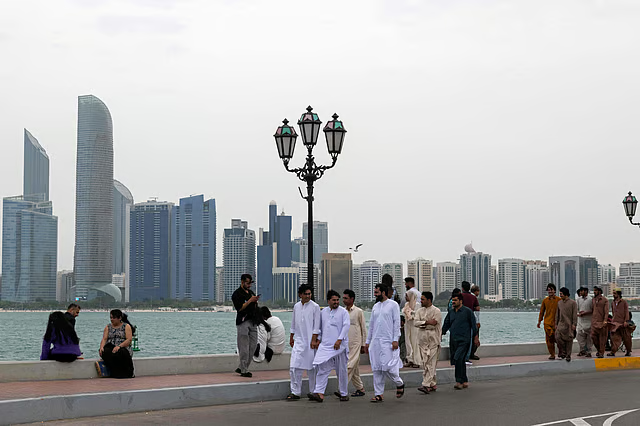
The UAE’s non-oil economy is still growing. Just not with the same easy momentum businesses were enjoying before. Recent changes in UAE business confidence reflect this shift in economic conditions.
In June, domestic spending and government investment helped keep confidence alive across the private sector, even as the country’s latest Purchasing Managers’ Index showed the weakest expansion in more than five years. The S&P Global UAE PMI fell to 50.8 in June, down from 52.6 in May, according to Gulf News. A reading above 50 still signals expansion, but this was a much thinner kind of growth.
For free zone companies, investors, exporters, service providers, and startups operating in the UAE, the message is fairly clear. The market is not collapsing. It is adjusting.
Domestic Spending Is Still Doing Some Heavy Lifting
One reason confidence has not disappeared is local demand.
Businesses continued to benefit from domestic spending and public sector-backed activity, especially those linked to confirmed contracts, construction work, digital services, and government-related projects. That matters because not every company in the UAE depends only on global demand or tourism flows.
Free zone firms serving local clients, public sector projects, logistics needs, technology services, and B2B operations may still find room to grow, even if wider market conditions feel slower.
The UAE has built much of its economic strategy around diversification, and June’s PMI reading shows why that matters. When external demand weakens or regional uncertainty affects spending, domestic activity can still provide a cushion.
The Growth Is There, But It Looks More Careful Now
The PMI report showed that new business improved to a three-month high, but it remained below the long-term average. That is not a small detail.
It suggests that companies are still winning work, but clients are taking longer to commit. Spending decisions are being delayed. Some firms are waiting for more clarity before signing contracts or expanding budgets.
This is where business owners need to read the market carefully. The UAE is still attractive, but buyers are more selective. Pricing, trust, service quality, and delivery timelines matter more when demand is softer.
For free zone companies, this could mean longer sales cycles. It could also mean stronger opportunities for firms that can offer cost efficiency, speed, compliance support, or niche expertise.
Hiring Took the Biggest Hit
The clearest pressure point in the report was employment.
UAE private sector employment fell for the first time in more than four years, with the fastest decline since August 2020. Companies linked the drop to softer demand, rising costs, and internal productivity measures.
That does not mean businesses have stopped operating. It means many are becoming more cautious about headcount.
Instead of hiring quickly, companies appear to be controlling costs, improving productivity, and protecting margins. For startups and SMEs, this is a familiar pattern. When demand becomes harder to predict, hiring slows first.
Free zone businesses may respond by relying more on outsourcing, automation, lean teams, and flexible service providers. That could create demand for HR, payroll, accounting, legal, and business support firms operating inside UAE free zones.
Supply Chains Showed Some Relief
Not all parts of the report were negative.
Supplier delivery times improved at the fastest pace in four months. Gulf News reported that firms linked the improvement to easing shipping bottlenecks in the Strait of Hormuz, helping supply chains recover after earlier disruptions.
Purchasing activity also rebounded in June after contracting in May. Some companies restocked to meet sales needs, while others built buffer inventories in case material shortages returned.
For UAE free zone companies involved in trading, import-export, warehousing, logistics, and manufacturing, this is important. Better supply movement can ease pressure on delivery commitments and operating costs. Still, businesses are not fully relaxed. Many continue to watch shipping conditions, raw material prices, and regional risks closely.
Costs Are Still Squeezing Margins
The cost issue has not gone away.
Businesses continued to report higher purchasing expenses, transport fees, and commodity costs. Selling prices increased only modestly, because many companies were not willing to pass the full cost increase on to customers.
That is the uncomfortable part. Demand is cautious, competition is strong, and costs are still elevated.
So margins get squeezed.
For free zone firms, especially smaller companies, this can affect pricing strategy. Raising prices too quickly may push clients away. Holding prices too low may hurt profitability. There is no perfect answer here. Many businesses will likely focus on tighter operations, better supplier terms, and higher-value services rather than simple price increases.
Dubai’s Non-Oil Sector Also Slowed
Dubai followed a similar pattern.
The Dubai PMI dropped to 50.7 in June from 52.0 in May, marking the weakest improvement in operating conditions since January 2021. New business rose only slightly, while some companies pointed to delayed spending and weaker travel-related activity linked to regional tensions.
Still, output growth improved, and business expectations remained positive. Firms with confirmed contract work and exposure to public sector spending were more confident, while those relying more heavily on external demand stayed cautious.
That split is important for Dubai-based free zone firms. The companies tied to steady contracts, public investment, infrastructure, technology, and domestic business demand may feel more stable. Others, especially those exposed to tourism, international trade uncertainty, or discretionary spending, may need to plan more carefully.
What This Means for UAE Free Zone Businesses
For companies operating in UAE free zones, June’s PMI data does not point to panic. It points to a slower, more disciplined business environment.
The easy growth phase may be softer for now. Clients are more cautious. Hiring is more controlled. Costs are still a problem. But domestic spending, government investment, supply chain recovery, and contract-backed activity are keeping business confidence from falling sharply.
That creates a different kind of opportunity.
Free zone businesses that can stay lean, manage costs, serve local demand, and offer clear value may still perform well. The UAE market is not standing still. It is becoming more selective.
And sometimes that is where stronger companies start to separate themselves from the rest.
