

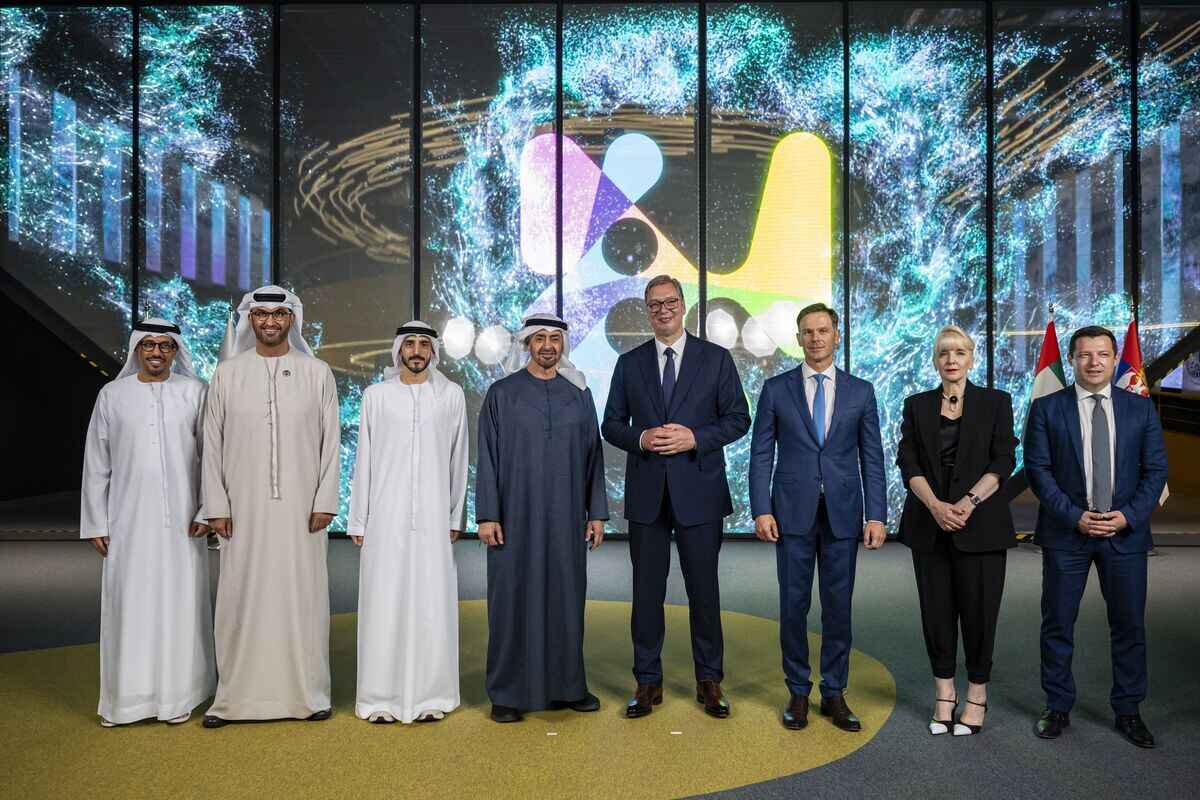
The United Arab Emirates and Serbia are looking for more than another round of diplomatic promises.
During talks in Belgrade, UAE President His Highness Sheikh Mohamed bin Zayed Al Nahyan and Serbian President Aleksandar Vučić focused on expanding cooperation across trade, investment, renewable energy and other sectors where both countries see room for practical growth.
The meeting took place during Sheikh Mohamed’s working visit to Serbia on 30 July 2026. Both leaders described the relationship as one that should continue moving forward under the UAE–Serbia Comprehensive Strategic Partnership and the Comprehensive Economic Partnership Agreement, or CEPA.
Economic Cooperation Takes Centre Stage
Trade and investment sat near the top of the agenda.
The UAE has already built a sizeable commercial presence in Serbia, while Serbian businesses increasingly view the Emirates as an entry point to Gulf and Middle Eastern markets. The conversation in Belgrade reflected that reality. This was not simply about maintaining friendly relations. It was about finding the next projects.
Renewable energy received particular attention, alongside broader opportunities in technology, logistics, agriculture and other priority industries. These sectors fit closely with the UAE’s push to expand its non-oil economy and Serbia’s efforts to attract international capital into areas with long-term growth potential.
The UAE–Serbia CEPA Gives Businesses a Clearer Route
The economic relationship now has a working trade framework behind it.
The UAE–Serbia CEPA was signed in October 2024 and came into force at the beginning of June 2025. It was designed to reduce trade barriers, simplify customs procedures and make it easier for companies from both markets to invest and operate across borders.
More than 96 per cent of UAE imports from Serbia benefit from immediate tariff elimination under the agreement. Over 95 per cent of Serbian imports from the UAE receive the same treatment.
That matters for companies dealing in goods. Lower duties can change pricing, supply-chain decisions and whether a business considers entering a new market at all. The agreement also includes provisions covering services, investment, intellectual property and small and medium-sized enterprises.
Serbia Offers the UAE a Gateway Into the Balkans
Serbia gives Emirati businesses something strategically useful: access to Southeast Europe and the wider Balkan region.
Its location, manufacturing base, agricultural capacity and skilled workforce make it an interesting market for companies searching for regional production or distribution opportunities. For UAE-based investors, Serbia can also serve as a bridge into nearby European markets without carrying the same cost structure found in some larger economies.
The UAE–Serbia CEPA is projected to contribute around $351 million to the UAE economy by 2032. Bilateral non-oil trade reached approximately $121.4 million in 2024, twice the level recorded in 2021.
Those numbers remain modest compared with the UAE’s largest trading relationships. The direction, though, is difficult to ignore.
Renewable Energy and Food Security Remain Practical Opportunities
Renewable energy is one of the clearest areas for deeper cooperation.
The UAE has experience financing and developing major clean-energy projects abroad, while Serbia is working to diversify an energy system that has traditionally relied heavily on coal. That creates room for investment in solar, wind, infrastructure and supporting technologies.
Agriculture carries its own strategic importance. Serbia has strong agricultural resources, while the UAE continues to strengthen overseas food supply partnerships as part of its food security plans.
Recent cooperation has covered sustainable agriculture, agri-technology, livestock development, water management and agricultural trade. Emirati-linked agricultural investments in Serbia already show that the relationship is moving beyond government meetings and into physical assets and operating businesses.
Scholarships Add a Different Layer to the Partnership
One part of the meeting moved away from tariffs and investment figures.
Sheikh Mohamed directed that scholarships be provided to Serbian students who want to study at universities in the UAE. The programme will cover several disciplines, with particular attention given to science, technology and artificial intelligence.
President Vučić welcomed the initiative and described it as another sign of the close relationship between the two countries.
The scholarships could create something trade agreements cannot manufacture quickly: long-term professional connections. Serbian students educated in the UAE may later become researchers, founders, executives or government officials who understand both markets.
What the Partnership Means for UAE Companies
For companies operating in the UAE’s free zones, the Serbia relationship presents several possible routes into a less crowded market.
Trading businesses may benefit from preferential tariff access. Logistics operators can explore new routes connecting the Gulf with Eastern and Southeast Europe. Technology companies may find partnership opportunities in digital services, artificial intelligence and industrial modernisation.
Food companies, renewable-energy developers and infrastructure investors also have clearer reasons to study the Serbian market.
The CEPA does not automatically remove every difficulty. Businesses must still comply with rules of origin, product standards, health requirements and local regulations. Preferential market access only works when companies understand the paperwork behind it.
Still, the framework gives UAE businesses a more predictable place to start.
UAE and Serbia Look for the Next Stage of Growth
The latest presidential meeting suggests that the UAE and Serbia want their partnership measured through projects rather than diplomatic language alone.
Trade rules are already in place. Investment links exist. Cooperation now stretches from energy and agriculture to education and artificial intelligence.
The next test will be execution. More private-sector deals, joint ventures and direct business activity would show whether the strategic partnership can deliver the growth both leaders expect.
For UAE companies looking beyond familiar international markets, Serbia may deserve a closer look.
Sources
- Economy Middle East
- Emirates News Agency – Presidential Meeting
- UAE President Official Website
- UAE Ministry of Economy and Tourism – UAE–Serbia CEPA
- Emirates News Agency – UAE–Serbia CEPA Enters Into Force
