
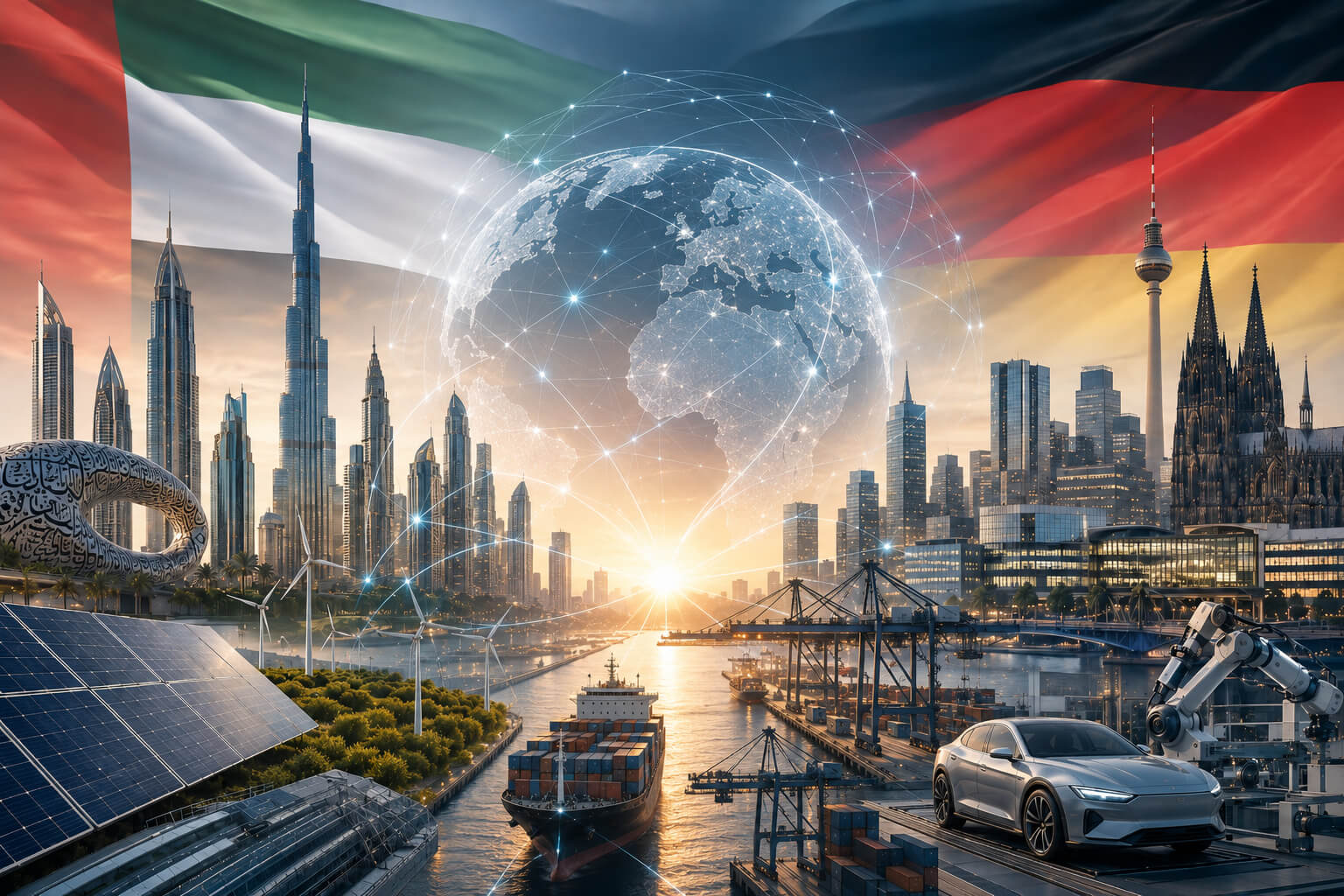
The UAE and Germany are trying to move their business relationship into a more practical phase. Less ceremony, more deals. More company-to-company work. More projects that can actually sit inside factories, ports, innovation hubs, energy systems, and regional headquarters.
H.E. Badr Jafar, Special Envoy of the Minister of Foreign Affairs for Business and Philanthropy, has concluded an official working visit to Germany, where he held meetings with senior business leaders and institutional representatives in Düsseldorf and Munich. He was accompanied by H.E. Ahmed Alattar, UAE Ambassador to Germany.
UAE-Germany Trade Momentum Is Already Building
The timing matters. Bilateral trade between the UAE and Germany surpassed €13.56 billion in 2025, while German imports from the UAE rose by more than 50 percent. That is not a small movement in the numbers. It points to a relationship that is widening beyond traditional trade lines.
Germany remains one of the UAE’s major economic partners in Europe, while the UAE continues to position itself as a commercial bridge between Europe, the Gulf, Asia, and Africa. For German companies, that makes the country more than a sales market. It can be a base.
Around 2,000 German companies now operate offices in the UAE, with many using the country as a regional platform for the Middle East, Africa, and Asia.
Private Sector Cooperation Moves to the Centre
This visit was clearly not only about government-to-government relations. The focus was private sector engagement. That is where the next layer of UAE-Germany cooperation is likely to happen.
The meetings explored opportunities across industry, energy, advanced manufacturing, water technology, mobility, digital infrastructure, space, sport, culture, and innovation. It is a broad list, yes. But it also reflects where both economies are trying to go: cleaner energy, smarter production, better infrastructure, and technology-led growth.
For UAE free zones, this kind of cooperation is worth watching closely. German firms looking at regional expansion often need flexible licensing, logistics access, tax-efficient structures, industrial space, and fast company setup. That is exactly where the UAE’s free zone ecosystem can become part of the story.
German Companies See the UAE as a Regional Base
During the visit, Badr Jafar reportedly held more than 15 meetings with executives and representatives from major German organisations, including names linked to aerospace, automotive, energy, water technology, digital construction, and industrial systems.
The discussions were not limited to exports. They also covered investment, industrial cooperation, research and development, advanced manufacturing, and wider access to regional markets. That last part is important. The UAE is not only selling itself as a destination. It is selling itself as a launchpad.
For German manufacturers and technology firms, a UAE presence can support expansion into the Gulf and beyond. For UAE-based companies, closer German cooperation can bring access to advanced engineering, clean energy systems, automation, and industrial know-how.
Energy, Water, AI and Infrastructure Are High on the Agenda
Energy was one of the major themes of the visit. Talks covered energy security, supply diversification, clean energy, battery storage, low-carbon fuels, hydrogen, and carbon management. These are not side topics anymore. They are becoming central to how countries build long-term economic partnerships.
Water technology also came into focus, along with AI-enabled innovation in the water sector, smart logistics, transport safety, sustainable infrastructure, secure communications, Earth observation, and space systems. That sounds like a lot packed into one visit, but it shows how wide the cooperation field has become.
The UAE has been investing heavily in future economy sectors, while Germany brings deep industrial and engineering strength. Put those together properly, and the partnership can move beyond trade statistics.
Why This Matters for UAE Free Zones
Free zones could benefit if more German companies decide to scale operations from the UAE. Industrial free zones, logistics hubs, technology parks, and innovation districts all stand to gain from deeper UAE-Germany private sector activity.
A German company entering the UAE may start with a representative office, then move into distribution, manufacturing, R&D, or regional management. That growth path fits neatly with the country’s free zone model.
It also supports the UAE’s wider ambition to attract high-value companies, not just shell offices or short-term trading entities. Advanced manufacturing, digital infrastructure, clean energy, and mobility are exactly the types of sectors that can create stronger business ecosystems.
UAE-Germany Cooperation Is Becoming More Commercial
The UAE and Germany already have a long-standing economic relationship. What appears to be changing now is the tone. The conversation is becoming more commercial, more sector-specific, and more focused on practical partnerships.
With trade already growing and German companies using the UAE as a regional base, the next step is likely to involve deeper investment, joint projects, and more private sector-led expansion.
For the UAE, that supports its position as a global business hub. For Germany, it offers a stronger gateway into fast-growing markets. And for free zones across the Emirates, it could mean more serious investors looking for a place to build, operate, and grow.
