
The global economy is still moving. Just not with much speed.
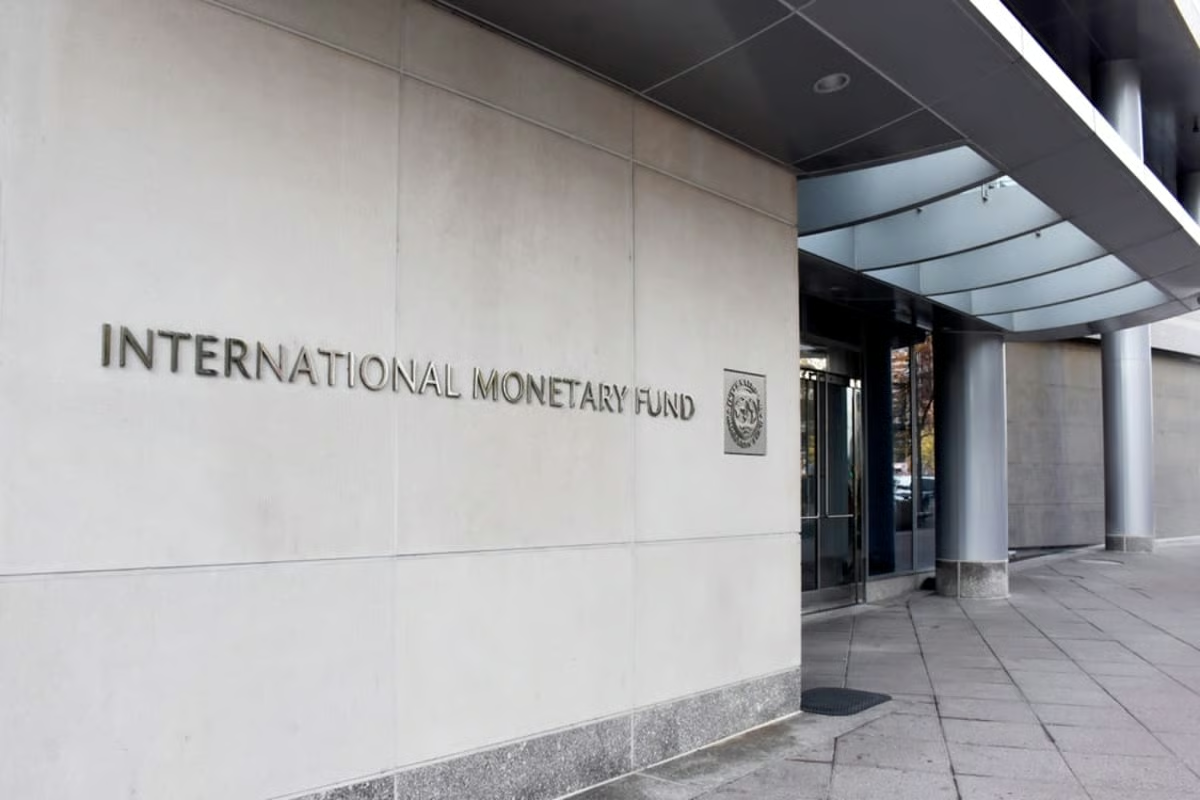
The International Monetary Fund has lowered its global growth forecast to 3.0 percent, pointing to rising geopolitical risks, weaker confidence, and pressure from energy and inflation shocks. The downgrade comes at a time when businesses are already watching trade routes, borrowing costs, shipping delays, and regional tensions more closely than usual.
For free zone companies in the UAE, this is not just another economic headline from Washington. Slower global growth can show up in practical ways: cautious investors, delayed expansion plans, tighter funding, and more careful decisions around imports, exports, hiring, and warehousing.
Global Growth Is Holding, But Barely
The IMF’s latest outlook suggests the world economy is showing resilience, but not enough to erase the pressure building underneath. Earlier projections had placed global growth slightly higher, but the new update reflects a more fragile environment shaped by conflict risks, financial market volatility, and stalled disinflation.
That word, “resilience,” gets used a lot. It can sound comforting. But in this case, it does not mean the global economy is strong. It means it has not cracked yet.
Businesses are still trading. Consumers are still spending in many markets. Technology investment, especially around AI, continues to support some economies. But the margin for error is thinner now. One major disruption in energy, shipping, finance, or trade policy could quickly change the mood.
Why Geopolitical Risks Matter for Trade Hubs
The Middle East sits close to several pressure points in the global economy. Energy flows, aviation routes, maritime logistics, capital movement, and regional investment sentiment all connect through the region in one way or another.
That is why geopolitical uncertainty matters so much for UAE free zones. Companies based in Dubai, Abu Dhabi, Sharjah, Ras Al Khaimah, and other emirates often use the UAE as a regional base for wider operations across the Gulf, Africa, South Asia, and Europe.
When global growth slows, businesses do not always stop. They become more selective.
A company may still open a branch, but with a smaller team. It may still lease warehouse space, but negotiate harder. It may still import goods, but hold less stock. These are small decisions, but together they shape the real business climate.
Inflation Has Not Fully Gone Away
The IMF also warned that global disinflation has stalled. That matters because inflation affects almost every part of business planning, from rent and salaries to logistics and supplier contracts.
For free zone firms, the concern is not only local prices. Many companies operate across borders. A business registered in a UAE free zone may source from Asia, sell into Africa, invoice clients in Europe, and hold accounts in multiple currencies.
If inflation remains sticky in major markets, central banks may keep interest rates higher for longer. That can make financing more expensive and reduce demand from customers who are already under pressure.
Not dramatic. Just uncomfortable.
AI Investment Is Helping, But Not Everyone Benefits Equally
One interesting part of the IMF outlook is the role of technology. AI-related demand is helping some countries and sectors, especially those linked to the global technology supply chain.
That could be relevant for the UAE, where free zones continue to attract companies in AI, fintech, digital services, logistics technology, and advanced trade platforms. The country has been positioning itself as a business base for high-growth sectors, not only traditional trading companies.
Still, AI is not a magic shield. A tech company may benefit from new demand, while a trading firm may struggle with shipping costs. A logistics startup may grow, while a small importer may face tighter margins. The impact is uneven, and that is the point.
What This Means for UAE Free Zone Companies
For UAE free zone businesses, the IMF forecast is a reminder to plan with more caution. Companies may need to look harder at cash flow, supplier risk, currency exposure, and market concentration.
A firm depending heavily on one export market may now consider adding another. A startup planning regional expansion may need to stretch its runway. A trading company may review contracts more carefully, especially if shipping or commodity costs move again.
This does not mean the UAE free zone sector is in trouble. Far from it. The UAE still benefits from strong infrastructure, business-friendly zones, regional connectivity, and its role as a neutral commercial hub. In uncertain periods, that can actually become more attractive.
But businesses hate unclear conditions. They can handle higher costs. They can handle slower demand. What they struggle with is not knowing which risk comes next.
A Slower World Can Still Create UAE Opportunities
There is another side to this. When global companies rethink supply chains, regional headquarters, tax structures, and market access, the UAE often enters the conversation.
Free zones can benefit from that shift if businesses want flexible licensing, full foreign ownership, customs advantages, and a base close to emerging markets. Slower global growth may reduce risk appetite, but it can also push companies to search for more stable operating locations.
That is where the UAE’s free zone model still has an edge.
The IMF’s 3 percent forecast is not a collapse story. It is a caution story. The world economy is still growing, but the easy assumptions are gone. For investors and companies in the UAE, the message is simple enough: expand, but do it with sharper numbers, stronger buffers, and less faith in smooth conditions.
