

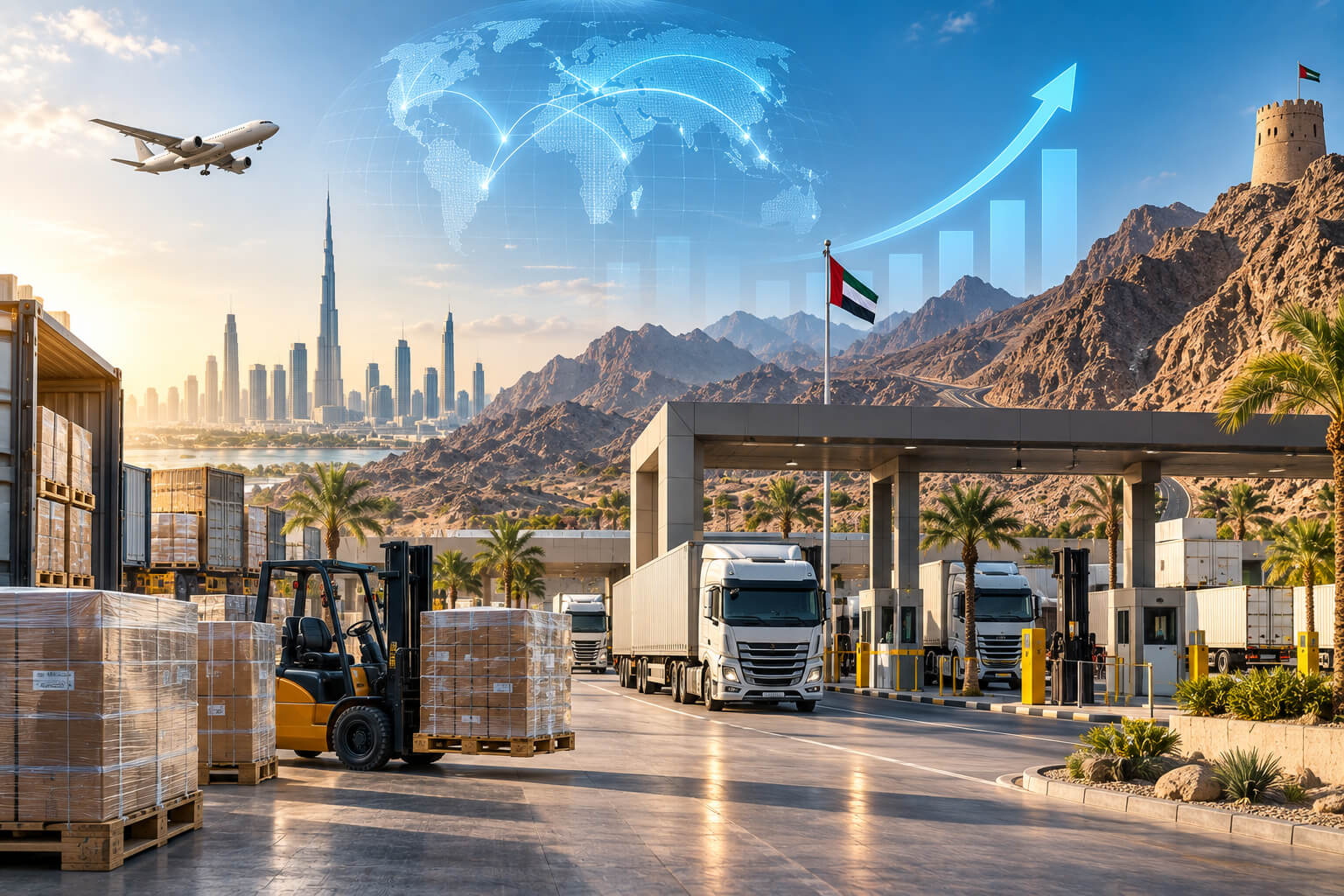
Trade through Dubai’s Hatta Customs Crossing surged during the first half of 2026, with the value of goods moving through the land border reaching more than AED37.08 billion. That compares with AED13.48 billion during the same period in 2025, representing year-on-year growth of 175%, according to Dubai Customs.
The jump was not limited to trade value. Commercial truck traffic also climbed sharply, highlighting Hatta’s growing importance as an overland logistics route connecting Dubai with Oman and other regional markets. For companies involved in logistics, re-export, distribution and cross-border trade, the figures show how quickly Dubai’s land-based trade infrastructure is becoming more important.
Hatta Trade Value Reaches AED37.08 Billion
Total trade through the Hatta Customs Crossing exceeded AED37.08 billion during the first six months of 2026, up from AED13.48 billion a year earlier. The 175% increase reflects a substantial shift in trade activity through the border and underlines the growing role of Hatta in Dubai’s wider logistics network. Its location on a major route between Dubai and Oman gives the crossing strategic importance for goods moving across the UAE and into neighboring Gulf markets. The performance also supports Dubai’s broader ambitions under the Dubai Economic Agenda D33, which aims to strengthen the emirate’s position as one of the world’s leading business and trade hubs.
Loaded Truck Traffic Jumps More Than 160%
Commercial vehicle movement rose just as sharply as trade value. Dubai Customs recorded 108,811 loaded trucks passing through the Hatta crossing during the first half of 2026, compared with 41,831 during the same period in 2025. That represents an increase of 160.1% and gives a clearer picture of the physical scale of the trade growth. The rise suggests that companies are increasingly using Hatta as an alternative or complementary route for regional cargo, especially as businesses adjust supply chains in response to shipping delays, higher transport costs and changing trade conditions.
Passenger Movement Continues to Grow
Hatta remains an important passenger gateway as well as a commercial trade crossing. More than 919,000 travellers passed through the border during the first six months of 2026, accompanied by approximately 322,000 light vehicles. Bus traffic also increased by 77.5% compared with the same period a year earlier. The combination of rising passenger numbers and heavier commercial traffic puts greater pressure on border management and customs processing, yet the crossing continues to handle both efficiently while supporting growing movement between the UAE, Oman and other GCC markets.
Dubai Turns Trade Disruption Into New Cargo Flows
The increase in activity at Hatta also reflects Dubai’s wider response to disruption in regional and international trade routes. Businesses have faced higher shipping costs, congestion and changing supply-chain patterns, prompting logistics operators to look for more flexible alternatives. Dubai Customs has responded by expanding trade facilitation measures and creating additional routes for cargo movement, including its Green Corridor initiative. Between March and June 2026, the program facilitated more than 203,000 containers, carrying over 3.16 million tonnes of goods valued at more than AED33.9 billion, reinforcing Dubai’s effort to keep trade flowing even when conventional routes face pressure.
Hatta Becomes More Important for Dubai’s Logistics Network
Hatta’s rising cargo volumes show that the border crossing is no longer simply a secondary route between the UAE and Oman. It is becoming a more prominent part of Dubai’s overall logistics infrastructure. Dubai Customs has introduced measures to attract additional cargo flows through land routes while giving businesses more flexibility in how they move goods. These measures include expanding logistics service options and facilitating consignments entering through Khorfakkan, Fujairah and Hatta for onward road transport. Customs authorities have also extended certain transit periods from 30 to 90 days, giving businesses more time to manage shipments during periods of regional disruption.
Shahin Electronic Seals Improve Cargo Tracking
Technology is playing an increasingly important role in managing the higher volume of goods passing through Hatta. During the first half of 2026, the Hatta Customs Centre used 7,870 electronic seals through Dubai Customs’ Shahin smart electronic seal system. The technology allows authorities to track and secure shipments as they move through the customs network while giving businesses a more transparent and predictable process. Greater visibility over cargo movement can help reduce delays, strengthen supply-chain security and support faster customs clearance as truck traffic continues to increase.
Customs Security Remains a Priority
Rapid trade growth has not reduced the focus on enforcement and border security. Dubai Customs recorded 129 seizures at the Hatta Crossing during the first half of 2026, showing that inspection teams continue to monitor cargo closely while handling significantly higher traffic. The challenge for customs authorities is to support faster trade without weakening compliance standards, and the Hatta figures suggest that both objectives are being pursued at the same time. Efficient border processing remains important for businesses, but it must operate alongside strong checks designed to protect the UAE economy and prevent illegal trade.
What Hatta’s Trade Growth Means for UAE Businesses
For companies operating in Dubai and across the UAE’s free zones, the expansion of trade through Hatta creates another viable option for moving goods across the region. Businesses involved in manufacturing, wholesale, e-commerce, re-export and distribution increasingly need multiple routes to manage supply-chain risk. Dubai’s ports and airports remain central to international trade, but reliable land corridors provide additional flexibility when maritime routes become more expensive, congested or unpredictable. Hatta’s growth therefore gives free zone companies and logistics operators another route for reaching Oman and other regional markets.
Dubai Strengthens Its Position as a Regional Trade Gateway
Dubai’s trade strategy increasingly depends on linking ports, airports, customs facilities, free zones and land crossings into one connected logistics ecosystem. Hatta’s rapid growth during the first half of 2026 shows how important land trade is becoming within that model. With trade value up 175%, loaded truck traffic rising more than 160% and smart customs systems being used to manage the increased volume, Hatta is developing into a strategically important part of Dubai’s regional trade network rather than simply serving as a conventional border checkpoint.
Sources
Government of Dubai Media Office
https://www.mediaoffice.ae/en/news/2026/september/08-09/dubai-customs-hatta-trade-surges-175-in-h1-2026
Dubai Customs
https://www.dubaicustoms.gov.ae/en/mobile/pages/newsdetails.aspx?itemid=2196
Dubai Customs – Green Corridor
https://www.dubaicustoms.gov.ae/en/mobile/pages/newsdetails.aspx?itemid=2181
