

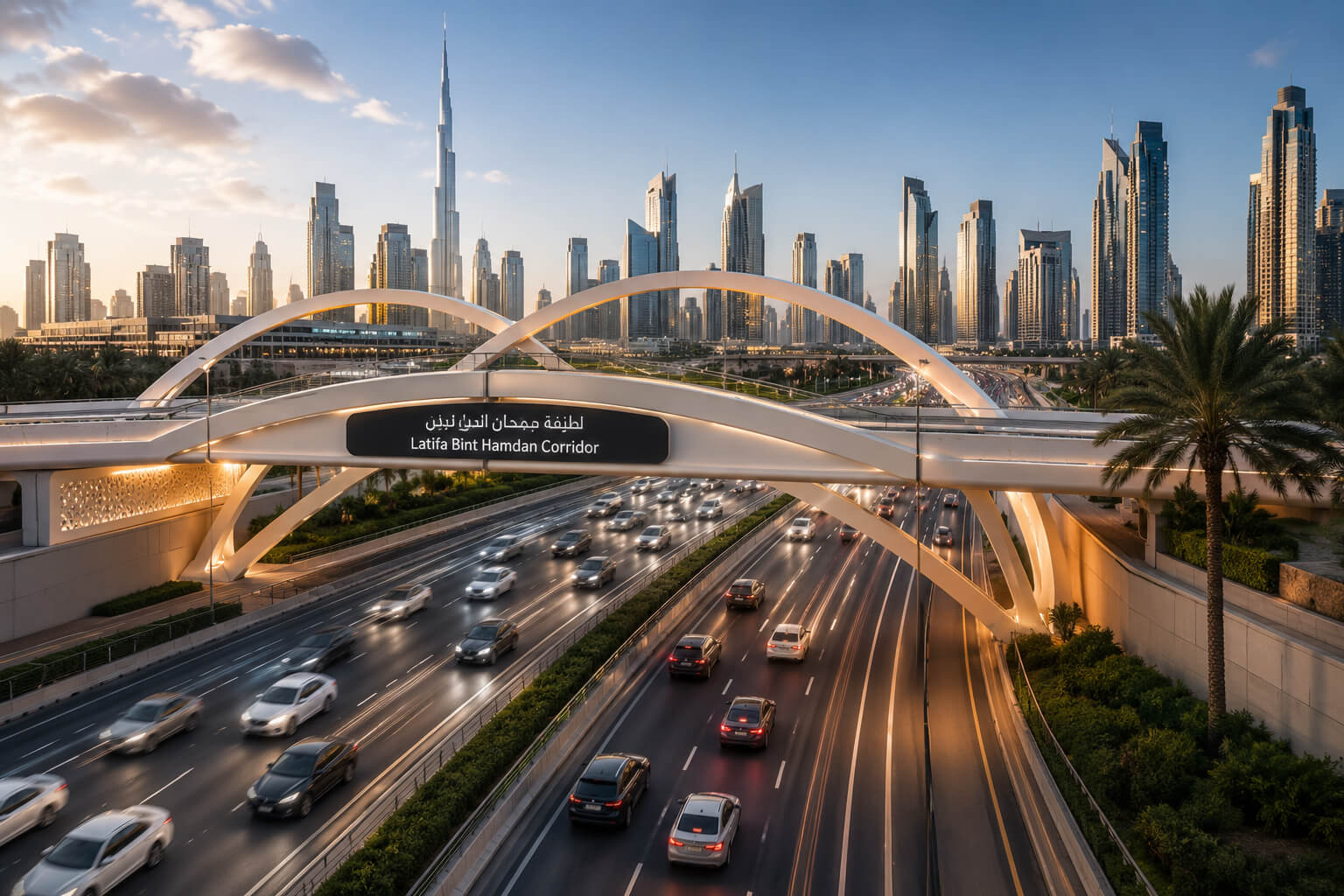
Dubai is moving ahead with another major road upgrade, and this one is not small.
The Roads and Transport Authority has awarded the Latifa Bint Hamdan Corridor project, valued at around $544.6 million, as the city continues trying to stay ahead of traffic pressure, population growth, and daily commuter demand.
The project is designed to improve road movement across one of Dubai’s important corridors. Once completed, it is expected to reduce travel time by 54 percent, which is the kind of number drivers notice immediately.
A New Push to Cut Travel Time in Dubai
The Latifa Bint Hamdan Corridor project is part of Dubai’s wider effort to make daily movement across the city faster and less frustrating.
Dubai’s population is growing. More people are moving between residential districts, business hubs, logistics zones, and major highways every day. That growth brings opportunity, yes, but it also brings traffic. Lots of it.
This project directly targets that pressure.
The development will upgrade road links, improve intersections, and support smoother traffic flow between major routes. It is not just about adding more asphalt. It is about making the road network work better as Dubai keeps expanding.
What the Latifa Bint Hamdan Corridor Project Includes
The corridor upgrade will cover key road sections connected to Latifa Bint Hamdan Street. Earlier project details reported by regional infrastructure outlets show that the development includes widening existing road sections, building new bridges, upgrading interchanges, and improving access to nearby communities and developments.
Larsen & Toubro has also been linked to Phase 1 work on the Latifa Bint Hamdan Street development, with the scope including upgrades between Emirates Road and Sheikh Mohammed Bin Zayed Road. The work involves expanding the existing dual carriageway from two lanes to four lanes in each direction, which should help increase capacity and ease traffic flow.
That matters because this corridor connects with some of Dubai’s busiest road systems.
When a project like this works, the benefit is not limited to one stretch of road. It can affect surrounding routes too, especially during peak-hour movement.
Why This Project Matters for Dubai Residents
For residents, the headline is simple: less time stuck in traffic.
The Latifa Bint Hamdan Street development is expected to serve more than one million residents and add capacity for about 16,000 vehicles per hour in both directions, according to earlier Dubai road development details.
That is a big capacity jump.
Dubai has been investing heavily in road corridors, bridges, tunnels, public transport, and traffic management systems because the city is not planning for today only. It is planning for the next decade, maybe longer.
The Dubai 2040 Urban Master Plan expects the emirate’s population to keep rising, and transport infrastructure has to keep pace with that. If roads do not expand smartly, congestion becomes a daily tax on everyone’s time.
Part of Dubai’s Larger Roads Development Plan
The Latifa Bint Hamdan Corridor project sits inside a much wider road improvement strategy.
Dubai’s RTA has been rolling out a major roads development plan that includes several strategic corridors, including Hessa Street, Al Fay Street, Umm Suqeim–Al Qudra, Al Safa Street, Meydan Road, and other high-demand routes. These projects are aimed at cutting travel times, increasing vehicle capacity, and supporting future growth.
The city has also been working on rapid traffic solutions, public transport improvements, and corridor upgrades to manage congestion before it becomes worse.
That is the important part.
Dubai is not waiting for traffic to completely break before responding. It is building ahead.
Better Roads, Bigger Growth
Infrastructure is often easy to ignore until it fails.
But in a city like Dubai, roads are part of the economic engine. They affect delivery times, business movement, tourism, emergency response, daily commutes, real estate access, and quality of life.
The Latifa Bint Hamdan Corridor project is another sign that Dubai sees mobility as a long-term competitiveness issue. A city can have towers, malls, airports, hotels, and business zones, but if people cannot move efficiently between them, growth becomes harder to manage.
So yes, this is a road project.
But it is also about how Dubai wants the city to feel in the years ahead: faster, connected, and less clogged by the pressure of its own success.
Sources:
- Economy Middle East: Dubai awards $544.6 million Latifa Bint Hamdan Corridor project to cut travel time by 54 percent
- Saudi Gulf Projects: L&T awarded significant road works contract in Dubai
- ET Infra: L&T wins road development contract in Dubai
- Gulf News: How Dubai’s Dh16 billion roads development plan will transform urban mobility
- Dubai Protocol: Hamdan bin Mohammed reviews progress of key strategic road corridors projects timeline through 2027
