


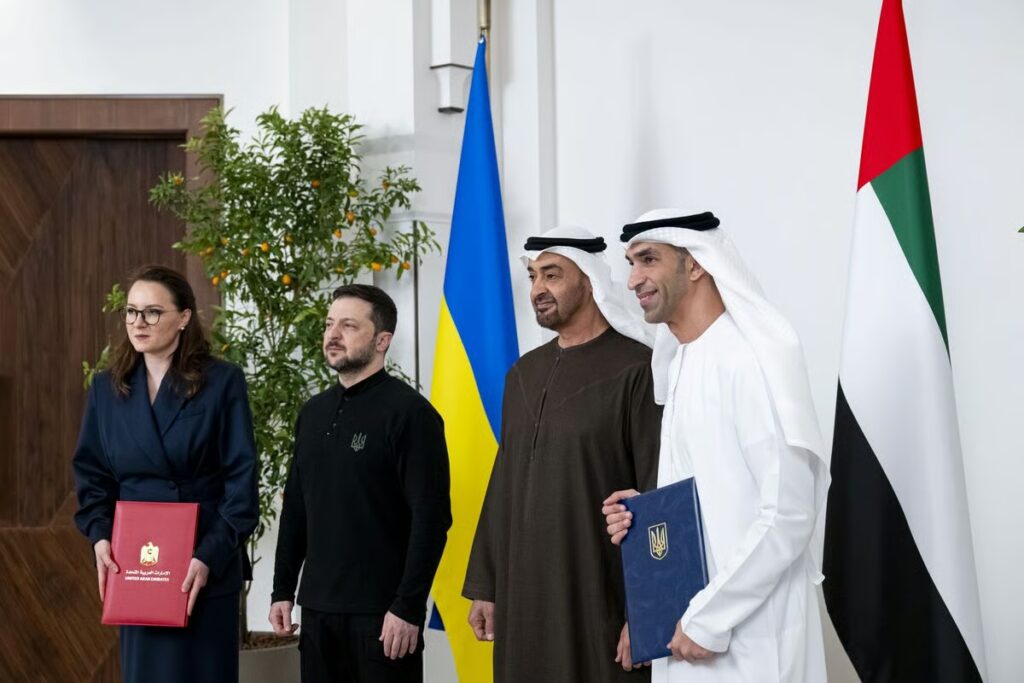
The UAE-Ukraine Comprehensive Economic Partnership Agreement has entered into force on July 1, giving both countries a new framework for trade, investment, and long-term economic cooperation.
It is not just another agreement added to the UAE’s growing CEPA list. This one carries a different weight. Ukraine is rebuilding, repositioning, and trying to keep its economy moving under very difficult conditions. The UAE, on the other hand, is expanding its role as a global trade connector, especially between Europe, the Middle East, Asia, and Africa.
The agreement was signed in Abu Dhabi in February 2025, in the presence of UAE President Sheikh Mohamed bin Zayed Al Nahyan and Ukrainian President Volodymyr Zelenskyy. It was signed by Dr. Thani bin Ahmed Al Zeyoudi, UAE Minister of State for Foreign Trade, and Yulia Svyrydenko, Ukraine’s First Deputy Prime Minister and Minister of Economy.
What the UAE-Ukraine CEPA Changes
Under the UAE-Ukraine CEPA, 99 percent of Ukrainian imports of UAE goods and 97 percent of Ukrainian exports to the UAE are set to be exempt from customs duties. That is a big opening for exporters on both sides, especially businesses that have been waiting for lower barriers and clearer access to each market.
For UAE companies, the agreement gives another route into Eastern Europe. For Ukrainian businesses, the UAE becomes more than a market. It becomes a gateway into the Gulf, Africa, and Asia, where logistics networks, free zones, ports, and re-export channels can help Ukrainian products travel further.
This matters for free zone companies too. Traders, logistics firms, food importers, machinery suppliers, aviation-related businesses, and technology companies could all find new openings as trade rules become easier to work with.
Food Security Is Part of the Story
Ukraine is one of the world’s important producers and exporters of grains, including wheat and barley. For the UAE, that matters. Food security has become a serious part of trade policy, not just an agriculture issue kept somewhere in the background.
Dr. Thani Al Zeyoudi said the agreement supports the flow of food supplies and strengthens the UAE’s trade partnerships. He also pointed to Ukraine’s role as an important food security partner, especially for critical commodities such as wheat and barley.
For the UAE, trade agreements are increasingly about resilience. Not only cheaper goods. Not only export numbers. Reliable supply chains now sit at the center of national economic planning.
Why Free Zones Should Watch This Closely
The UAE’s free zones may become one of the practical winners from this agreement. That is where the CEPA could move from policy language into actual business activity.
Free zone companies already operate across import, export, logistics, storage, e-commerce, manufacturing, services, and regional distribution. With the UAE-Ukraine CEPA now active, firms based in UAE free zones could explore new trade flows involving Ukrainian agricultural goods, metals, machinery, technology products, and industrial inputs.
There may also be fresh opportunities for companies supporting warehousing, customs facilitation, packaging, cold chain logistics, freight forwarding, and regional re-export. Not every benefit will appear overnight. Trade agreements need business adoption. But the route is now clearer.
Investment Opportunities Go Beyond Goods
The agreement is not only about tariffs. It is also designed to support wider cooperation in investment and services. According to WAM, the CEPA is expected to create opportunities in infrastructure, heavy industry, aviation, aerospace, and information technology.
That mix is important. Ukraine will need investment to rebuild key industries and infrastructure. The UAE has capital, logistics expertise, construction capacity, aviation links, and free zone ecosystems that already serve international companies.
It is easy to talk about trade in a clean way. Goods move. Tariffs fall. Numbers rise. But the more interesting part may be what happens around the trade: financing, storage, partnerships, digital services, engineering, food supply chains, and regional distribution.
Trade Numbers Still Have Room to Recover
Bilateral non-oil trade between the UAE and Ukraine reached $372.4 million in 2024. That figure shows there is already activity between the two economies, but it also reflects how much room remains for recovery and expansion. Before the war, trade stood at $904.4 million in 2021.
The agreement is expected to contribute $369 million to the UAE’s GDP and $874 million to Ukraine’s GDP by 2031. It is also expected to help accelerate Ukraine’s economic recovery while creating new commercial channels for both countries.
Those numbers will depend on actual business movement, not just signatures. Companies need to use the agreement. Exporters need to test the market. Logistics players need to build routes. Investors need to see where the real demand is.
Part of the UAE’s Bigger CEPA Strategy
The UAE-Ukraine CEPA is part of the UAE’s wider push to expand non-oil trade and deepen partnerships with strategic markets. The UAE has set a target to increase non-oil foreign trade to AED4 trillion by 2031, and CEPA agreements are one of the main tools behind that plan.
The UAE has already signed multiple CEPA deals across Asia, Europe, Africa, and other regions. Ukraine adds another European connection, but with a specific angle: recovery, food security, industrial rebuilding, and access to fast-growing markets through the UAE.
For Emirates Free Zone News readers, the important point is simple. This agreement is not just diplomatic news. It could shape new trade activity through UAE ports, free zones, logistics hubs, and business platforms.
What Comes Next
Now that the UAE-Ukraine CEPA has entered into force, the next phase belongs to businesses. The agreement can reduce costs, remove barriers, and make trade easier, but companies still have to move first.
Free zone operators, exporters, logistics providers, and investors should watch how demand develops across food products, machinery, metals, infrastructure support, aviation, aerospace, and IT. Some opportunities will be obvious. Others may appear quietly through supply chain shifts and new regional distribution models.
The deal gives the UAE and Ukraine a stronger commercial bridge. What happens on that bridge now depends on how quickly businesses decide to cross it.