

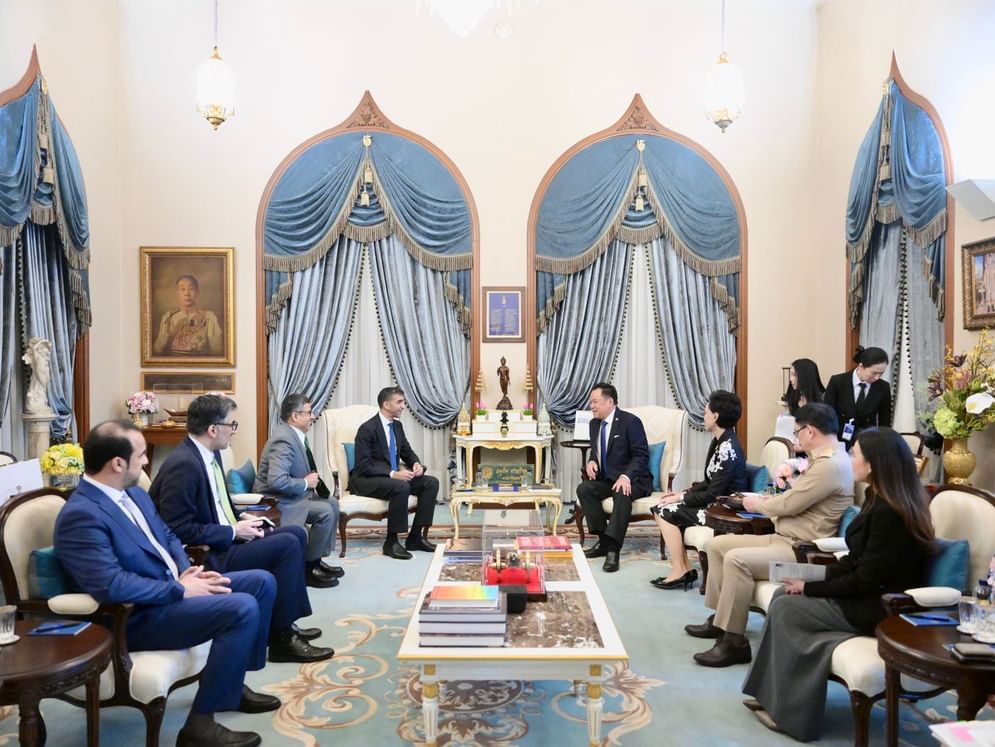
The UAE and Thailand have concluded negotiations for a Comprehensive Economic Partnership Agreement (CEPA), bringing the two countries closer to a new trade and investment framework linking the Gulf with Southeast Asia.
The negotiations were concluded in Bangkok during a meeting attended by Dr. Thani bin Ahmed Al Zeyoudi, UAE Minister of Foreign Trade; Anutin Charnvirakul, Prime Minister of Thailand; and Suphajee Suthumpun, Thailand’s Deputy Prime Minister and Minister of Commerce.
The agreement will still need to go through the required signing, ratification and implementation procedures before it takes effect. But the commercial relationship is already substantial, with bilateral trade growing sharply.
For UAE businesses, the development could open another route into Southeast Asia while giving Thai companies greater access to the UAE and the wider markets connected through it.
UAE-Thailand Trade Is Growing Fast
The decision to conclude CEPA negotiations comes against a backdrop of rapidly expanding trade between the two economies. Non-oil trade between the UAE and Thailand reached $12.3 billion in 2025, representing a 65.2% increase from the previous year.
The growth has continued into 2026. During the first half of the year, bilateral non-oil trade reached $10.2 billion, marking a 75.4% increase compared with the same period in 2025.
Those numbers help explain why the CEPA matters. The agreement is arriving after businesses on both sides have already increased their commercial activity. The next question is whether the new framework can make that relationship even larger and easier to navigate.
UAE Exports to Thailand Continue to Expand
UAE companies are already supplying a range of products to the Thai market, with non-oil exports reaching $4.5 billion in 2025. Gold and aluminium products were among the key export categories contributing to the trade relationship.
Thailand, meanwhile, exported $7.2 billion worth of goods to the UAE during the same year. The two-way flow reflects a relationship that covers more than a single industry, creating room for manufacturers, commodity traders, distributors and other businesses to deepen their activities.
A formal CEPA could give companies more certainty as they look at expanding those flows. For exporters based in the UAE, Thailand becomes another market within an increasingly broad network of trade relationships.
Advanced Manufacturing and Logistics Could Drive the Next Phase
The UAE and Thailand have identified sectors including advanced manufacturing, logistics, food security, digital trade, renewable energy and precious metals as areas with potential for greater cooperation.
There is a practical reason these sectors stand out. Thailand has a significant manufacturing base and an established position in Asian supply chains, while the UAE has developed major ports, airports, logistics infrastructure and business hubs that connect companies to markets across the Middle East, Africa and Europe.
That combination could encourage companies to think beyond simple import and export arrangements. A manufacturer in Thailand could use the UAE as a regional distribution point, while a UAE-based company could explore Thai production, sourcing or partnerships as part of a broader Asian strategy.
UAE Free Zones Could Become a Key Link for Thai Businesses
The CEPA could also create new opportunities for companies operating through UAE free zones. These zones are already used by international businesses for regional headquarters, trading operations, warehousing, distribution and market expansion.
A Thai company looking to enter the Middle East, for example, can establish a UAE presence and use the country’s logistics infrastructure to reach customers in neighbouring markets. The reverse also applies to UAE businesses looking for a foothold in Thailand and Southeast Asia.
For free zone operators, stronger UAE-Thailand trade could therefore mean more demand from companies that want a base between Asian suppliers and Gulf, African or European customers.
Logistics and Supply Chains Sit at the Centre of the Opportunity
The logistics connection between the two markets is particularly important because both countries occupy strategic positions in their respective regions. Thailand is deeply integrated into Southeast Asian production networks, while the UAE has spent years developing itself as an international logistics and re-export centre.
A stronger trade framework could encourage companies to build more efficient supply chains linking the two markets. Goods sourced or manufactured in Thailand can move toward Gulf markets through UAE logistics infrastructure, while UAE businesses can use Thailand as a gateway into a broader Asian commercial network.
That makes the CEPA relevant not only to exporters. Freight companies, warehouses, distributors, manufacturers and other supply-chain businesses could also find new opportunities as trade volumes increase.
Digital Trade Adds a New Layer to the UAE-Thailand Partnership
The inclusion of digital trade among the areas of cooperation shows how the relationship is moving beyond traditional merchandise. Technology companies and digital service providers increasingly operate across borders without the same physical footprint required by conventional exporters.
For the UAE, this fits with its wider effort to build a digital economy and attract technology-driven businesses into its commercial ecosystem. Thailand, meanwhile, offers access to a large and increasingly digital Southeast Asian market.
The combination could create opportunities in areas such as digital services, technology partnerships and cross-border business platforms as the agreement moves toward implementation.
Renewable Energy Creates Another Investment Opportunity
Renewable energy is another area highlighted by the two countries, adding an investment dimension to the CEPA beyond conventional trade.
Both markets are pursuing economic diversification and investing in new energy technologies. Greater cooperation could bring companies, investors and project developers from the two countries into closer contact, particularly as demand for cleaner energy infrastructure grows.
For UAE investors and businesses, Thailand could become an additional market for energy-related partnerships. Thai companies could likewise gain access to UAE capital, expertise and regional networks.
Thailand Strengthens the UAE’s Southeast Asian Trade Network
The Thailand CEPA also fits into the UAE’s broader strategy of building a network of trade agreements with key international markets.
The UAE has pursued CEPAs as a way to reduce barriers, expand market access and encourage investment between the country and major trading partners. The agreements form part of a wider effort to position the UAE as a global commercial hub connecting different regions.
Thailand is particularly relevant to that strategy because of its location, manufacturing base and role in Southeast Asian trade. A stronger UAE-Thailand relationship can add another important connection between Gulf businesses and Asian supply chains.
The CEPA Still Needs to Move Through the Formal Process
While negotiations have now concluded, businesses should not treat the agreement as immediately operational. The UAE and Thailand still need to complete the necessary legal procedures, including signing and ratification, before the CEPA enters into force.
That distinction matters for companies planning investments or changes to their supply chains. The commercial opportunities may be significant, but the precise benefits and implementation timetable will depend on the final agreement and its entry into force.
For now, the conclusion of negotiations sends a clear signal that both governments want the relationship to move into a deeper phase.
UAE Businesses Have Another Southeast Asian Market to Watch
The UAE-Thailand CEPA arrives at a time when companies are increasingly looking for diversified supply chains, new export destinations and stronger regional operating bases.
Thailand gives UAE businesses access to one of Southeast Asia’s major manufacturing and commercial markets. The UAE, meanwhile, offers Thai companies a platform for reaching the Gulf and other international markets.
Once the agreement takes effect, its impact will ultimately be measured by what businesses do with it. More factories, distribution agreements, investment projects, logistics routes and cross-border partnerships would be the clearest signs that the CEPA is translating into real economic activity.
For UAE free zones, that is where the opportunity becomes especially interesting. A stronger Thailand connection could bring another group of Asian companies into the UAE’s growing network of regional business hubs.
Sources
- Emirates News Agency (WAM) — UAE and Thailand conclude CEPA negotiations
https://www.wam.ae/en/article/c2n1hr9-uae-thailand-conclude-cepa-negotiations-opening - UAE Ministry of Economy — Comprehensive Economic Partnership Agreements
https://www.moec.gov.ae/ - UAE Government — National Programme to Strengthen Supply Chain Resilience
https://u.ae/en/about-the-uae/strategies-initiatives-and-awards/strategies-plans-and-visions/business/National-Programme-to-Strengthen-Supply-Chain-Resilience
