

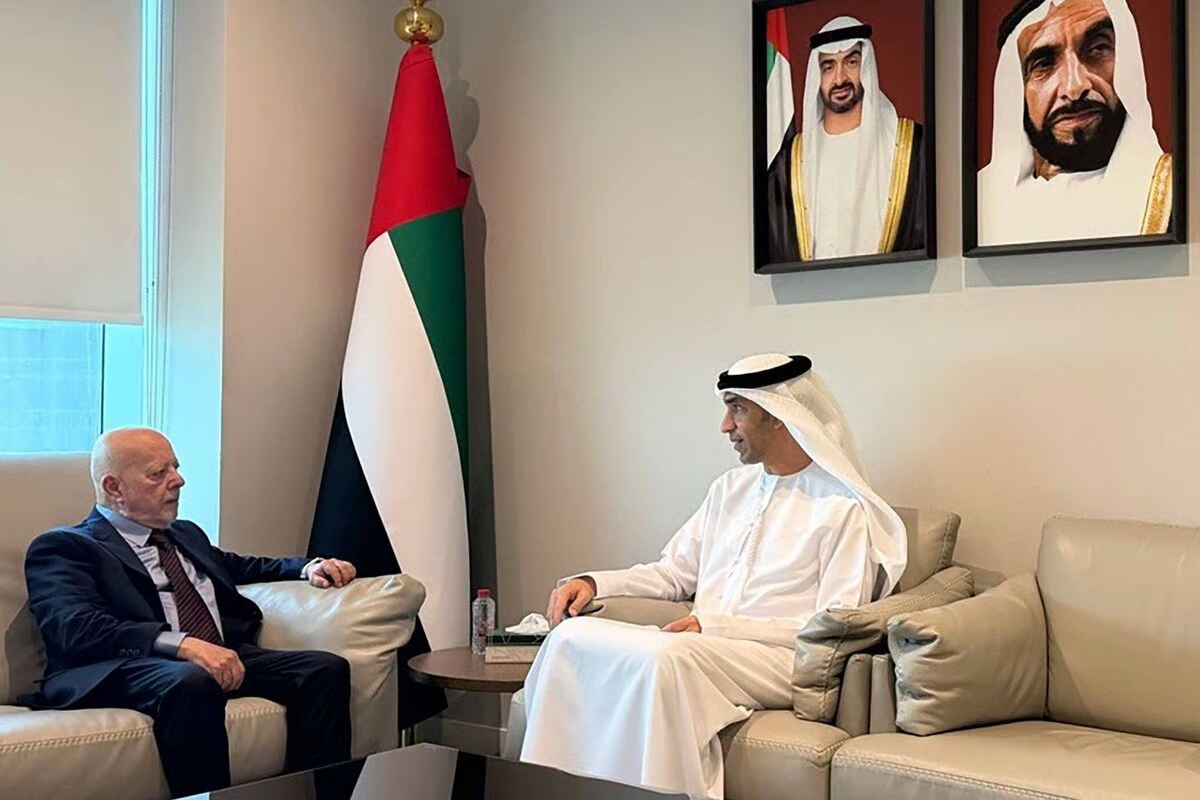
The UAE and Syria have restructured their joint business council, giving companies and investors from both countries a formal platform to pursue new trade deals, investment projects and private-sector partnerships.
The move was announced following talks in Abu Dhabi between UAE Minister of Foreign Trade Dr Thani bin Ahmed Al Zeyoudi and Syrian Minister of Economy and Industry Dr Mohammed Nidal Al-Shaar.
Both sides want the UAE-Syria Business Council to move beyond diplomatic discussion and focus on actual commercial opportunities. That includes connecting business owners, identifying viable projects and opening access to sectors where investment is urgently needed.
UAE-Syria Business Council Gets a New Structure
The restructured council will operate as a shared platform for companies, investors and industry representatives from the UAE and Syria.
Its job is fairly practical: create direct communication between the two business communities, develop investment partnerships and prepare a roadmap for future economic cooperation.
Al Zeyoudi said reactivating the council reflected a desire from both countries to restore trade and investment relations to their full potential. He also pointed to the importance of creating the right commercial environment rather than leaving cooperation at the government level.
Private companies will sit closer to the centre of the relationship.
That matters. Government agreements can establish direction, but businesses still need credible partners, market information, financing routes and clearer access to decision-makers before projects can move.
Council Targets Agriculture, Logistics and Infrastructure
The UAE-Syria Business Council will concentrate on a broad group of priority industries.
These include food security, agricultural investment, logistics, manufacturing, energy, infrastructure, technology, digital transformation and financial services.
There is no shortage of potential projects.
Syria needs investment across transport networks, industrial facilities, utilities, agriculture and digital infrastructure. UAE companies, meanwhile, have experience operating major logistics, energy, real estate and financial platforms across emerging markets.
The council is expected to help identify where those capabilities can meet Syria’s development needs.
Al-Shaar said Syria wants the platform to increase trade exchange and attract investment that supports development and reconstruction. He also described the council as a way to activate the private sector rather than relying entirely on state-led cooperation.
Syria’s Location Could Support Regional Trade
Syria’s geography is another part of the calculation.
The country sits between several important regional markets and has access to the Mediterranean Sea. That position could support new trade corridors linking the Gulf, the Levant, Türkiye, southern Europe and North Africa.
Al Zeyoudi said joint projects could strengthen Syria’s role as a commercial and logistics gateway to Mediterranean and global markets.
Turning that potential into functioning trade routes will take more than location alone. Ports, roads, customs systems, warehousing, payment channels and regulatory processes all need to work together.
Still, the commercial logic is clear.
For UAE logistics and infrastructure companies, Syria could become a market for long-term projects rather than short-term contracting work.
Emirati Business Leaders Join the Council
Essa Abdullah Al Ghurair will chair the Emirati side of the UAE-Syria Joint Business Council, while Yahya bin Saeed Lootah has been appointed vice chairman.
The council also includes business leaders from different economic and investment sectors.
Members include Ahmed Abdulqader Al-Sankari, Mohammed Juma Al-Musharrakh, Amer Al-Bakrawi, Sultan Hareb Al-Falahi, Faisal Abdulaziz Abdullah Al-Zarooni, Aref Al-Khoury, Saeed Al-Zari Al-Shamsi, Hamda Al-Mansoori, Amna Al-Dhaheri and other UAE executives and investors.
Ahmed Jama Al-Qizi, Assistant Secretary-General, will serve as the council’s rapporteur.
The mixed membership is deliberate. It gives the council access to decision-makers from several industries instead of placing the entire agenda under one narrow commercial sector.
Humaid Mohammed Bin Salem, Secretary-General of the Federation of UAE Chambers of Commerce and Industry, said the appointments would strengthen institutional links between the two business communities and support sustainable economic partnerships.
Syrian Side Was Established in June
Syria had already taken steps to rebuild the council before the Abu Dhabi announcement.
The Syrian side was established in June 2026 through a decision issued by Al-Shaar. The move formed part of a broader effort to encourage trade and investment cooperation with the UAE.
The latest restructuring now gives both sides a clearer mechanism for coordination.
That could include business delegations, investment forums, industry committees, project introductions and direct meetings between companies looking for partners.
Not every opportunity will move quickly. Investors will still weigh commercial risk, payment systems, legal protections and project viability before committing capital.
The council gives those discussions somewhere to start.
What the Council Could Mean for UAE Companies
For UAE businesses, the restructured council may provide earlier access to opportunities linked to Syria’s economic rebuilding.
Companies involved in logistics, construction materials, agriculture, renewable energy, telecommunications, fintech and industrial services could be among the first to explore the market.
Free zone companies may also find openings.
Many UAE free zones already support regional trading firms, logistics operators, technology companies and professional service providers. Businesses based in these zones could use the UAE as a headquarters for Syrian trade, project management, procurement or regional distribution.
The council itself will not remove every barrier. It can, however, make introductions easier, surface investment opportunities and give companies a more direct route to officials and potential partners.
For now, the announcement is a framework rather than a list of signed projects.
The next test will be whether the council turns its planned roadmap into real deals, functioning partnerships and measurable growth in bilateral trade.
