

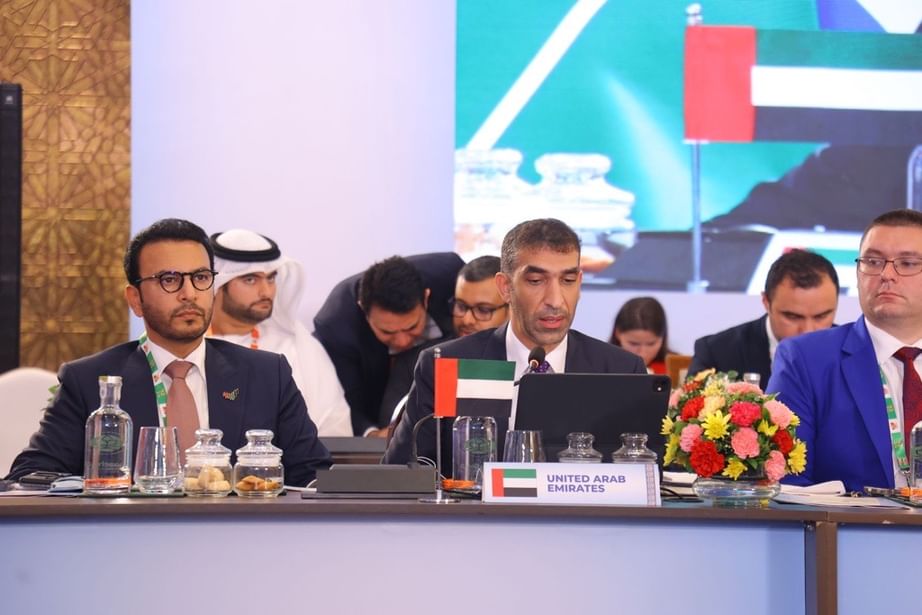
The UAE has stepped up its economic engagement with BRICS countries, joining trade ministers from some of the world’s largest emerging markets for talks in Jaipur, India.
Dr Thani bin Ahmed Al Zeyoudi, UAE Minister of Foreign Trade, represented the country at the 2026 BRICS Trade Ministers Meeting, hosted by India as part of its BRICS Chairmanship. Abdulla Al Nuaimi, UAE Ambassador to India, also attended.
The meeting wasn’t limited to broad statements about cooperation. Trade resilience, access to markets, small and medium-sized businesses, digital transformation and changing global supply chains were all on the table as governments looked at how BRICS economies can work together in an increasingly unsettled trading environment.
UAE Looks for More Trade and Investment Across BRICS Markets
For the UAE, Jaipur also provided room for direct conversations.
Al Zeyoudi met officials from India, China, Egypt, Indonesia, South Africa and Russia, with discussions centred on bilateral trade, investment opportunities, priority economic sectors and stronger participation from private businesses.
That matters for companies operating in the UAE, including businesses established in the country’s free zones. BRICS markets already represent a substantial share of the Emirates’ international commercial activity, and deeper government-to-government ties can create openings in logistics, manufacturing, technology, services, food trade and cross-border investment.
The numbers behind those relationships have become difficult to ignore.
UAE-BRICS Non-Oil Trade Surpasses $312 Billion
Non-oil foreign trade between the UAE and BRICS member countries exceeded $312 billion in 2025, according to figures reported by WAM. That represents growth of 28.5% from approximately $243 billion in 2024.
BRICS economies accounted for roughly 31% of the UAE’s total non-oil foreign trade during 2025.
They were also responsible for 34% of UAE imports, while receiving 23% of the country’s non-oil exports. Another 28% of UAE re-exports were linked to BRICS markets.
Those figures put some weight behind the UAE’s BRICS strategy. This is no longer a relatively small corner of the country’s foreign trade network. Nearly a third of non-oil trade is connected to the bloc.
For the UAE’s free zone ecosystem, that’s particularly relevant. Free zones sit at the intersection of imports, re-exports, logistics, regional distribution and international investment — exactly the areas likely to feel the effects of stronger commercial links with major emerging economies.
India-UAE Trade Remains a Major Part of the Picture
India received particular attention during Al Zeyoudi’s visit.
His meeting with Indian Commerce and Industry Minister Piyush Goyal reviewed progress under the India-UAE Comprehensive Economic Partnership Agreement (CEPA), which has been in force since May 2022.
The two sides discussed expanding cooperation in services, digital commerce, logistics and food security while improving trade facilitation and private-sector collaboration.
India remains one of the UAE’s biggest global trading partners. Bilateral non-oil trade reached $76.2 billion in 2025, up 17.3% from the previous year.
That relationship has become increasingly important for UAE-based companies looking toward South Asia, while the Emirates continues to position itself as a commercial bridge connecting Indian businesses with the Middle East, Africa and other international markets.
Strait of Hormuz Concerns Enter the Trade Discussion
The Jaipur meeting also took place against a much more difficult regional backdrop.
Al Zeyoudi raised the UAE’s concerns over attacks on commercial shipping linked to Iran and the continued closure of the Strait of Hormuz. He reiterated the UAE’s call for the waterway to be reopened immediately and unconditionally, alongside protection for freedom of navigation and international shipping under international law.
For a trade ministers’ meeting, this wasn’t a side issue.
Shipping routes, insurance costs, energy movements and supply-chain reliability can quickly affect businesses throughout the Gulf. Disruption around the Strait therefore has consequences well beyond maritime operators themselves.
The wider BRICS discussions addressed trade resilience and market connectivity, although ministers ultimately did not reach consensus on a joint declaration at the conclusion of the meeting.
BRICS Is Becoming a Bigger Part of the UAE Trade Strategy
The UAE joined an expanding BRICS grouping that now includes Brazil, Russia, India, China, South Africa, Indonesia, Ethiopia, Egypt, Iran and the UAE.
Together, the ten economies represent around 40% of the world’s population and approximately 25% of global GDP, according to figures cited by WAM.
For the Emirates, participation fits neatly into a broader policy: build more trading relationships, reduce reliance on individual markets and give UAE-based businesses access to a wider network of growing economies.
The country’s CEPA programme is another piece of that strategy.
Since the programme was launched in September 2021, the UAE has concluded 38 economic partnership agreements across Asia, Africa, Europe and the Americas. Eighteen were in force at the time of the BRICS meeting, including agreements with BRICS members India and Indonesia.
The bigger target is ambitious. The UAE wants its non-oil foreign trade to reach $1.1 trillion by 2031.
For companies choosing the UAE as a base for regional or international operations, the significance is fairly straightforward. The country isn’t only expanding its domestic business environment. It is steadily building a larger network of trade agreements and economic relationships around it.
BRICS is becoming an increasingly important part of that network.
Sources
- Emirates News Agency (WAM) — UAE participates in 2026 BRICS Trade Ministers Meeting in Jaipur, India
- Khaleej Times — UAE voices grave concern over ship attacks, Strait of Hormuz closure
