


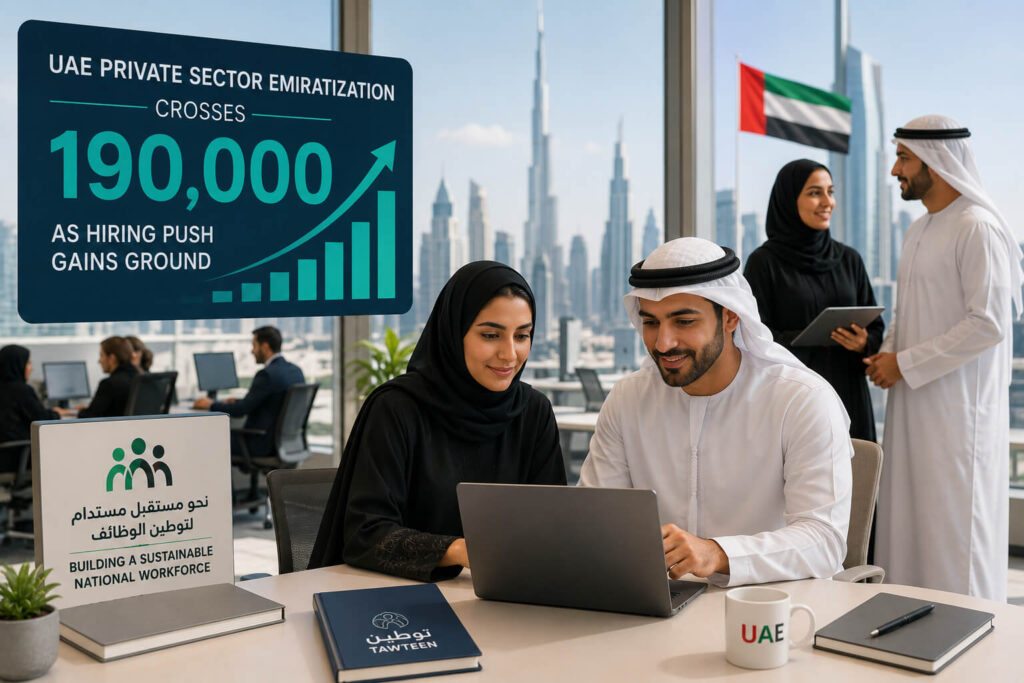
The UAE’s Emiratization drive has crossed a new mark, and this one is hard to ignore.
More than 190,000 Emiratis are now working in the UAE private sector, while 95 percent of companies covered by Emiratization policies met their targets in the first half of 2026. Nearly 32,000 private companies now employ Emirati citizens, showing how much the national hiring program has moved from policy language into actual workplace numbers.
For years, the private sector was seen as the harder side of the employment equation. Government jobs had the pull. Private companies had the scale, but not always the structure to attract and retain national talent.
That gap is narrowing.
UAE Private Sector Emiratization Reaches a New Level
The latest figures show a clear shift in the country’s labor market. Emiratization is no longer just about meeting quotas on paper. More companies are hiring Emiratis, and more Emiratis are entering private sector roles across different industries.
According to the Ministry of Human Resources and Emiratisation, the number of companies employing UAE citizens has climbed to nearly 32,000. That is a meaningful jump because it spreads national employment across a wider business base instead of concentrating opportunities in a smaller group of large firms.
This matters for free zone companies, mainland businesses, family groups, startups, and larger private employers. Emiratization is becoming part of normal business and workforce planning, not something businesses can leave until the final month of the year.
Why the 95 Percent Compliance Figure Matters
The headline number is 190,000 Emirati employees. Fair enough. It is the easy number to remember.
But the 95 percent compliance rate may be just as important.
It shows that most covered companies are not simply reacting to penalties. They are adjusting hiring plans, using Nafis support, opening roles for national talent, and building internal systems that make Emiratization easier to sustain.
That does not mean the process is effortless. For many businesses, especially fast-moving private firms, hiring is already complicated. Add skills matching, salary expectations, training, retention, and reporting requirements, and it becomes even more demanding.
Still, the numbers suggest that companies are adapting.
Nafis Continues to Shape the Hiring Market
Nafis remains central to the UAE’s Emiratization push. The program gives Emirati citizens support to join private sector roles while helping companies bring national talent into their teams.
The latest Emiratization growth reflects stronger coordination between the Ministry of Human Resources and Emiratisation and the UAE Competitiveness Council, which oversees Nafis. Reports also noted that the private sector’s participation has grown as more companies use the program to meet hiring goals and support Emirati employees.
This is where the policy becomes practical. Training support, wage support, career development, and company engagement can make a difference, especially for businesses that want to hire Emiratis but need a clearer path.
What This Means for UAE Businesses
For companies in the UAE, Emiratization is now a long-term operating requirement.
Businesses can no longer treat it as a side task handled once or twice a year. It affects recruitment, HR planning, compliance, talent development, and even employer branding. A company that builds a serious Emiratization pipeline early has an advantage over one that waits for deadlines.
Private employers also need to think beyond hiring. Retention matters. Career growth matters. If Emirati employees enter a company but do not see a future there, the numbers may look good for a while but the strategy will not hold.
That is the harder part.
Hiring gets the announcement. Retention proves whether the system works.
Free Zone Companies Should Watch the Direction Closely
For UAE free zone businesses, the latest figures are worth watching closely.
Many free zones attract international companies, regional headquarters, startups, service providers, logistics operators, financial firms, and technology businesses. As Emiratization continues to mature, workforce expectations across the wider private sector may keep becoming more structured.
Even companies that are not directly covered in the same way as larger mainland employers should still pay attention. The direction of travel is clear. The UAE wants deeper national participation in the private economy, and that priority is not slowing down.
For businesses planning expansion, licensing, hiring, or regional headquarters activity, Emiratization should sit inside the workforce strategy from the beginning.
Not later. Not after growth. Not when the deadline arrives.
The Bigger Picture for the UAE Economy
The UAE has been pushing hard to make the private sector a stronger career destination for citizens. That shift supports a broader economic goal: building a more diversified workforce that can grow with the country’s non-oil economy.
The private sector needs talent. Emirati graduates and professionals need access to meaningful roles outside government. The country needs both sides to meet somewhere more naturally.
The latest numbers suggest that meeting point is becoming easier to see.
More than 190,000 Emiratis in private sector jobs does not solve every workforce challenge. Skills alignment, retention, career mobility, and company readiness still matter. But the progress is visible.
And in a labor market where policy targets can sometimes feel distant from daily business reality, visible progress counts.
Sources
- Economy Middle East – UAE private-sector Emiratization surpasses 190,000 as 95 percent of companies meet targets
- WAM – Emiratisation agenda advances with leadership support, private sector participation
- Emirates 24/7 – UAE private sector employment of Emiratis surpasses 190,000 in the first half of 2026