

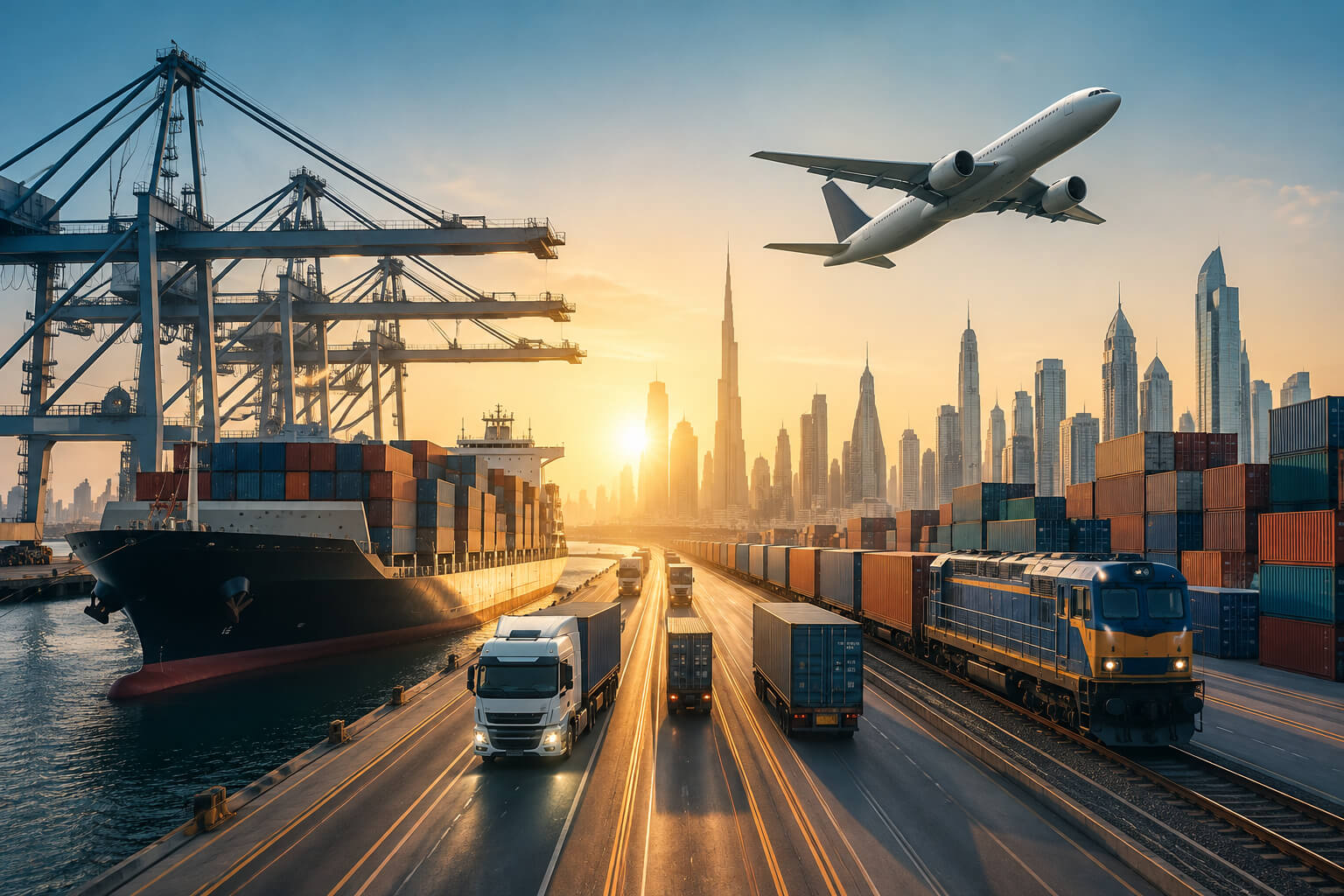
The UAE is building something bigger than a collection of ports, airports and free zones. At the heart of this strategy is the development of a UAE multi-modal logistics network that will connect these assets seamlessly.
Those pieces are increasingly being connected into one logistics system.
In 2026, the country is pushing further into multi-modal trade infrastructure, linking maritime routes, roads, railways, air cargo facilities, industrial zones and free zones more closely together. The goal is fairly practical: cargo should have more than one way to move, especially when traditional shipping routes become congested or disrupted.
For companies operating inside UAE free zones, that shift matters.
Manufacturing, warehousing and distribution facilities are becoming part of a wider logistics network rather than isolated business zones sitting beside a port or airport.
The UAE Is Turning Logistics Into a Connected Trade Platform
The UAE has spent decades positioning itself between Asia, Europe and Africa. What is changing now is the level of integration behind that position.
Manufacturing facilities can sit close to storage centres. Storage can connect directly with ports. Rail networks can move cargo between industrial areas and major maritime terminals. Airports offer another route when speed matters more than shipping cost.
That makes the UAE multi-modal logistics network less dependent on any single transport channel.
It also changes the role of free zones. They are increasingly becoming production, storage and distribution nodes inside a much broader supply chain.
Gulf News, citing WAM, reported that the UAE is moving from the traditional role of an import-export hub toward an end-to-end logistics platform connecting manufacturing and warehousing with airports, ports and border crossings.
Sharjah Is Building Stronger Links With Oman
Sharjah is one of the clearest examples of how regional logistics routes are expanding.
The Sharjah Ports, Customs and Free Zones Authority has worked with Oman Customs on a new logistics corridor linking Sharjah’s coastal ports with major Omani ports including Sohar, Duqm and Salalah.
Khorfakkan Port forms part of the network and is targeting future capacity of around 10 million containers.
There is also significant development happening inland.
Sharjah is developing the Al Dhaid Logistics Complex across more than 16 million square feet, with an initial planned capacity of approximately 1.5 million TEUs.
That is important for businesses considering Sharjah’s industrial and free zone ecosystem. More logistics capacity means companies potentially gain additional options for storage, cargo consolidation and regional distribution without relying entirely on coastal facilities.
Rail Is Becoming a Bigger Part of the UAE Supply Chain
Rail freight has been one of the more interesting changes in the UAE logistics story.
Etihad Rail is connecting industrial centres with major ports and logistics terminals, creating another freight option alongside trucking.
According to the Gulf News report, Etihad Rail transported roughly 1.8 million tonnes of sulphur, more than 4 million tonnes of aggregates and 129,000 containers during 2026 through 11 terminals connecting industrial hubs and major ports such as Khalifa Port and Jebel Ali.
Cross-border ambitions are moving ahead as well.
Hafeet Rail signed contracts in February 2025 for the design and construction of railway facilities in Oman, another step toward deeper freight connectivity between the UAE and Oman.
For manufacturers, this is not simply another infrastructure project. Rail can give businesses operating in industrial zones and free zones an additional way to move large volumes between production centres and ports.
Abu Dhabi Airports Free Zone Is Expanding Air Cargo Capacity
Abu Dhabi is building out the air freight side of the system.
Abu Dhabi Airports Free Zone includes the Al Falah Logistics Park, covering about 8.3 million square metres. A new East Midfield cargo terminal is also expected to provide annual handling capacity of approximately 1.5 million tonnes when completed in 2027.
That creates a potentially powerful setup for companies handling pharmaceuticals, electronics, high-value products, perishables and other goods where fast international movement can be important.
The free zone advantage becomes more obvious when warehousing, airport access and international cargo handling sit within the same logistics ecosystem.
Businesses are not simply choosing office space or a trade licence. Location inside that infrastructure can become part of the company’s supply chain strategy.
Fujairah Is Becoming More Important When Trade Routes Get Disrupted
Fujairah offers something slightly different.
Its location on the UAE’s east coast gives businesses another route into global shipping networks, particularly when maritime disruptions affect other parts of the region.
Fujairah Terminals handled more than 70,000 TEUs and around 100 cargo vessels during recent regional disruptions, according to the report. Planned development at Rugeilat Port and Dibba Al Fujairah could add further capacity.
This redundancy is becoming increasingly valuable.
Companies do not want a sophisticated supply chain that works perfectly until one route closes. They want alternatives.
Fujairah gives the UAE another access point, and that can strengthen the attractiveness of nearby industrial and free zone operations.
Dubai Already Has One of the UAE’s Strongest Sea-to-Air Connections
Dubai’s logistics model shows what full integration can look like.
The Dubai Logistics Corridor links Jebel Ali Port with Al Maktoum International Airport, allowing cargo to move between sea and air infrastructure through the same broader logistics ecosystem.
Jebel Ali Free Zone is sitting right inside that network.
Jafza attracted AED854 million in new investments during the first four months of 2026, with investment flowing into manufacturing, logistics, healthcare and food production facilities.
That combination is difficult to ignore.
A company can manufacture or store goods in the free zone, access one of the region’s major ports and connect with international air freight without having to build its supply chain across several disconnected locations.
For exporters and regional distribution businesses, this is one of the UAE free zone model’s strongest selling points.
Digital Logistics Is Starting to Matter as Much as Physical Infrastructure
Roads and terminals are only part of the story.
Digital cargo tracking and coordination systems increasingly determine how quickly operators can react when routes change.
According to Gulf News, platforms associated with Abu Dhabi’s economic development ecosystem expanded connections to more than 30 logistics operators in 2026, supporting functions such as real-time cargo rerouting and emergency response coordination.
That becomes particularly useful during sudden disruption.
Instead of waiting for a shipment to hit a bottleneck before reacting, logistics operators can potentially redirect cargo between available routes, terminals and storage facilities.
The competitive advantage is not simply moving goods quickly. It is knowing where those goods can move next when the original plan stops working.
Free Zones Are Becoming Part of the UAE’s Supply Chain Strategy
Free zones have traditionally been marketed around ownership structures, tax advantages, streamlined licensing and access to international markets.
Those benefits are still important.
But logistics is becoming an equally important part of the pitch.
A manufacturing company looking at the UAE may now consider how quickly it can reach a railway terminal. An e-commerce distributor may care about airport access. Food producers may look at cold-chain infrastructure. Heavy industry may care more about port connections and bulk freight.
The UAE’s increasingly connected logistics model gives different free zones room to specialize around these requirements.
It also makes location decisions more strategic. The cheapest licence may not necessarily produce the lowest operating cost if the business spends substantially more moving goods afterward.
UAE Non-Oil Trade Is Growing Alongside the Logistics Expansion
The infrastructure push is happening while the UAE continues to expand its non-oil economy.
The country’s real GDP grew 3% in the first quarter of 2026 to around AED485 billion at constant prices. Non-oil foreign trade reached a record AED1.937 trillion during the first half of the year, according to figures cited in the report.
Multinational companies are also making use of the UAE as a distribution base.
Healthcare company Novo Nordisk has established one of its three global distribution hubs in the country, highlighting how the UAE’s logistics position can support operations well beyond the Middle East.
That is exactly the type of investment the expanding network is designed to attract.
What This Means for Companies Considering a UAE Free Zone
The UAE free zone conversation is changing.
Licensing costs, visa allocations and office requirements still matter, particularly for smaller companies. But businesses involved in manufacturing, importing, exporting, e-commerce or regional distribution should probably look one layer deeper.
Which port is nearby?
Can products move by rail?
How quickly can cargo reach an international airport?
Are warehouses available inside or close to the free zone?
And perhaps more importantly now: what happens when the normal route is disrupted?
The UAE multi-modal logistics network is giving companies more answers to those questions.
Ports, airports, rail networks, roads, warehouses and free zones are being stitched together into a system designed to keep trade moving. That makes logistics infrastructure something more than background development.
For many companies choosing where to establish themselves in the UAE, it could become one of the deciding factors.
Sources
- Gulf News / WAM — UAE Expands Multi-Modal Logistics Network as Global Trade Evolves
- UAE Government / WAM
- Etihad Rail
- Jebel Ali Free Zone (Jafza)
- Abu Dhabi Airports Free Zone
