

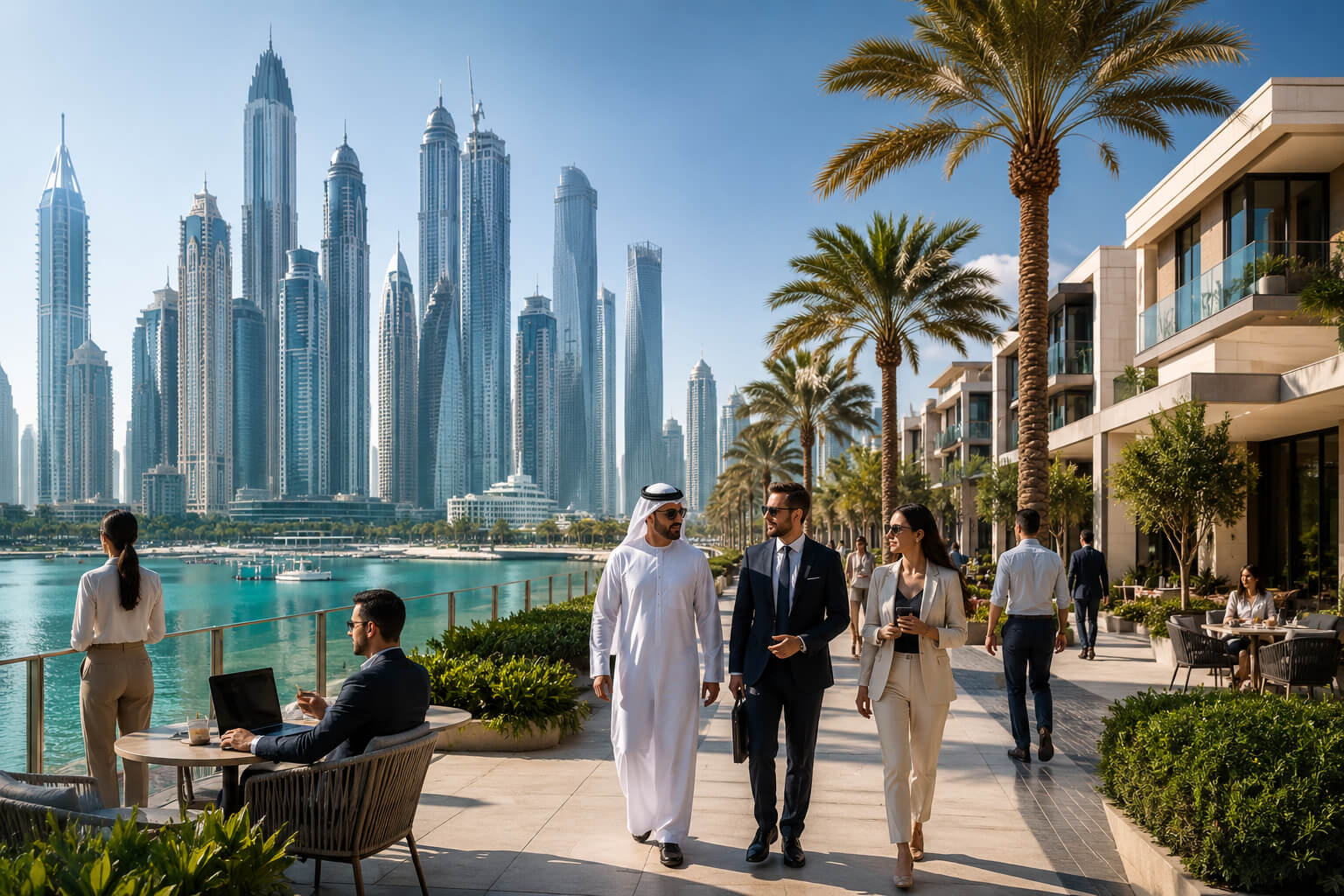
The UAE has always sold opportunity well. Business licences. Free zones. Tax efficiency. Global connectivity. Fast setup. Strong infrastructure. But that is no longer the whole story.
A growing number of investors, entrepreneurs, executives, and skilled professionals are not choosing the UAE only because it is a good place to do business. They are choosing it because it is becoming a place where business, lifestyle, family, mobility, and long-term planning can sit together without feeling forced.
That shift matters. The UAE’s lifestyle communities are now part of the country’s wider economic engine. They are helping attract global talent and capital in a way that goes beyond office towers and investor incentives.
The UAE Is Selling More Than Business Access Now
For years, the UAE’s appeal was easy to explain.
Come here, set up a company, access regional markets, benefit from strong logistics, and operate from one of the world’s most connected business hubs.
That still works. But the conversation has widened.
Global founders, investors, and senior professionals now look at schools, healthcare, housing quality, walkable districts, security, leisure, transport, and whether their families can actually build a life around the business opportunity. This is where lifestyle communities come in.
Master-planned communities, mixed-use districts, waterfront developments, green neighbourhoods, branded residences, and live-work zones are becoming part of the UAE’s talent strategy without always being called that. People do not only move for a licence anymore. They move for a full operating base.
Lifestyle Communities Are Becoming Talent Infrastructure
Talent attraction is usually discussed in terms of visas, salaries, and jobs. Fair enough.
The UAE has made clear through its national talent strategy that it wants to strengthen its position as a preferred destination for living, working, and investing. The strategy focuses on attracting and retaining skilled people who can support the country’s knowledge economy. But talent does not stay because of paperwork alone.
A founder may come for a free zone licence. A fund manager may come for financial access. A consultant may come for regional clients. A tech specialist may come because the market is growing. They stay when life works.
That means homes close to schools. Communities with cafés, parks, clinics, gyms, co-working spaces, retail, and reliable transport. It also means places where families can settle quickly instead of treating the move as a temporary posting.
This is not soft infrastructure. Not anymore. For the UAE, lifestyle has become a serious competitiveness tool.
Investors Are Following the Same Logic
Capital is moving in the same direction.
Real estate investors are not only chasing towers in prime locations. Many are looking at communities that offer a more complete living experience. The logic is simple: if global residents want long-term quality of life, then communities built around that demand can hold stronger appeal.
Recent property market coverage has pointed to rising interest in UAE communities with lifestyle differentiation, infrastructure expansion, tourism potential, and long-term investment upside.
That is why lifestyle-led developments matter for free zone and business ecosystems too. A business hub can attract companies. A strong residential and lifestyle environment can help those companies keep people.
This is especially relevant for entrepreneurs, SMEs, family offices, and remote-first companies that do not always separate office location from living location in the old corporate way. The business decision and the life decision now overlap.
Free Zones Benefit From the Lifestyle Shift
For Emirates Free Zone News readers, this trend has a direct connection to the free zone economy.
Free zones already give foreign investors and companies a practical entry point into the UAE. They offer licensing structures, sector-focused ecosystems, ownership benefits, and access to regional and global markets. But a company still needs people. That is where lifestyle communities help strengthen the broader proposition.
A founder setting up in Dubai, Abu Dhabi, Sharjah, Ras Al Khaimah, or another emirate is not only asking where to register the business. They are also asking where their team can live, whether talent can relocate easily, whether employees will enjoy the move, and whether the UAE can support long-term expansion.
The stronger the lifestyle offering, the easier that decision becomes.
In many cases, the UAE is no longer competing only with other business hubs. It is competing with cities where people want to live. And that is a tougher game.
Global Wealth Wants Stability, Not Just Returns
The UAE’s appeal to global capital is also tied to stability. Investors are looking for markets where they can place capital, manage family wealth, build companies, and create long-term structures. The UAE has increasingly positioned itself as a connector of global wealth and capital, supported by diversification, infrastructure, and political stability.
Lifestyle communities fit neatly into that story.
A high-net-worth family may enter through property investment. A business owner may start with a free zone company. A founder may arrive for funding access. A senior executive may relocate for a regional role. Different entry points. Same wider question. Can the UAE become a base?
For more people, the answer is yes.
Not because everything is cheap. It is not. Not because every community is perfect. They are not. But because the package is strong: safety, connectivity, business access, international schools, healthcare, real estate options, and a daily lifestyle that feels global without being disconnected from the region.
The New UAE Growth Story Feels More Residential
The old version of the UAE growth story was about airports, ports, free zones, towers, and mega projects. The new version still has all of that. But now it also has neighbourhoods. That may sound less dramatic, but it is important.
A country that wants to attract capital needs confidence. A country that wants to attract talent needs livability. A country that wants to retain both needs communities where people can see themselves staying longer than one contract cycle.
This is why UAE lifestyle communities are becoming more than real estate products. They are part of the country’s economic positioning.
For free zones, developers, investors, and business setup firms, the message is clear enough: the next wave of growth will not be driven by licences alone. It will be shaped by places where people can work, live, invest, raise families, and build something that feels permanent.
The UAE seems to understand that. And global talent is paying attention.
Sources:
- Economy Middle East – How UAE lifestyle communities attract global talent and capital
- UAE Government Portal – UAE Strategy for Talent Attraction and Retention
- UAE Ministry of Economy – Talent Attraction and Retention
- Economy Middle East – The UAE’s rise as a strategic connector of global wealth and capital
- Gulf News – UAE property market and lifestyle-led investment communities
