
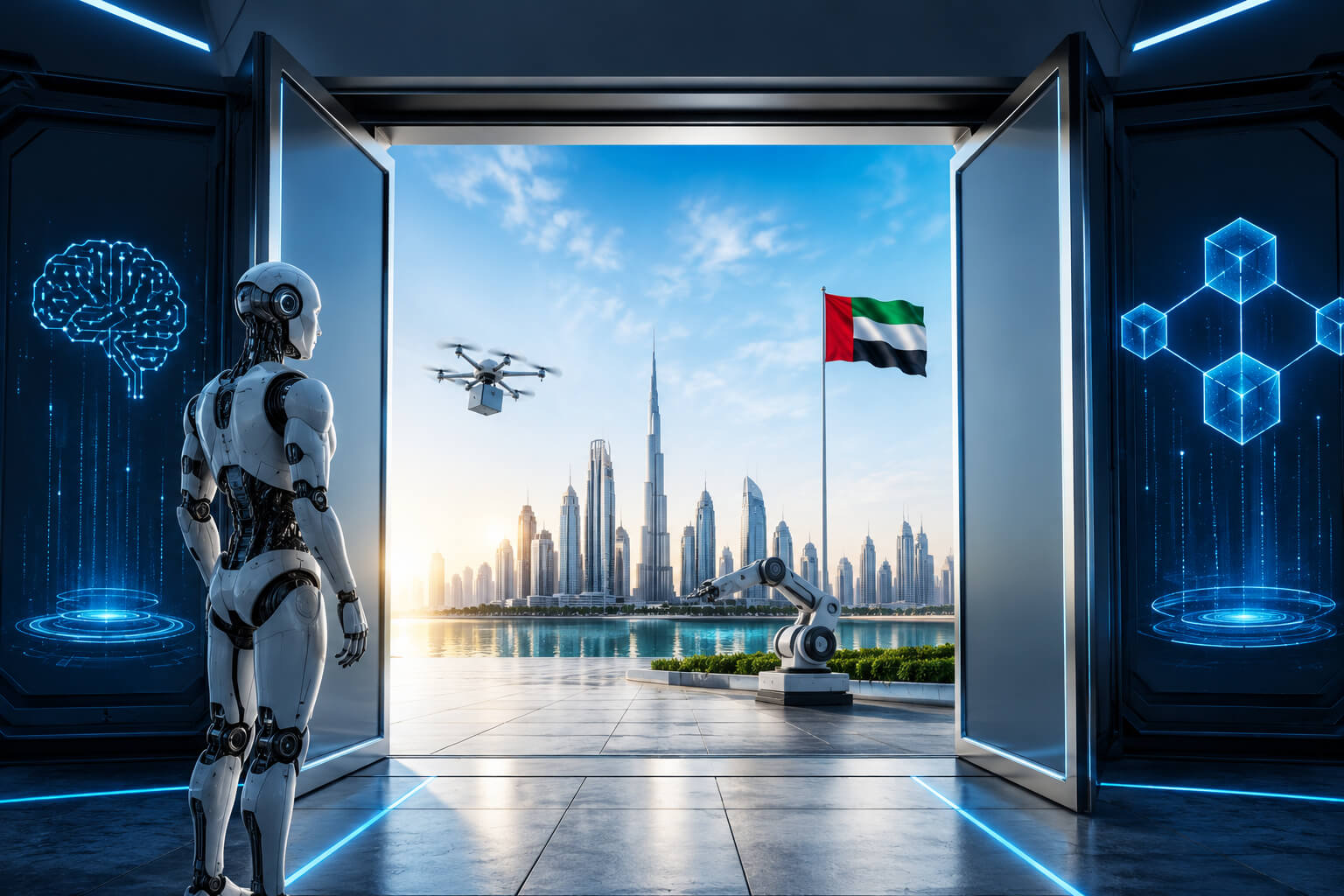
The UAE is preparing a new kind of free zone called the UAE Machine Economy Free Zone. This one is not built around commodities, media companies or conventional financial services. It is designed for machines that can work, generate income and interact with people—or even with other machines.
Blockchain platform peaq and Abu Dhabi-based venture studio Pulsar Group have announced the world’s first Machine Economy Free Zone, with activities planned across Abu Dhabi and Dubai.
The initiative sounds futuristic, but its purpose is fairly practical. It will create a controlled environment where companies can test autonomous robots, artificial intelligence systems, connected infrastructure and blockchain-based ownership models before trying to deploy them at scale.
The project was first announced on June 11, 2025. Peaq describes it as a dedicated sandbox for regulation, investment, technology deployment and research linked to the emerging machine economy.
What the Machine Economy Free Zone Actually Means
The “machine economy” refers to an economic system in which connected devices, robots and AI-powered equipment can deliver services, make transactions and create measurable financial value.
That could include an autonomous vehicle charging customers for transport, a delivery robot completing paid orders or a smart energy device selling unused power back to a network.
Some of this already happens in limited forms. The bigger idea is to connect these machines to digital payment systems and blockchain networks so they can operate with less human involvement.
The UAE Machine Economy Free Zone will give founders, investors, researchers and policymakers a place to explore those business models without immediately pushing them into a full commercial market.
Peaq and Pulsar want the zone to support real-world deployment rather than become another technology discussion forum. Physical and virtual testing environments are expected to allow companies to trial devices, applications and infrastructure for future smart cities.
Abu Dhabi and Dubai Will Share the Project
The Machine Economy Free Zone is expected to operate across Abu Dhabi and Dubai rather than sit inside a single conventional business district.
That structure gives the initiative access to two different but closely connected technology ecosystems. Abu Dhabi brings sovereign investment institutions, research centres and a growing venture capital market. Dubai offers international business networks, startup communities and a strong base of companies working in blockchain, artificial intelligence and digital services.
Peaq also said it would establish its headquarters in the UAE to support the initiative on the ground.
The move matters. It suggests the company is treating the free zone as a long-term operating platform, not simply a short pilot attached to an overseas team.
Regulation Comes Before the Robots
The most difficult part may not be building the machines. It may be deciding how they can legally earn, own assets or accept investment.
The Machine Economy Free Zone will work on regulatory sandboxes for autonomous technologies and the compliant tokenisation of robots, vehicles and other machines.
Tokenisation involves creating a digital representation of an asset on a blockchain. In this case, a costly machine could theoretically be divided into smaller digital ownership interests.
Several investors might then hold a share of a robot, autonomous vehicle or vertical farming system. When the machine generates revenue, the returns could be distributed according to those ownership shares.
That model creates obvious questions. Who carries the liability if an autonomous machine causes damage? How should income be taxed? What rights do token holders receive? And who maintains the equipment?
The free zone will provide a place to test some of those questions before commercial deployment becomes widespread.
Machine Tokenisation Could Lower Investment Barriers
One of the first concepts planned for testing is a framework for machine tokenisation.
The aim is to make expensive robots and infrastructure projects more accessible to investors who may not be able to fund an entire machine themselves. Instead of one company owning the full asset, several participants could potentially co-own it through blockchain-based tokens.
Peaq connects this idea to what it calls “Machine DeFi,” a decentralised financial system built around income-producing machines.
The concept could eventually apply to autonomous taxis, charging stations, agricultural robots, vertical farms, delivery devices and other connected infrastructure.
Still, the model remains experimental. It will need clear ownership rules, reliable revenue reporting and safeguards for investors. A machine may generate income, but it can also break down, become obsolete or face restrictions that affect its commercial use.
Universal Basic Ownership Offers a Different Automation Story
The free zone will also host a pilot called Universal Basic Ownership.
The idea is to distribute part of the income created by machines to individuals or communities affected by automation. Rather than concentrating all profits with the company that owns the equipment, the model would allow more people to hold an economic interest in productive machines.
It is an unusual response to concerns about AI and robotics replacing human jobs.
Most conversations about automation focus on retraining workers or providing financial support after employment disappears. Universal Basic Ownership starts from another point: people could own part of the technology doing the work.
How that would operate in practice remains unclear. The pilot will need to address who qualifies, how ownership is distributed and what happens when a machine produces little or no profit.
Even so, it gives the free zone a social experiment alongside its commercial and regulatory work.
Four Areas Will Shape the Free Zone
The initiative will concentrate on regulation, deployment, investment and the creation of an innovation hub.
Regulatory work will cover sandboxes and compliant investment structures. Deployment programmes will allow founders to test machines and decentralised infrastructure in physical or virtual environments.
The investment side will connect projects built on peaq with institutions and regional funding bodies. Meanwhile, the innovation hub will support research, product development and partnerships between technology builders and organisations that may use their systems.
That combination is important. Startups often find funding but struggle to secure regulatory approval or real-world testing locations. Others build strong products without finding customers.
The Machine Economy Free Zone is trying to bring those pieces into the same environment.
DePIN Projects Could Find a UAE Testing Ground
The free zone will pay particular attention to decentralised physical infrastructure networks, commonly known as DePIN.
DePIN projects use blockchain-based incentives to encourage individuals or businesses to provide physical resources. Those resources may include wireless coverage, computing power, mapping data, energy equipment, transport infrastructure or environmental sensors.
Instead of one central company owning the entire network, participants contribute devices or services and receive digital rewards.
Supporters argue that this model can reduce infrastructure costs and allow networks to grow faster. Critics point to uncertain demand, token price volatility and the difficulty of proving that decentralised systems work better than conventional operators.
The UAE sandbox could offer a useful reality check. Projects will have to move beyond online communities and show that their machines or networks can perform reliably in real environments.
Why the UAE Is Pursuing the Machine Economy
The project fits the UAE’s broader effort to attract companies working in artificial intelligence, blockchain, autonomous transport and smart-city infrastructure.
Free zones have long played a central role in that strategy. They give businesses specialised environments where licensing, ownership structures and sector-specific services can be organised around a particular industry.
The Machine Economy Free Zone takes that model into less familiar territory. It is not just providing office space or company registration. It is trying to build rules for economic activity involving autonomous machines.
That ambition could attract founders looking for a jurisdiction willing to test ideas that are difficult to launch elsewhere.
The announcement, however, should not be mistaken for evidence that a fully operational machine economy already exists. Many of the proposed systems still require regulatory approval, technical testing and clear commercial demand.
The UAE is effectively placing an early bet—and creating a place where that bet can be tested.
A Free Zone Built Around What Comes Next
The Machine Economy Free Zone arrives at a moment when artificial intelligence is moving out of software and into physical systems.
Robots are entering warehouses, vehicles are becoming more autonomous and smart devices are beginning to make decisions without constant human instruction. The economic structure around those machines remains unfinished.
Who owns them, who profits from them, and where does the risk actually fall?
Peaq and Pulsar Group believe the UAE can help answer those questions through controlled experiments, investment frameworks and real-world deployments.
Some projects will probably fail. Others may discover that decentralisation adds complexity without solving a genuine problem. That is part of what a sandbox is meant to reveal.
The more interesting outcome would be finding a model that lets autonomous technology create value without leaving ownership and profits in the hands of only a few large companies.
Sources
- Arabian Business – World’s First Machine Economy Freezone to Launch in UAE
- peaq – Welcome to the World’s First Machine Economy Free Zone in the UAE
- Chainwire – peaq and Pulsar Launch Machine Economy Free Zone for the UAE
- UAE Ministry of Economy and Tourism – Establishing a Business in Free Zones
