


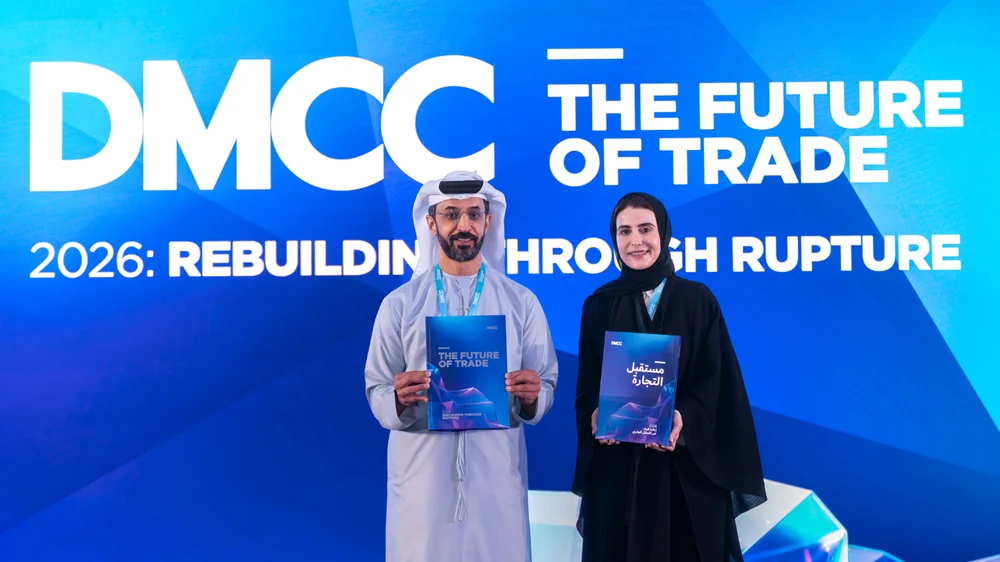
The UAE has held on to second place in the 2026 Commodity Trade Index, according to DMCC’s latest Future of Trade 2026 report. That is not a small ranking. It puts the UAE behind only the United States and reinforces the country’s role as one of the world’s strongest commodity trading hubs.
For Dubai, and especially for business districts like DMCC, the result says a lot about where global trade is moving. Companies are not just looking for cheap routes anymore. They want stable jurisdictions, better infrastructure, access to capital, reliable logistics, and markets that can still function when the global system becomes messy.
And the global system is definitely messy.
DMCC Report Points to a New Trade Map
DMCC launched its Future of Trade 2026 report in Dubai under the title “Rebuilding Through Rupture.” The report argues that global trade is still resilient, but it is no longer operating under the old model. AI, tariff volatility, resilient supply chains, energy transition pressures, and new financial infrastructure are all changing how companies move goods, capital, and value across borders.
The report also found that more than 80% of respondents expect slow and uneven trade growth over the next one to three years. Only 4% expect the best-case scenario. That detail matters because it shows how businesses are thinking now. Disruption is no longer treated as a rare event. It is becoming part of the planning process.
South-South Trade Is Becoming Harder to Ignore
One of the biggest findings from the report is the growth of South-South trade. DMCC said South-South trade now accounts for around 35% of global trade, overtaking North-North flows, which stand at around 25%.
That shift changes the center of gravity. More trade growth is now coming from corridors linking Asia, the Middle East, Africa, and Latin America. It is not the old picture where advanced Western economies dominate the trade conversation from every angle. The newer map is more distributed, more regional, and frankly more interesting.
This is where the UAE fits in neatly. The country sits in the middle of many of these corridors, with ports, airports, free zones, commodities infrastructure, financial services, and trade links that allow companies to operate across multiple regions without being locked into one bloc.
UAE as a Connector Economy
The report identifies the UAE as a key “connector economy,” a country that can help businesses navigate fragmented markets and connect with high-growth regions. That role is built on geography, infrastructure, capital, commodities expertise, and diversified trade relationships.
This is not just a nice label. For companies based in UAE free zones, it is part of the value proposition. A business operating from Dubai can reach Gulf markets, Africa, South Asia, Europe, and wider global trade routes with fewer barriers than many competing locations. That matters even more when companies are redesigning supply chains for resilience instead of only chasing the lowest possible cost.
The report also notes that the UAE ranked among the top five global recipients of greenfield investment in 2024, showing that capital is moving toward economies that can work credibly across different trade systems.
Why the Commodity Trade Index Ranking Matters
The UAE’s second-place ranking in the 2026 Commodity Trade Index reflects more than trading volume. DMCC said the country scored strongly across areas such as regulatory quality, commodities endowment, geographic position, trade facilitation, and institutional strength. The UAE also offered the most competitive corporate tax regime among the ten leading commodities hubs assessed in the index.
That combination is important for long-term investors. Companies involved in commodities need more than access to buyers and sellers. They need financing, storage, logistics, rules they can understand, and a jurisdiction that does not become a problem when markets are already under pressure.
In a period of energy route disruption, shipping pressure, and supply chain redesign, that reliability becomes part of the UAE’s competitive edge.
AI Trade Is Becoming a Growth Engine
The report also connects the UAE’s trade position with the rapid rise of AI-related commerce. DMCC found that AI-related goods represented around 15% of global trade by volume but accounted for 43% of global trade growth in the first half of 2025. Trade across 100 AI-related product lines reached USD 1.92 trillion in the same period, up more than 20% year-on-year.
That is a huge signal for trade hubs. AI is not only a software story. It depends on semiconductors, data centers, power grids, cooling systems, water, critical minerals, ports, and logistics networks. The countries that can support those physical requirements will have a better chance of capturing the next wave of AI-enabled trade.
For the UAE, this aligns with its infrastructure-led growth model. The country already has strong logistics, energy, investment, and free zone ecosystems. That gives it room to compete not only in traditional commodities, but also in the trade flows created by advanced technology.
Free Zones Sit Close to This Opportunity
For Emirates Free Zone News readers, this is where the story becomes practical. The UAE’s trade strength is not only about national rankings. It affects companies choosing where to register, expand, store goods, manage regional operations, or build international supply chains.
Free zones such as DMCC play a direct role in this environment. They give companies a platform to access commodities markets, digital services, financial infrastructure, logistics networks, and global business communities. As trade becomes more fragmented, that kind of platform becomes more valuable.
A company does not want to spend every month solving cross-border friction. It wants a base that already understands trade.
Digital Payments and New Financial Infrastructure Are Rising
DMCC’s report also points to the UAE’s role in next-generation financial infrastructure. It identifies the country among a small group of jurisdictions, alongside Singapore, Hong Kong, and the UK, that are developing or introducing clear stablecoin regulatory frameworks. The UAE is also involved in mBridge, a major wholesale central bank digital currency initiative.
This matters because trade finance is still a major pain point globally. The report said the UAE’s trade finance gap is negligible, while the global trade finance gap remains at USD 2.5 trillion.
That gives the UAE another advantage. If companies can trade, settle, finance, and move value more efficiently, the country becomes more than a logistics hub. It becomes a financial and digital trade hub too.
Energy Transition Adds Another Layer
The report also frames the energy transition as a competition for industrial advantage. The UAE is positioned as one of the middle powers building a role in critical minerals, clean energy supply chains, and processing capacity. DMCC noted that UAE sovereign capital is supporting major investments across the value chain, while access to renewable and nuclear power gives the country a cost advantage in energy-intensive processing.
This is important because future trade will not only be measured by who ships the most goods. It will also depend on who can support clean technology, process critical materials, finance large-scale projects, and connect suppliers with global demand.
The UAE is trying to sit across both worlds: traditional energy and the new energy economy. That position may become increasingly useful as companies look for partners that can handle both today’s trade needs and tomorrow’s transition pressures.
A Strong Signal for Dubai’s Trade Future
The UAE’s second-place ranking in the 2026 Commodity Trade Index is not just another international ranking to add to a press release. It reflects a deeper shift in global trade, where connector economies are becoming more important and where businesses want locations that offer stability, infrastructure, capital, and access to fast-growing markets.
DMCC’s Future of Trade 2026 report makes one thing clear: the UAE is not waiting for global trade to settle down. It is building around the disruption. Through Dubai, DMCC, and the wider free zone ecosystem, the country is positioning itself as a serious platform for commodities, AI-enabled trade, clean energy supply chains, digital payments, and cross-border business growth.
The old trade map is being redrawn. The UAE wants to be one of the places companies use to redraw their own.