


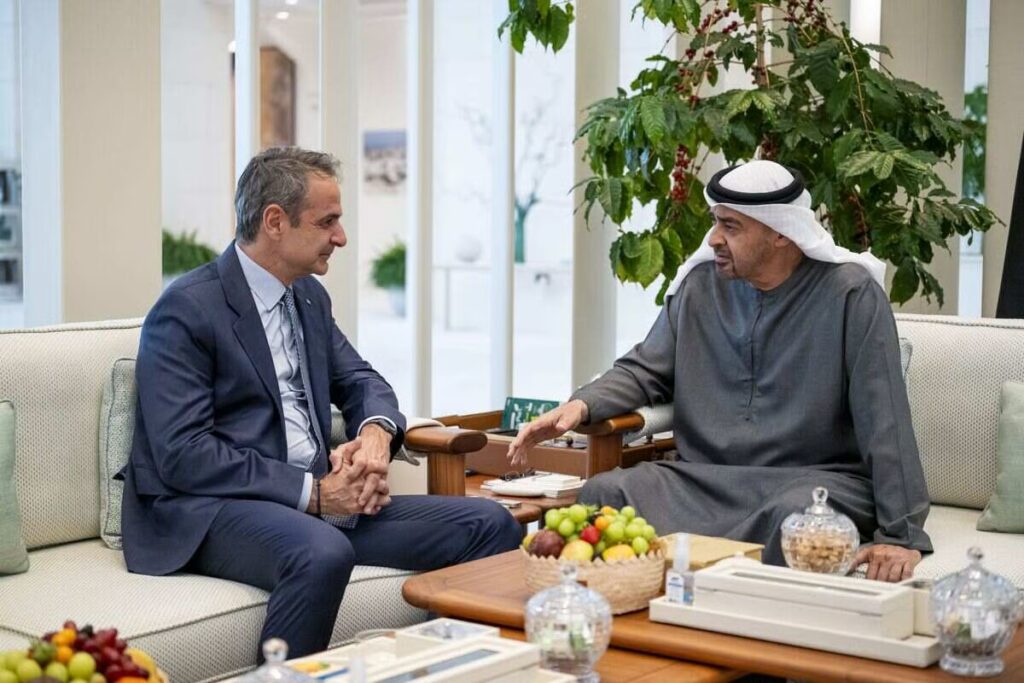
The United Arab Emirates and Greece are pushing their relationship into a more practical phase, with investment, artificial intelligence, energy and infrastructure sitting near the centre of the conversation.
UAE President His Highness Sheikh Mohamed bin Zayed Al Nahyan received Greek Prime Minister Kyriakos Mitsotakis in Abu Dhabi during a working visit on May 5, 2026. Their meeting focused on expanding the Comprehensive Strategic Partnership between the two countries and identifying areas where cooperation could lead to actual economic growth.
This was not simply another diplomatic meeting built around broad promises. Both governments are looking at sectors where capital, technology and long-term policy interests already overlap.
UAE and Greece Put Economic Cooperation at the Centre
The two leaders reviewed opportunities to deepen cooperation across the economy, investment, technology, artificial intelligence, renewable energy, sustainability, infrastructure and culture.
That is a fairly wide list, but it reflects how the UAE-Greece relationship has developed. The partnership now stretches well beyond conventional trade. It includes investment platforms, clean-energy projects, advanced industries and growing links between companies in the two markets.
For UAE-based businesses, the direction matters. Greece offers access to the European Union, an established maritime economy and a strategic location connecting Europe with the Eastern Mediterranean. The UAE brings investment capacity, global logistics networks and experience in building fast-moving sectors around technology and energy.
Put those strengths together and the commercial logic becomes clearer.
Artificial Intelligence and Technology Enter the Partnership
Artificial intelligence appeared among the sectors discussed by the two leaders, showing how quickly AI has become part of the UAE’s international economic relationships.
The UAE is building partnerships around AI infrastructure, digital services, advanced computing and new technology investment. Greece, meanwhile, is working to grow its digital economy and attract more international capital into technology-led projects.
Cooperation could eventually take several forms. Joint investments, research partnerships, digital infrastructure projects and business expansion between UAE and Greek technology companies are all possible. No major new AI agreement was announced during the meeting, but the subject now sits firmly inside the wider strategic relationship.
That opens another route for companies operating from UAE free zones, particularly those involved in software, cloud services, AI development, cybersecurity and digital consulting.
Renewable Energy Remains a Natural Area for Growth
Energy cooperation has already created a strong connection between the UAE and Greece.
Masdar, the UAE’s clean-energy company, has previously worked with Greek partners on renewable projects, including initiatives linked to the Greek islands. At COP28 in Dubai, Greece presented the island of Poros as part of its GR-eco Islands programme in cooperation with Masdar.
The latest talks suggest that renewable energy and sustainability will remain important parts of the partnership.
Greece has considerable potential in solar, wind and offshore energy. The UAE has capital, project-development experience and companies looking for international clean-energy opportunities. Unlike some areas of diplomatic cooperation, this one already has a visible commercial base.
Future projects could involve energy infrastructure, electricity networks, storage systems and technology used to manage renewable power.
Investment Links Could Create Opportunities for UAE Businesses
The partnership may also help companies in the UAE explore Greece as a base for European expansion.
Businesses registered in UAE free zones often look beyond the domestic market. Greece can offer access to European customers, shipping routes, tourism demand and regional infrastructure projects. UAE companies working in logistics, construction, financial services, hospitality, energy and technology may find the market increasingly relevant.
Greek businesses could also use the UAE as a platform for reaching customers across the Gulf, Asia and Africa.
The UAE’s free-zone ecosystem may play a practical role here. Free zones provide sector-focused business communities, international ownership structures and access to regional transport and logistics networks. Greek companies entering the Gulf could use those platforms to establish regional operations without building everything from scratch.
Nothing in the leaders’ meeting amounted to a new free-zone policy or dedicated incentive programme. Still, stronger government-level ties usually make private-sector conversations easier. They create confidence. They bring trade missions, investment forums and institutional partnerships behind them.
Partnership Has Expanded Since 2020
The UAE and Greece formally elevated their relationship through a Comprehensive Strategic Partnership in 2020. At the time, both countries described it as covering not only economic cooperation but also foreign policy, security and defence.
Further agreements followed in areas including advanced industries, technology, security and investment. By 2022, both governments were already describing the partnership as having gained new momentum through a broader collection of memoranda of understanding.
The relationship has continued through regular meetings, official visits and phone discussions between the two leaders. During the May 2026 meeting, they also noted that the UAE and Greece were marking 50 years of diplomatic relations.
Five decades is useful symbolism. The more important point, though, is what happens next.
Regional Stability Also Featured in the Talks
The meeting was not limited to trade and investment. Sheikh Mohamed bin Zayed and Mitsotakis also discussed regional and international developments.
The Greek prime minister reiterated Greece’s support for the UAE and stressed the importance of diplomacy, sustainable peace and regional security.
Economic partnerships do not operate separately from regional conditions. Shipping, energy markets, tourism and cross-border investment all depend on a reasonable level of stability. Greece and the UAE both sit near major trade corridors, making security and economic policy difficult to separate.
That connection explains why regional diplomacy continues to appear alongside investment and technology in their bilateral talks.
What the UAE-Greece Partnership Means for Companies
The immediate outcome of the meeting was political alignment rather than a single headline agreement.
Still, the sectors placed on the table tell businesses where future activity may emerge: AI, renewable energy, infrastructure, investment, advanced technology and sustainability.
Companies should watch for follow-up announcements involving sovereign investors, government agencies, energy developers and private-sector groups. Business councils, investment delegations and joint projects are likely to provide the clearest evidence of how the partnership develops.
For companies operating in UAE free zones, the relationship adds another European market worth tracking. Greece offers more than tourism and shipping. It is becoming part of a wider investment corridor connecting UAE capital and technology ambitions with European infrastructure, clean energy and digital growth.
The diplomatic language may sound familiar. The commercial direction does not.
Sources
- Economy Middle East – UAE President and Greek Prime Minister discuss advancing strategic partnership
- Emirates News Agency – UAE President receives Greek Prime Minister
- Prime Minister of Greece – Meeting with the UAE President in Abu Dhabi
- Prime Minister of Greece – UAE-Greece Comprehensive Strategic Partnership
- Emirates News Agency – UAE and Greece agreements and memoranda of understanding