


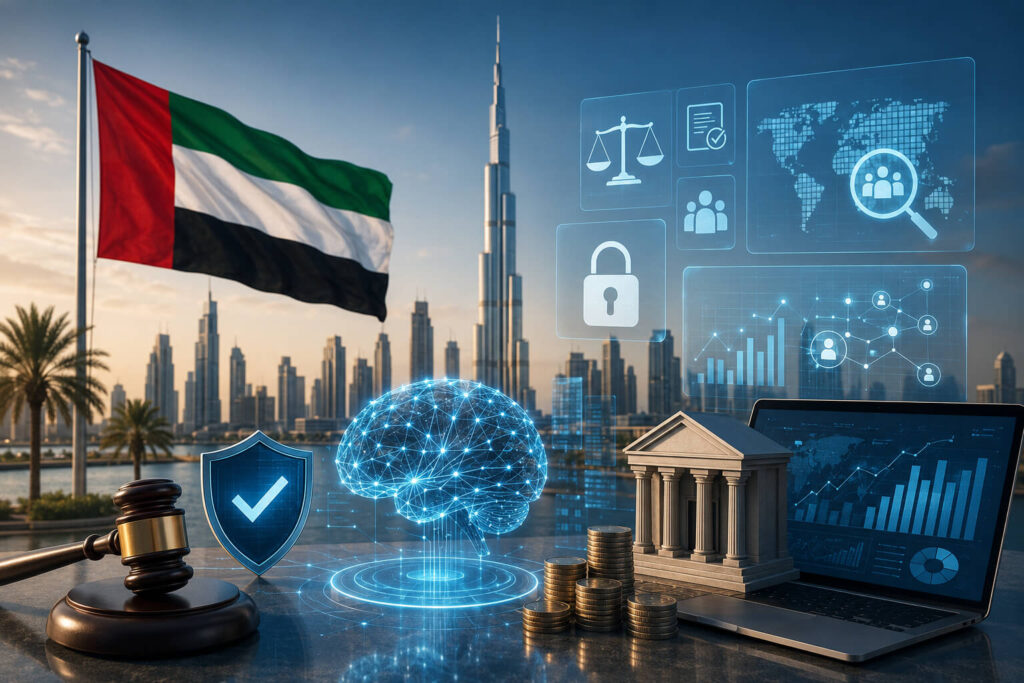
The UAE is tightening the machinery behind its business environment.
Artificial intelligence, anti-money laundering controls, corporate governance, commodity price monitoring and equipment financing may look like separate policy areas. The UAE’s Economic Integration Committee is treating them as connected pieces of the same economic system.
During its latest meeting, the committee reviewed national initiatives designed to modernise economic regulation while making the market safer and easier to navigate for companies, investors and consumers.
The meeting was chaired by Abdulla bin Touq Al Marri, UAE Minister of Economy and Tourism, with directors general from economic development departments across the Emirates taking part.
AI Is Moving Into the UAE’s Regulatory System
The UAE is not limiting artificial intelligence to private-sector experiments or new digital products. It is bringing AI directly into the way economic legislation, policies and indicators are developed.
Bin Touq said the country has launched an AI-powered regulatory ecosystem alongside the National Programme for Developing the Statistics System. The aim is to give policymakers better information, improve economic readiness and help the government respond more quickly to new industries and business models.
That could have practical consequences.
Regulation often struggles to keep pace with technology. A new financial service, digital platform or ownership model may develop long before the rules surrounding it become clear. An AI-supported regulatory system could help authorities study economic data, identify gaps and prepare legislation before those gaps become larger problems.
The bigger ambition is already visible. The UAE wants to become a global leader in proactive legislation for emerging economic sectors under the We the UAE 2031 vision.
This is not simply about writing more rules. It is about shortening the distance between economic change and the government’s response to it.
AML Controls Remain Part of the Business Strategy
The committee also examined initiatives intended to strengthen the UAE’s legislative framework for combating money laundering and the financing of terrorism.
AML compliance can sometimes be viewed as a burden sitting outside normal business activity. The UAE is framing it differently. Stronger controls support investor confidence, protect the country’s financial reputation and reduce the risks attached to operating in fast-growing markets.
For free zone companies, financial institutions and designated non-financial businesses, that direction matters. Regulators increasingly expect companies to understand who they are dealing with, identify beneficial owners, monitor unusual transactions and maintain reliable internal records.
Loose compliance may make business faster for a while. It rarely makes it safer.
By aligning economic authorities across federal and local levels, the committee wants to reduce fragmented procedures and strengthen the consistency of enforcement across the Emirates.
Corporate Governance Comes Under Review
Corporate governance was another central part of the meeting.
The committee discussed frameworks that could help UAE companies conduct a wider range of economic activities more efficiently. It also considered how government services and procedures can better serve businesses, investors and other stakeholders.
Governance sounds technical until something goes wrong.
Clear responsibilities for directors, managers and shareholders can reduce disputes and make decision-making easier to trace. Investors also tend to place greater trust in companies that maintain transparent reporting, defined approval processes and proper oversight of senior management.
This becomes especially important in free zones, where companies may have founders, shareholders, customers and suppliers spread across several countries.
The committee did not announce specific corporate governance amendments or a timetable for new requirements. The discussion nevertheless signals that procedural efficiency and corporate accountability will continue to develop together.
UAE Steps Up Commodity Price Monitoring
The UAE is also building a more coordinated system for monitoring essential commodity prices.
A specialised team made up of representatives from the Ministry of Economy and Tourism, economic development departments and other national entities is developing an integrated price-monitoring framework. It will use transparent criteria, clearly defined standards and market data to assess price movements.
This work is partly about consumer protection. It is also about supply-chain stability.
Sudden price changes can point to shortages, distribution problems, international disruptions or questionable market behaviour. Better data gives authorities a chance to spot those signals earlier instead of reacting after costs have already climbed.
The committee said regular market oversight and proactive measures would help maintain the availability of essential goods, protect supply chains and preserve consumer confidence.
Non-Bank Finance Leasing Could Help SMEs Buy Equipment
One of the more immediate business developments involved finance leasing.
The Ministry of Economy and Tourism presented proposals concerning finance lease activities offered by legal entities that do not fall under the regulation of the Central Bank of the UAE.
Finance leasing allows a business to use equipment over an agreed period without paying the full purchase price upfront. That difference can be significant for a small company trying to preserve working capital.
A logistics operator may need another truck. A clinic may require expensive diagnostic equipment. A manufacturer could be ready to add a production line but unwilling to drain its cash reserves in one purchase.
Leasing creates another route.
Assets identified as potentially suitable for these arrangements include trucks, aircraft, IT systems, medical and industrial equipment, production lines, and equipment used in construction and energy projects.
The government believes a clearer framework could diversify financing options for SMEs while attracting international leasing companies to the UAE.
It could also support sectors where equipment costs remain one of the biggest barriers to expansion, including healthcare, logistics, manufacturing and technology.
What This Means for UAE Free Zone Companies
For businesses operating in UAE free zones, the policy direction is fairly clear.
The country wants a market that is easier to enter but harder to misuse.
Companies could gain from faster digital government services, clearer corporate procedures and more flexible ways to finance business assets. At the same time, they should expect closer attention to ownership transparency, financial records, governance and AML compliance.
Free zone businesses considering finance leasing will still need to review the exact licensing, contractual and regulatory requirements that apply to their activities. The committee’s meeting introduced the policy direction, not a universal leasing programme available immediately to every company.
Still, the pieces are beginning to fit together.
AI may help the government develop rules more quickly. Better statistics can improve economic decisions. AML controls protect market credibility. Finance leasing gives companies another way to grow without tying up large amounts of capital.
It is a broad regulatory agenda, perhaps deliberately so. The UAE is trying to build the infrastructure of a modern business hub rather than fixing one isolated problem at a time.