


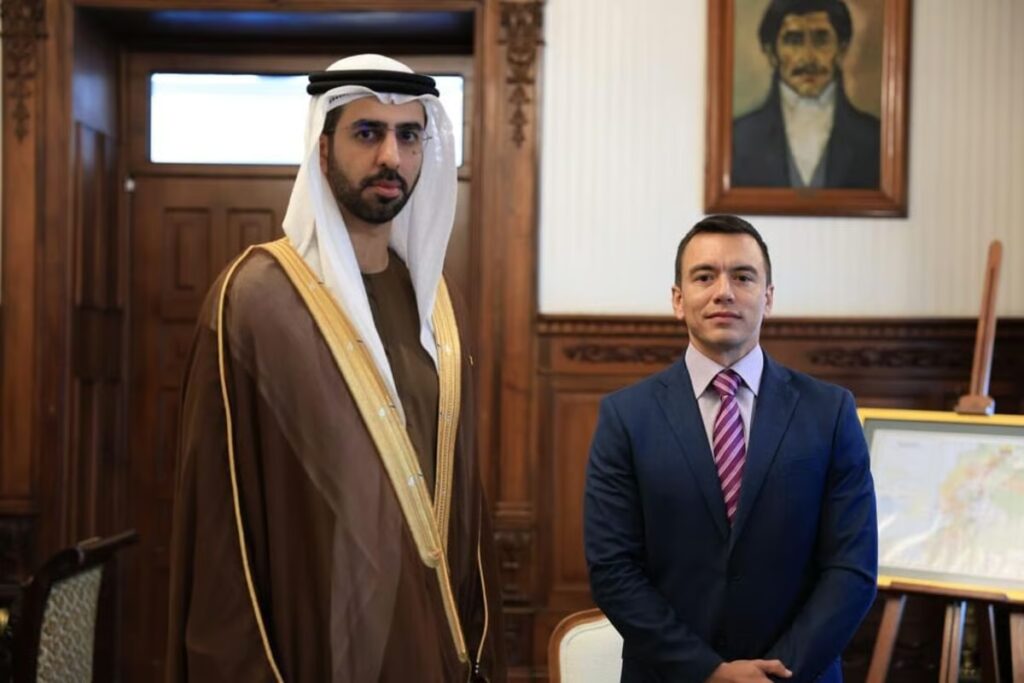
The UAE and Ecuador are moving into a much more ambitious phase of their economic relationship. The newly announced Comprehensive Economic Partnership Agreement puts trade, investment and private-sector cooperation firmly at the centre of the partnership.
The UAE–Ecuador CEPA was formally announced in March 2026 during the visit of Sheikh Khaled bin Mohamed bin Zayed Al Nahyan, Crown Prince of Abu Dhabi, to Ecuador. It follows several years of steadily expanding commercial ties between the two countries. Moreover, it arrives at a point when both governments are looking well beyond traditional bilateral trade.
For companies operating from the UAE, particularly businesses using the country as a regional trading and logistics base, the agreement could also open an interesting route into Latin America.
UAE–Ecuador Trade Has Already Been Growing
The CEPA is not starting from scratch. Non-oil trade between the UAE and Ecuador reached $373.6 million in 2025, up 3.2% from 2024 and more than three times the level recorded in 2019, according to the UAE Ministry of Foreign Trade. The UAE has also become Ecuador’s largest trading partner across the Arab world and Africa. In fact, it accounts for around 30% of Ecuador’s total trade with countries in those regions.
That is a fairly significant position for a relationship that, until recently, attracted much less attention than the UAE’s established commercial links with Asia, Europe or North America. Ecuador brings something different to the table: agricultural production, natural resources and a strategic location on South America’s Pacific coast. The UAE, meanwhile, offers logistics infrastructure, capital and access to a much wider commercial network.
More Than 96% of Goods Could See Lower or Zero Tariffs
One of the biggest practical changes under the UAE–Ecuador CEPA will be tariff treatment.
The agreement is designed to eliminate or reduce customs duties on more than 96% of traded goods and products. That should make it easier for exporters in both countries to compete on price. In addition, this will remove some of the friction involved in moving products between the two markets.
For UAE-based traders, this matters beyond direct exports to Ecuador. Businesses frequently use UAE free zones to consolidate, re-export, process and distribute goods across several markets. A stronger trade framework with Ecuador gives those companies another potential sourcing and distribution corridor. Particularly, this applies to food products, agricultural commodities, industrial materials and higher-value manufactured goods.
Investment Opportunities Stretch Well Beyond Trade
The deal is also being framed as an investment agreement rather than simply a tariff-cutting exercise.
More than $3 billion worth of potential investments have been under discussion between the two countries, according to announcements made around the CEPA. Priority areas include clean and renewable energy, agriculture, advanced technology, logistics and other sectors linked to economic diversification.
Renewable energy looks especially relevant. So does logistics. The UAE has spent years building international port, shipping and supply-chain networks. In contrast, Ecuador offers direct Pacific access and connections to wider Latin American markets.
Agriculture and food production could develop just as quickly. Food security remains a strategic priority for the UAE. This makes relationships with agricultural producers in markets such as Ecuador commercially important rather than merely diplomatic.
Technology, AI and Advanced Industries Enter the Picture
Some of the newer areas of cooperation are less obvious.
The two countries have identified artificial intelligence, advanced manufacturing, mining, education, tourism, hospitality and technology among the industries that could benefit from the CEPA. Renewable energy, agriculture, logistics and food production remain important. However, the scope is clearly wider.
Technology cooperation had already started taking shape before the trade agreement was announced. During earlier bilateral discussions, the UAE and Ecuador explored greater collaboration around AI, digital innovation and cybersecurity. UAE-backed initiatives have also included AI and prompt-engineering training for young Ecuadorians.
That gives the relationship a slightly different character. It is not simply Ecuador exporting agricultural goods while the UAE supplies capital. Both governments appear to be building something broader around investment, skills, technology and infrastructure.
Ecuador Gets a Gateway to the UAE and Wider Markets
For Ecuadorian companies, the UAE offers considerably more than a domestic consumer market.
Dubai and the wider UAE can function as a distribution base into the GCC, Middle East, Asia, Africa and parts of Europe. The UAE Ministry of Foreign Trade has specifically described the CEPA as a trade and investment corridor. This corridor can help Ecuadorian businesses expand into Asian, Middle Eastern and European markets.
Ecuador has also opened a trade office in Dubai to support cooperation with companies and the private sector. That physical presence could make the agreement more practical for exporters rather than leaving it as another government-to-government framework.
The same logic works in reverse. UAE companies looking for a stronger foothold in South America gain another market from which to explore regional opportunities.
Why UAE Free Zone Businesses Should Pay Attention
There is an obvious free zone angle here.
UAE free zone companies involved in international trading, food distribution, logistics, technology services, manufacturing, commodities or renewable energy could find new commercial routes emerging as the agreement is implemented.
Lower tariffs may improve the economics of importing Ecuadorian products into the UAE. Easier market access could help UAE exporters move goods in the other direction. Logistics businesses may gain from increasing volumes between the Gulf and Latin America.
Then there are companies that do neither. A business established in a UAE free zone may simply use the Emirates as its headquarters for investing into Ecuador or servicing clients there.
That is often where CEPAs become more useful than the headline numbers suggest. They influence where companies establish regional offices and which ports they use. In addition, they affect how supply chains are structured and where investors begin looking for their next project.
Investment Protection Adds Another Layer
The two countries have also signed an Investment Promotion and Protection Agreement. According to the UAE Ministry of Foreign Trade, the framework is intended to create a more transparent and stable environment for foreign direct investment. It includes measures related to investment risks, intellectual property protection and dispute resolution.
For businesses considering long-term projects rather than straightforward imports and exports, that layer matters.
A renewable energy project, agricultural investment, logistics facility or technology venture requires far more certainty than a single shipment. Clearer investment protections can make those decisions easier to take. This is particularly true when companies are entering a market for the first time.
UAE Continues Expanding Its CEPA Network
The Ecuador agreement also fits into a much larger UAE trade strategy.
The country has steadily expanded its network of Comprehensive Economic Partnership Agreements as it looks to increase non-oil trade, attract foreign investment and strengthen its role as a global logistics and business hub. The UAE Ministry of Foreign Trade now describes trade agreements, trade facilitation, export growth and global partnerships as core elements of its international trade agenda.
Latin America is becoming a more visible part of that strategy.
For UAE-based companies, that creates a growing network of markets where tariff reductions and improved commercial rules may eventually make cross-border business easier. Ecuador is the latest piece of that network — and potentially an important one for companies looking toward the Pacific side of South America.
The agreement still has to prove itself through actual trade flows, projects and private-sector activity. But with tariffs covering more than 96% of goods set for elimination or reduction and billions of dollars in potential investment already being discussed, there is considerably more behind this partnership than diplomatic ceremony.
Sources
- Economy Middle East — UAE and Ecuador deepen strategic ties as CEPA opens new trade and investment opportunities
- UAE Ministry of Foreign Trade — UAE accounts for 30% of Ecuador’s trade with Arab, African countries
- Abu Dhabi Media Office — Crown Prince of Abu Dhabi and President of Ecuador announce CEPA
- UAE Ministry of Foreign Affairs — UAE and Ecuador joint statement
- ARN News Centre — UAE and Ecuador announce CEPA signing and investment pipeline