


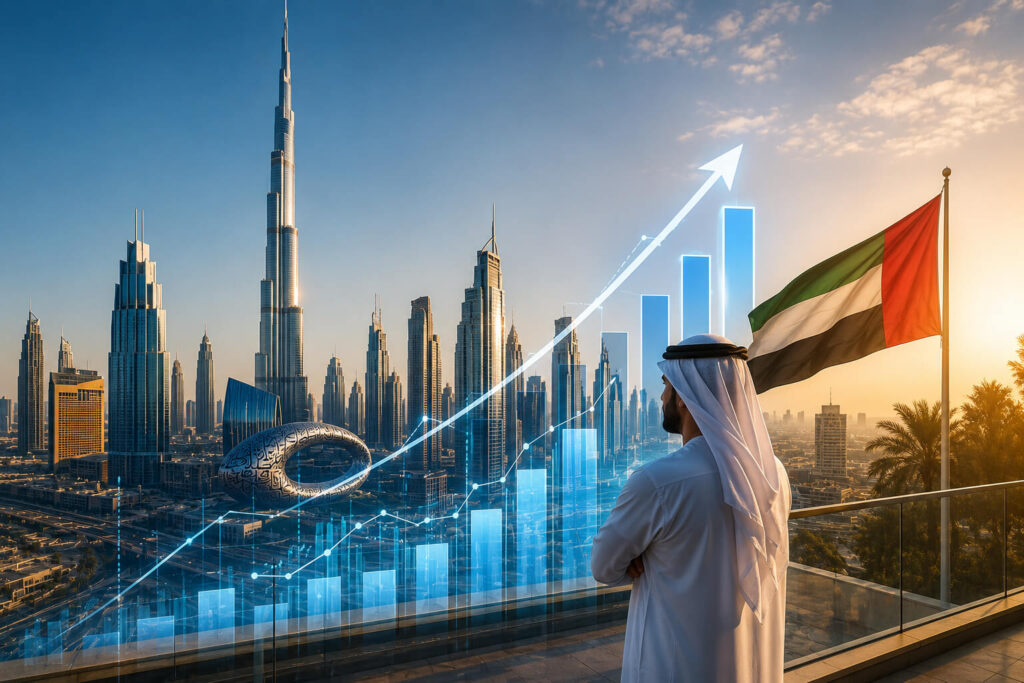
UAE Business Leaders Are Still Looking Ahead
Confidence among UAE businesses has not disappeared despite a more complicated global economic picture. Mastercard research cited by Economy Middle East found that 74% of UAE business decision-makers remain confident about the year ahead, with growth continuing to sit high on the corporate agenda.
That matters because companies are making plans against a backdrop that is hardly straightforward. Costs, shifting customer expectations and rapid technological change are all part of the equation. Yet the mood among UAE decision-makers remains broadly positive. Rather than retreating, many businesses appear to be looking for the next practical route to expansion.
The sentiment also fits a longer-running pattern in the UAE. Mastercard’s 2023 SME Confidence Index found that 74% of UAE SMEs were optimistic about the year ahead, while 80% expected revenues to either remain stable or grow.
Growth Is Still the Main Conversation
For businesses operating in the UAE, growth can mean several things at once. It might involve entering another market, investing in technology, expanding a team or simply finding a more efficient way to reach customers.
That appetite has remained visible even when companies have become more selective about spending. Separate research reported by Khaleej Times found that 67% of UAE business leaders were “very confident” about their organisation’s growth prospects for the remainder of 2024 and into 2025. Increased demand, new business opportunities and improving economic conditions were among the reasons behind that confidence.
There is caution in the market, certainly. But caution is not the same as pessimism.
Digital Transformation Keeps Moving Up the Agenda
Technology is no longer being treated as an optional upgrade. Digital payments, automation, data tools and online customer experiences increasingly sit inside day-to-day business strategy.
Mastercard’s earlier research across the Middle East and Africa found that SMEs viewed digitalisation as an important part of staying competitive. Businesses were looking at better data, access to credit, digital capabilities and employee skills as possible routes to future growth.
For companies establishing themselves in UAE free zones, that shift is particularly relevant. Many free zone businesses are young, internationally focused or built around services that can be delivered digitally. A lean company entering the UAE today can operate very differently from one entering the market a decade ago.
The infrastructure around it has changed too.
UAE Free Zones Sit Close to This Growth Story
Strong business confidence has obvious implications for the UAE’s free zone sector.
Entrepreneurs and international companies often use free zones as an entry point into the UAE because they provide dedicated business environments, licensing structures and access to commercial ecosystems covering industries from technology and professional services to logistics, media and e-commerce.
When companies are confident enough to pursue expansion, the question quickly becomes where that growth will happen.
For some, that may mean adding a UAE operation. For others, it could mean using an existing free zone company to pursue customers elsewhere in the Gulf, hire additional talent or introduce a new product line.
It isn’t simply about registering more companies. The more interesting story is what those companies do after incorporation.
Expansion Does Not Mean Businesses Are Ignoring Risk
The upbeat numbers shouldn’t be read as businesses expecting an easy year.
Companies have been dealing with international uncertainty, cost pressures and competition for skilled employees. In a 2024 survey of 100 senior UAE business decision-makers, 63% of companies still planned to increase headcount over the following 12 months, although some businesses were delaying recruitment decisions because of global uncertainty and interest-rate concerns.
That creates a slightly unusual business climate: firms want growth, but many want it on tighter terms.
Investments have to make sense. Hiring has to solve a real problem. Technology has to produce something useful rather than simply tick an innovation box.
That may actually favour the UAE’s free zone model, particularly for businesses looking for flexible structures while testing a new market or building a regional operation.
Confidence Is Broader Than One Survey
Other research has pointed in a similar direction. CNN International Commercial’s Business Decision Makers’ Mindset study surveyed nearly 2,000 senior decision-makers across 14 markets, including the UAE. Globally, 81% said they were confident about delivering revenue growth over the coming year, while digital transformation was a top objective for the same proportion of respondents.
Middle East respondents were even more bullish in the regional findings. Research covering senior business leaders in the UAE and Saudi Arabia found 92% were confident about delivering revenue growth, with digital transformation, global talent, market expansion and sustainability among the priorities receiving attention.
The numbers vary depending on the survey and the businesses questioned. The direction is harder to miss.
Companies still want to grow.
What It Means for the UAE Free Zone Market
For UAE free zones, sustained business confidence could translate into continued demand from startups, SMEs and established international companies looking for a regional base.
The opportunity is no longer based purely on attracting businesses with a licence. Companies increasingly expect digital processes, straightforward administration, access to banking and payment services, suitable office options and an ecosystem that can actually help them operate.
That raises the bar for free zones themselves.
As businesses become more sophisticated, competition between jurisdictions is likely to revolve around what happens after the licence is issued: how quickly a company can become operational, connect with customers, hire people and start generating revenue.
The latest confidence figures are encouraging. Perhaps the more important signal, though, is that UAE businesses haven’t stopped thinking about expansion even while keeping a closer eye on risk.
Growth is still on the table. Businesses are simply being more deliberate about how they get there.
Sources
- Economy Middle East — 74% of UAE business decision-makers remain confident about the year ahead as growth remains a top priority
- Mastercard Newsroom — Mastercard SME Confidence Index – UAE and MENA business outlook
- CNN International Commercial — The Business Decision Makers’ Mindset
- Khaleej Times — UAE companies and business growth prospects