
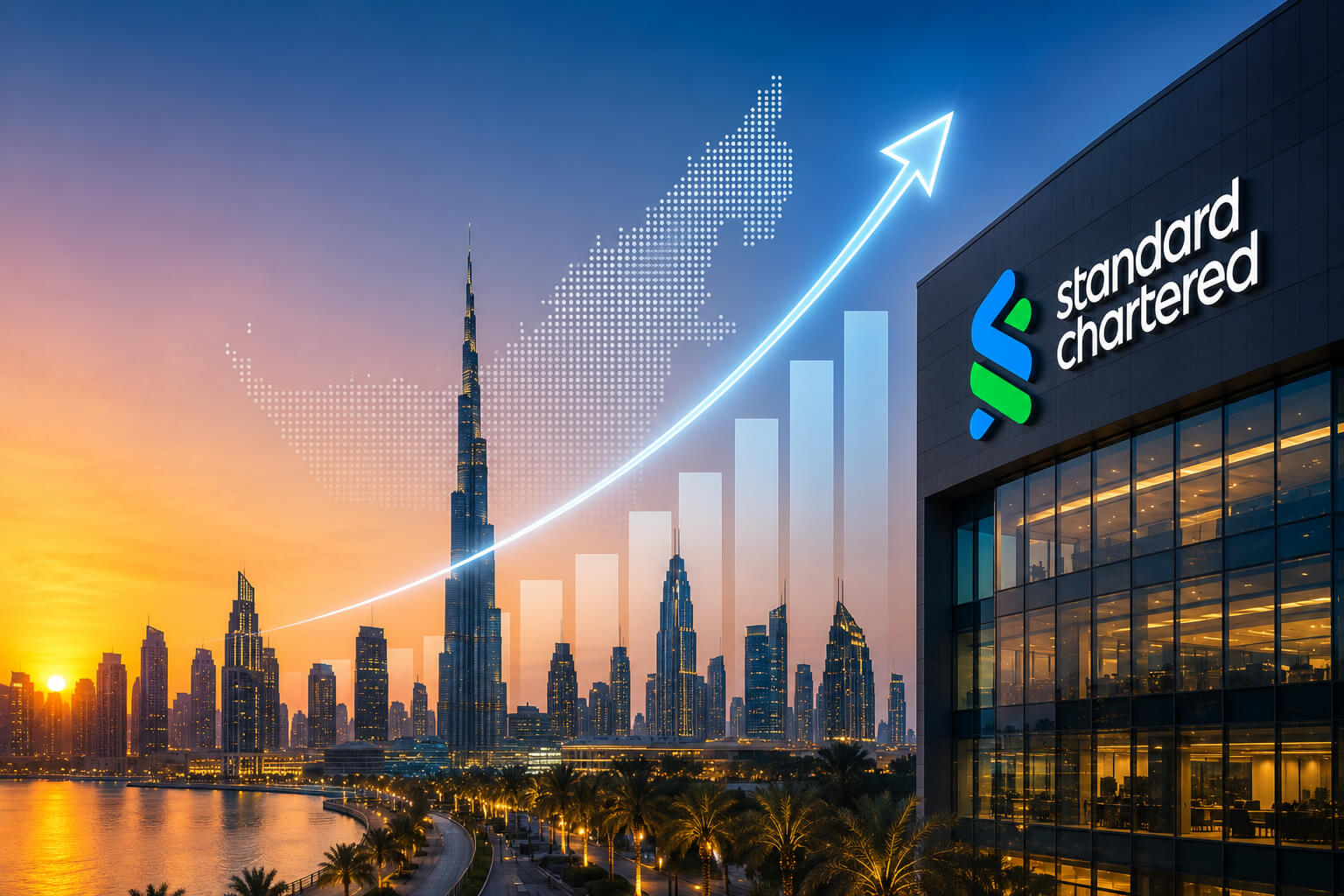
The UAE economy is not slowing down quietly. At least, that is the view coming from Standard Chartered, which expects business activity in the country to accelerate during the third quarter of 2026. In fact, many analysts are closely watching UAE business activity Q3 2026 as a key indicator of economic trends in the region.
The bank’s latest economic analysis points to continued strength in the UAE’s private sector, especially across non-oil activity. That matters. For years, the country has been working to deepen its position beyond energy, and the latest data suggests that shift is still holding firm.
UAE Non-Oil Economy Continues to Expand
Standard Chartered said the UAE’s June S&P Global Purchasing Managers’ Index stayed above the 50 mark, which signals expansion in business activity. For companies operating in free zones, trade hubs, logistics, services, real estate, finance, and technology, that is a useful signal.
It does not mean every sector is booming at the same speed. Economies rarely move that neatly. But it does show that private sector activity is still moving in the right direction.
The UAE’s non-oil growth appears to be supported by two familiar forces: domestic consumption and investment. People are still spending. Businesses are still putting money into expansion. Capital is still finding reasons to stay active in the country.
Why This Matters for UAE Free Zones
For UAE free zones, stronger business activity is more than an economic headline. It can translate into higher company formation interest, more office and warehouse demand, stronger licensing activity, and a better environment for foreign investors looking for a Middle East base.
Free zones already sit at the center of the UAE’s trade and investment story. They attract companies that want tax efficiency, easier market access, 100% foreign ownership in many cases, and proximity to regional and global trade routes.
So when business activity improves, free zones are often among the first places where that momentum becomes visible.
A startup looking to enter the Gulf. A logistics company expanding into Dubai or Abu Dhabi. A consulting firm targeting regional clients. A manufacturer using the UAE as a re-export base. These are the types of moves that become more likely when confidence improves.
Domestic Demand Is Doing Heavy Lifting
One of the more important parts of Standard Chartered’s view is the role of domestic consumption.
This is not just about exports or international capital flows. The UAE’s internal demand picture is helping support growth. That includes consumer spending, private sector investment, infrastructure-linked activity, and business services.
For free zone companies, this is a good sign. Many firms enter the UAE not only to serve the local market, but also to reach the wider GCC, Africa, South Asia, and Europe. A stronger domestic base gives those businesses a more stable launchpad.
Trade Flows Could Add More Support
Standard Chartered also expects the external sector to recover gradually as regional trade flows normalize.
That part deserves attention. The UAE is built around movement: goods, capital, people, services, and ideas. Dubai, Abu Dhabi, Sharjah, and other emirates have developed free zones and logistics corridors around that basic reality.
When regional trade flows improve, the benefits can spread across ports, customs services, warehousing, freight forwarding, aviation, e-commerce, fintech, and professional services.
Not every company will feel the effect immediately. But for trade-facing free zones, even a gradual recovery can make a difference.
A Resilient Private Sector Despite Uncertainty
Rola Abu Manneh, Standard Chartered’s Chief Executive Officer for UAE, Middle East and Pakistan, said the latest PMI reading reinforces the resilience of the UAE’s non-oil economy and private sector activity during a period of regional uncertainty.
That resilience is the bigger story here.
The region has faced pressure from geopolitical risks, shifting global demand, interest rate uncertainty, and changing investor appetite. Still, the UAE has kept positioning itself as a business hub that can absorb shocks better than many markets around it.
That is part of why companies continue to look at UAE free zones as a practical entry point. Not perfect. Not risk-free. But flexible, connected, and commercially active.
Outlook for Q3 2026
The third quarter of 2026 could bring stronger momentum for UAE business activity if the current trends hold.
Non-oil expansion remains the main driver. Domestic consumption is still supporting demand. Investment activity has not disappeared. External trade may slowly improve as regional flows normalize.
For investors, entrepreneurs, and companies considering UAE free zone setup, the message is fairly clear: the UAE’s business environment remains active, and the non-oil economy continues to offer room for growth.
The next question is not whether the UAE wants to become a bigger global business hub. That part is already obvious.
The question is how much more activity its free zones can capture as the economy moves into the second half of 2026.
