


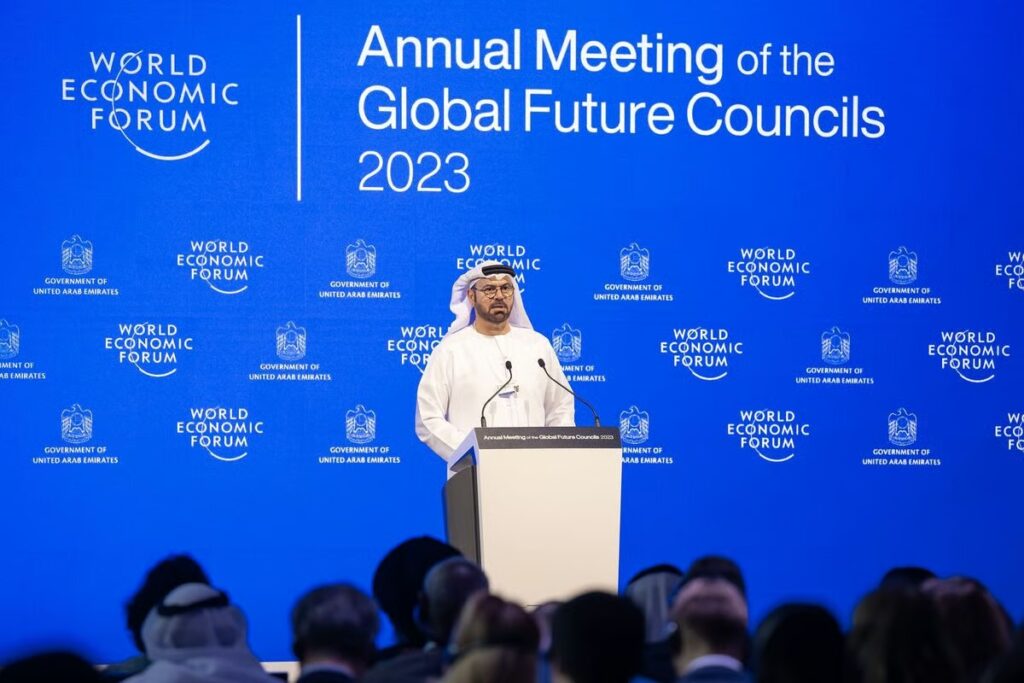
The UAE and the World Economic Forum are set to bring the Annual Meeting of Global Future Leaders to Dubai, placing the city once again at the center of high-level conversations on the future of economies, governments, technology, and global cooperation.
The meeting is listed by the World Economic Forum for October 13 to 16, 2026, in Dubai, United Arab Emirates. It follows a wider pattern that has become familiar in the UAE: bring decision-makers into the same room, push the discussion beyond routine policy language, and turn future-facing ideas into something more practical.
For Dubai, this is not really a surprise anymore. The emirate has spent years building itself into a meeting point for government leaders, investors, entrepreneurs, futurists, regulators, and global institutions. Still, the Global Future Leaders gathering carries a different weight. It is not just another conference on the calendar. It is tied to the question of who shapes the next phase of global development, and who gets left reacting to it.
A UAE-WEF Partnership That Keeps Expanding
The UAE’s relationship with the World Economic Forum has grown into one of its most visible international knowledge partnerships. In January 2026, the UAE Government and WEF launched a new phase of their strategic partnership, including an agreement for Dubai to host the Global Future Councils annual meetings for the next five years.
That matters because these gatherings are not built around one sector only. They sit across public policy, business, technology, society, climate, health, governance, and economic transformation. The UAE has been using these platforms to position itself as a country that does not only attend global conversations, but hosts and helps organize them.
There is a soft-power angle here, of course. But there is also a business angle. For free zones, investors, digital companies, consulting firms, fintech players, AI startups, and policy-focused organizations, events like this can strengthen Dubai’s role as a base for regional and global decision-making.
Why This Matters for the UAE Economy
Dubai’s event calendar is already crowded, but this one fits into a much larger economic story. The UAE is trying to build an economy where talent, capital, regulation, and innovation move together. Not perfectly. Not always smoothly. But deliberately.
Hosting a global future leaders meeting supports that direction. It gives the UAE another platform to bring international institutions, private-sector leaders, government officials, and emerging decision-makers into its ecosystem. That has knock-on effects for business confidence, investment visibility, and the country’s broader positioning as a place where future industries can be tested, scaled, and regulated.
For free zones, this is especially relevant. The UAE’s free zone model has always depended on openness, sector specialization, and international connectivity. When Dubai hosts global policy and leadership events, it adds another layer to that value proposition. Companies are not only setting up in a tax-efficient or business-friendly jurisdiction. They are entering a market where global conversations are happening close by.
From Conferences to Policy Influence
The more interesting part is not the event branding. It is the influence that comes after the panels, meetings, and closed-door discussions.
The UAE has already hosted major WEF-linked gatherings, including the Annual Meetings of the Global Future Councils and Cybersecurity 2025 in Dubai, which brought together more than 700 experts and specialists from 93 countries. That 2025 edition focused on themes including technology, economy, society, environment, governance, and health.
That is the kind of format where ideas can move quickly from theory into policy language. A discussion on AI governance can become a regulatory pilot. A debate on digital trade can influence investment thinking. A conversation on cybersecurity can feed into national resilience planning. Nothing happens overnight, but these meetings create the rooms where future agendas start to take shape.
Dubai’s Role as a Global Meeting Point
Dubai has become very good at one thing: making global gatherings feel operational rather than symbolic. The city has the venues, aviation links, hospitality capacity, free zone infrastructure, and government coordination needed to host events at scale.
That is why the Annual Meeting of Global Future Leaders feels like a natural fit. The UAE is not presenting itself only as a regional hub anymore. It is presenting itself as a place where global leadership networks can meet, debate, and build practical pathways for the next decade.
There is also a generational element. “Future leaders” is not just a polished phrase. Governments and companies are under pressure to prepare younger leaders for a world shaped by AI, energy transition, geopolitical uncertainty, new trade patterns, and faster technological disruption. Dubai wants to be part of that leadership pipeline.
A Signal to Investors and Free Zone Companies
For businesses operating in UAE free zones, the event adds to the country’s broader message: the UAE wants to be close to the future economy, not watching it from a distance.
That can matter for sectors such as artificial intelligence, fintech, cybersecurity, sustainability, logistics, digital health, education technology, and advanced manufacturing. These industries do not grow only through capital. They grow through regulation, partnerships, talent mobility, and access to decision-makers.
Events like the Global Future Leaders meeting help create that environment. They attract people who influence policy and investment. Global organizations also gain more reasons to come to Dubai. For local and international firms, these events strengthen the UAE’s position as a serious base for long-term expansion.
The Bigger Picture
The Annual Meeting of Global Future Leaders will arrive at a time when countries are competing not only for investment, but for relevance. The next phase of economic growth will be shaped by who can attract talent, build trusted institutions, regulate emerging technologies, and connect public and private sectors without slowing everything down.
The UAE clearly wants to be one of those countries.
By hosting the meeting in Dubai, the UAE and WEF are extending a partnership that has already made the country a regular home for future-focused global dialogue. For the Emirates’ business community, especially companies inside free zones, the event is another reminder that Dubai’s value is no longer just about location. It is about access, visibility, and proximity to the conversations shaping what comes next.