


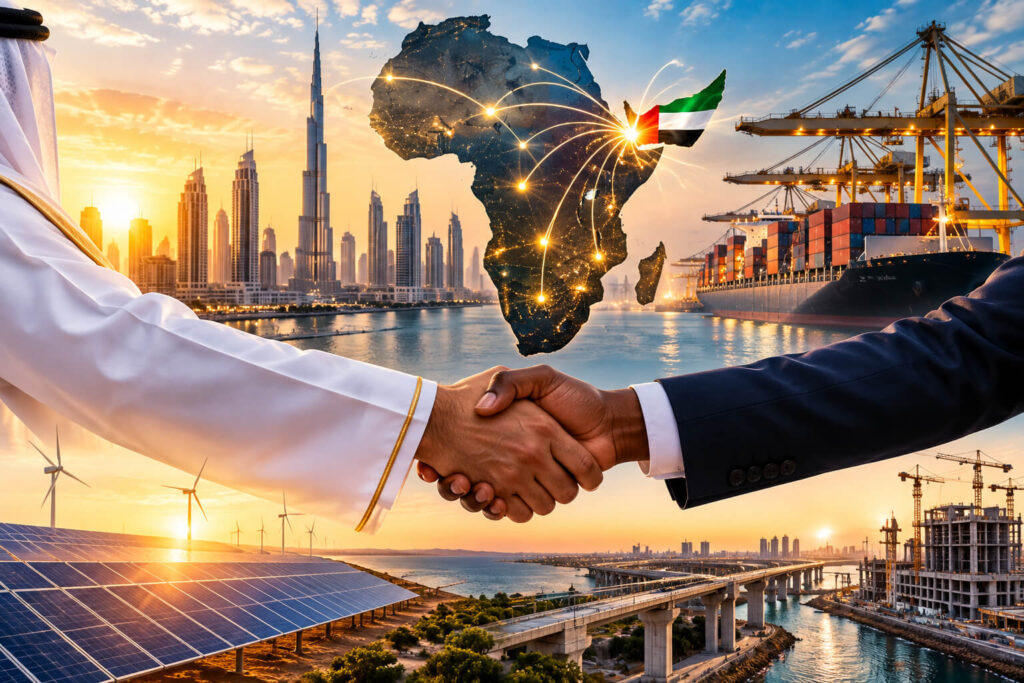
The UAE’s economic relationship with Africa is moving well beyond traditional trade. Investment is flowing into ports, renewable energy, industrial zones, logistics networks and digital infrastructure, creating a broader commercial bridge between the Emirates and some of Africa’s fastest-growing markets.
That relationship was highlighted by Sheikh Shakhboot Nahyan Al Nahyan, UAE Minister of State at the Ministry of Foreign Affairs, who described the UAE’s engagement with Africa as a long-term partnership built around investment, development and shared economic opportunity.
For companies operating from the UAE, including businesses based in free zones, this growing connection matters. Stronger trade corridors between the Emirates and Africa could open new routes into manufacturing, logistics, energy, commodities, technology and consumer markets.
UAE–Africa Trade Is Becoming Harder to Ignore
Commercial ties between the UAE and Africa have grown quickly. UAE non-oil trade with Sub-Saharan Africa surpassed USD 126 billion in 2025, representing a 45% increase compared with the previous year, according to figures cited by the Emirates News Agency. More than 30,000 African companies have also established a presence in the UAE.
Those figures point to a relationship that is becoming increasingly business-driven. The UAE is positioning itself as a gateway connecting African companies with markets across the Middle East, Asia and beyond, while African economies are giving UAE investors access to rapidly expanding consumer and industrial markets.
The UAE’s aviation network, ports, logistics infrastructure and free zone ecosystem strengthen that connection. Companies entering the region can use the Emirates as a base for distribution, financing, trade and international expansion without building every part of that infrastructure independently.
Nine CEPAs Strengthen the UAE’s African Trade Network
Trade agreements are becoming another important part of the UAE’s growing presence in Africa. The UAE has signed nine Comprehensive Economic Partnership Agreements with African countries, creating broader frameworks for trade, investment, services and market access.
For businesses, these agreements can reduce barriers and improve access to new markets. UAE-based exporters, manufacturers and service providers may find it easier to enter African economies, while African companies can use the UAE as a regional hub for expansion into the Gulf and other international markets.
The impact could be especially significant for businesses operating from UAE free zones. Companies involved in logistics, professional services, manufacturing, digital technology and wholesale trade may benefit from easier cross-border movement and stronger commercial links.
Ports and Logistics Are Building the Physical Connection
Some of the most visible signs of UAE–Africa cooperation are emerging through ports and logistics infrastructure. In Senegal, DP World has invested in the Port of Ndayane and the Dakar Container Terminal, helping expand trade capacity in one of West Africa’s important commercial gateways.
AD Ports Group has also expanded its presence across Africa, including investments in port and logistics infrastructure in Angola and the Republic of the Congo. These projects are designed to strengthen cargo movement, supply chains and access to international markets.
Kenya is another example. DP World and GulfCap Africa are developing the 222-hectare Mombasa Industrial Park, a special economic zone intended to attract investment, support manufacturing and improve regional trade connectivity.
For UAE companies, these projects create more than infrastructure. They build direct commercial links between African production centres and logistics hubs in the Emirates, making it easier to move goods between markets.
Renewable Energy Is Taking a Bigger Share of UAE Investment
Renewable energy has become one of the strongest pillars of UAE investment across Africa. UAE companies are developing solar projects, energy infrastructure and clean-power initiatives across several countries.
AMEA Power developed the Sheikh Mohamed Bin Zayed Solar Plant in Togo, while Global South Utilities developed the 50MW Sakaï solar project in the Central African Republic. UAE-supported solar facilities in the Comoros are also helping expand access to renewable electricity through generation, storage and transmission infrastructure.
Masdar has announced a USD 10 billion clean energy programme, while the UAE’s Etihad 7 initiative aims to expand access to clean electricity for as many as 100 million people by 2035.
These projects also have a wider economic effect. Reliable energy supports manufacturing, industrial development, data infrastructure, agriculture and urban growth, meaning renewable investment can help unlock activity across several other sectors.
More Than USD 110 Billion Committed Across Africa
Between 2019 and 2023, more than USD 110 billion was committed to projects across Africa, according to figures cited by WAM. Around USD 70 billion of that amount was directed toward renewable energy and green sectors.
The wider investment footprint stretches across mining, food security, logistics, infrastructure, industrial development and energy. This broad mix shows that UAE investment in Africa is not focused on a single industry.
In Zambia, International Resources Holding invested in Mopani Copper Mines with the aim of increasing production while supporting employment and local value creation. The project reflects a wider UAE interest in strategic commodities and industrial supply chains.
For free zone companies operating in commodities, logistics or industrial services, this type of investment can create new commercial opportunities tied to sourcing, transportation and downstream processing.
AI Is Joining the UAE–Africa Investment Story
Artificial intelligence is now becoming part of the UAE’s wider economic engagement with Africa. In November 2025, the UAE announced a USD 1 billion AI for Development initiative aimed at supporting digital transformation and innovation.
That investment places technology alongside energy, logistics and infrastructure as a growing area of cooperation. African markets are rapidly expanding digital services, particularly in financial technology, healthcare, agriculture, education and public services.
UAE-based AI companies and technology firms could find opportunities in these areas as governments and businesses across Africa invest in automation, data systems and digital platforms.
Free zones focused on technology, innovation and digital business may also become useful bases for companies targeting African markets, particularly as the UAE continues building its own AI ecosystem.
Water and Food Security Add Another Dimension
Water security is another major part of the UAE’s engagement with Africa. The UAE provided more than USD 1 billion in foreign assistance to Africa between 2023 and 2024, while the Mohamed bin Zayed Water Initiative is supporting technologies and solutions aimed at addressing water scarcity.
The issue will gain further attention when the UAE and Senegal co-host the 2026 UN Water Conference in Abu Dhabi in December. The event will focus on Sustainable Development Goal 6 and wider challenges related to water access and resource management.
Water security also has direct economic importance. It affects agriculture, food production, energy, industry and urban development, all of which are sectors where UAE companies are increasingly active.
For investors, water infrastructure can therefore become part of a broader commercial strategy rather than a standalone development issue.
What Growing UAE–Africa Links Mean for Free Zone Businesses
The expanding relationship between the UAE and Africa creates new possibilities for companies operating from the Emirates. UAE free zones already provide international investors with access to logistics networks, business services and regional markets, and stronger African trade links could add another layer to that advantage.
Exporters may gain access to new distribution markets, while logistics companies could benefit from higher cargo flows between Africa and the Gulf. Manufacturers may find opportunities in industrial zones and supply chains, while technology firms could explore demand linked to digital transformation.
Renewable energy companies, engineering firms and infrastructure specialists may also benefit as large-scale development projects continue across the continent.
The opportunities will vary by country, as regulations, taxation and licensing requirements differ across African markets. Still, the broader direction is becoming clear: commercial ties between the UAE and Africa are getting deeper and more structured.
UAE–Africa Partnership Moves Into Its Next Phase
The UAE’s relationship with Africa is increasingly visible through real assets, trade agreements and long-term investment programmes. Ports, industrial parks, renewable energy projects, mines and digital initiatives are creating a more connected commercial network between the two regions.
For the UAE, Africa offers large consumer markets, infrastructure demand and long-term investment potential. For African economies, the Emirates provide capital, logistics expertise, technology and access to international trade routes.
UAE free zones are likely to remain part of that relationship. As trade barriers fall and physical infrastructure improves, the Emirates can continue serving as a launchpad for companies moving between Africa, the Gulf and wider global markets.
Sources
Emirates News Agency (WAM) — UAE–Africa: Building a Shared Future Through Partnership and Investment
https://www.wam.ae/en/article/17fvc8h-uae%E2%80%93africa-building-shared-future-through
UAE Ministry of Foreign Affairs
https://www.mofa.gov.ae/