

For most of their history, free zones were a highly effective but fairly blunt instrument. Lower taxes, simplified licensing, a ring-fenced regulatory environment, and the ability to own your business outright in a market that would otherwise require a local partner. JAFZA opened in 1985 and largely set the template. The pitch was clear, and it worked.
But a pitch built around reducing friction is only durable if the world around it stays simple, and the world stopped being simple some time ago.
When the old model hit its limits
Between 2020 and 2022, something changed in the way boardrooms think about supply chains, achieving a breakthrough that a decade of consultant reports had failed to achieve. Three things happened in quick succession: a pandemic froze production networks globally, a single container ship blocked the Suez Canal for six days, costing an estimated $9.6 billion in trade per day, and a semiconductor shortage shut down car factories from Stuttgart to Sunderland. The vulnerability that had been discussed in theoretical terms became entirely, expensively real.
What emerged from that period was a sharper understanding of what companies require from a logistics jurisdiction. Not just ease of entry, but continuity of operation, the ability to keep moving goods when the world around you is not cooperating. A convenient address was never going to solve that problem. Infrastructure designed as an integrated operating environment might.
The most recent stress test is still live. Since March 2026, the Strait of Hormuz has been effectively closed following the escalation of the Iran conflict, with major carriers suspending transits and tanker traffic collapsing almost overnight. For the first time in modern history, both of the Middle East’s principal maritime corridors, the Strait and the Red Sea, are simultaneously disrupted.
The UAE’s response has been instructive: cargo has been rerouted through the east-coast ports of Khor Fakkan and Fujairah, with DP World and Abu Dhabi Ports coordinating onward transfers to Jebel Ali and Khalifa Port by truck and rail, while UAE Customs activated a Green Corridor through Oman for bonded transit. That kind of contingency involving activating alternative nodes, maintaining flow, absorbing a shock that would have paralysed a simpler logistics jurisdiction, is the product of infrastructure that was built with exactly this kind of scenario in mind.
McKinsey’s 2024 supply chain survey found that 60% of companies were actively pursuing dual-sourcing strategies and that regionalisation, the moving of parts of the supply chain closer to where decisions are made, had become a mainstream strategic priority, not just a contingency. That shift had to land somewhere. The UAE, and its free zones specifically, made a credible case for being that somewhere.
What the ecosystem shift looks like
The word ‘ecosystem’ gets used loosely, so it is worth being specific about what the evolution of UAE free zones involves, because it is more substantive than the marketing language usually suggests.
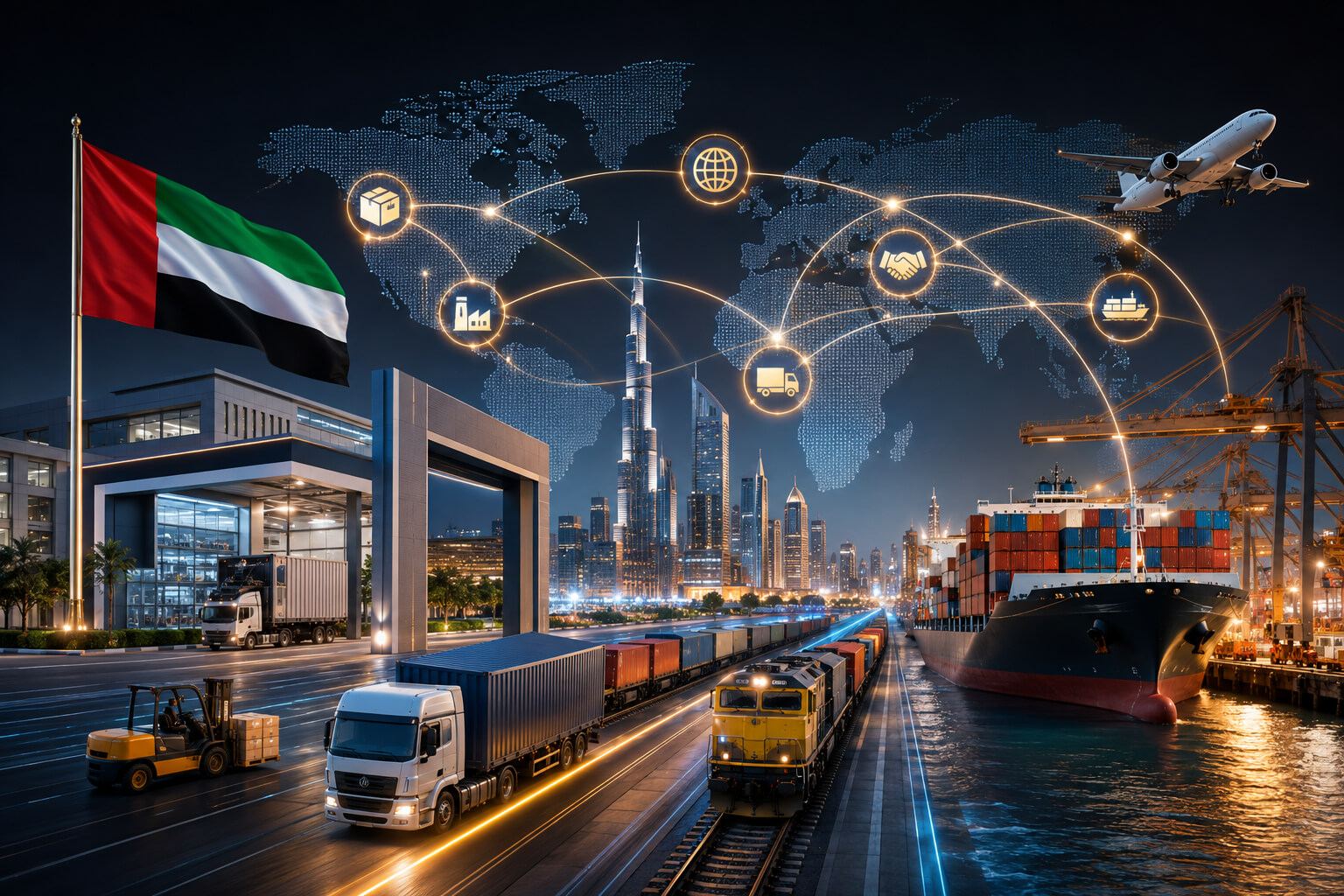
The first dimension is the integration of logistics, warehousing, light manufacturing, and governance under a single operational umbrella. This is not a matter of having a port near a free zone. It is the deliberate design of an environment in which goods can arrive, be processed, stored, manufactured into something else, and re-exported without ever encountering a seam between jurisdictions or regulatory regimes. JAFZA, operating within the broader DP World ecosystem at Jebel Ali, is the clearest expression of this. The port and the free zone are effectively one machine, and DP World’s deployment of AI-powered terminal management through its CARGOES TOS+ system, which learns daily operations and identifies inefficiencies in real time, is what that machine looks like when it is running well.
The second dimension is sector clustering as a deliberate strategic choice rather than organic proximity. DMCC’s depth in commodities trading, Khalifa Industrial Zone Abu Dhabi’s industrial anchors, Dubai Internet City’s concentration of technology firms represent a model in which the value of being inside the zone is partly determined by who else is inside it. Sector-specific clustering creates ecosystems of expertise, shared infrastructure, and commercial adjacency that a mixed-tenancy business park simply cannot replicate.
The third dimension, and the one that will define the next decade, is the embedding of data infrastructure and visibility into the operating environment itself. This is where the terminology shift from ‘trade gateway’ to ‘supply chain ecosystem’ becomes more than rhetorical. A gateway processes transactions. An ecosystem enables intelligence to see where goods are, anticipate where bottlenecks will form, and make decisions faster than disruption can propagate.
The fourth dimension is the financial and legal infrastructure embedded within the zone environment. The common-law framework of Dubai International Financial Centre, alongside its dispute resolution mechanisms, trade finance capabilities, and escrow services, allows companies to complete complex international transactions without operating across multiple jurisdictions. This creates a material operational advantage, particularly for emerging South-South trade corridors where legal and financial complexity has historically hindered execution.
The competitive implications
The way in which this evolution creates winners and losers among businesses is pretty straightforward. Companies that have treated free zones primarily as tax structures, optimising for the licensing package rather than the operational environment, are not getting the most from what is now on offer. The zones that are investing most heavily in ecosystem infrastructure are effectively pricing that investment into the long-term value proposition, not into the upfront cost. The gap between what a strategically minded occupant and a passively minded one extracts from the same free zone is widening.
Competition between the zones themselves is also intensifying. The UAE has over 40 free zones, and they no longer compete primarily on incentive packages. Instead, they compete on operational capability, sector depth, and the quality of the ecosystem they offer specific industries. This is a more demanding environment, and zones that fail to invest in differentiation will lose ground to those that do.
What this means for the region
The UAE’s free zone evolution is not occurring in isolation. It is coinciding with, and partly enabling, a significant reorientation of global trade flows. The disruption of traditional east-west corridors through the Red Sea crisis, the reconfiguration of Russia-linked routes following the Ukraine war, and the broader fracturing of the US-China trade relationship have pushed freight toward alternative pathways. Middle corridor volumes through Central Asia rose 86% year-on-year in 2023. South-South trade connections are scaling faster than they have in decades.
The Hormuz closure has also, painfully, stress-tested the argument in real time. Businesses with operations embedded in the UAE’s integrated port and free zone network have had routing options that those relying on single-corridor logistics did not. The disruption has made visible what the ecosystem model was built to deliver: not the absence of disruption, but the capacity to absorb it.
Allianz Trade’s 2025 analysis of next-generation trade hubs ranked the UAE first among multimodal logistics powerhouses, specifically citing Jebel Ali’s role in connecting Asia, the Middle East, and Europe. PwC’s analysis of emerging Middle East trade corridors, including the India-Middle East-Europe Economic Corridor, positions the UAE as critical connective tissue within a trade geography still being assembled. DP World and Abu Dhabi Ports have already secured port concessions across fifteen African countries. The infrastructure argument for the UAE as a Global South supply chain anchor is being built as we speak.
UNCTAD has noted that the disruption of traditional trade routes has made the digitisation and resilience of trade infrastructure more urgent, not less. The zones that have invested in data layers, multimodal connectivity, and embedded financial services are positioned to absorb that demand. Those that have not will find themselves competing on price in a market moving toward value.
Positioning for the future
The businesses that came through the supply chain disruptions of the early 2020s with relatively little damage were, for the most part, those that had already made structural decisions in areas such as dual sourcing, regional redundancy and operational visibility before those decisions became urgent. The current Hormuz crisis demonstrates this reality once again, even more starkly.
The UAE’s free zones are not passive beneficiaries of this shift. They are actively positioning for it through technology investment, sector deepening, and the construction of an ecosystem offer that was simply not available a decade ago. Any business thinking seriously about its regional footprint should choose a free zone based on the operating environment the supply chain will need when the next disruption arrives. The pattern of recent years makes one thing clear: there will always be another.
