


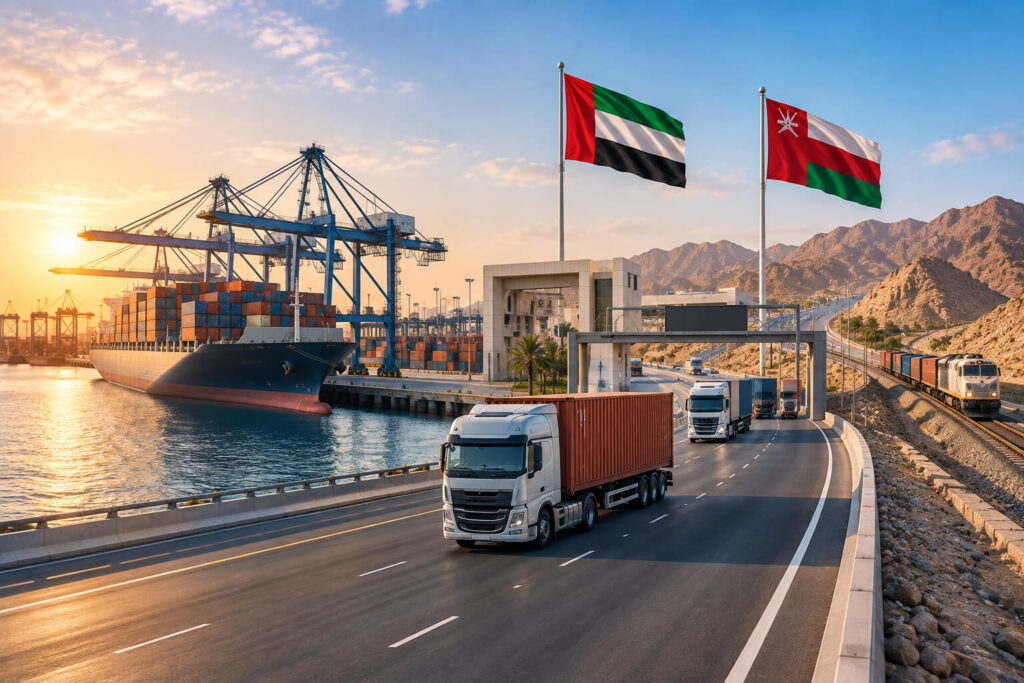
Sharjah’s trade connection with Oman is showing strong early momentum. The Sharjah–Oman logistics corridor handled around AED1.7 billion worth of cargo during its first three months, according to the Sharjah Ports, Customs and Free Zones Authority. Cargo value increased 66.26% compared with the corresponding period last year. Meanwhile, more than 34,000 truck movements and over 32,000 customs declarations were recorded during the same period.
Launched in May 2026 in cooperation with Oman Customs, the corridor links ports, border crossings and logistics hubs across the UAE and Oman. For companies operating in Sharjah and its free zones, the early numbers point to a growing alternative. This creates new potential for regional trade and cargo movement.
Sharjah–Oman Corridor Reaches AED1.7 Billion in Cargo
The corridor officially launched on 17 May 2026 as part of Sharjah’s effort to improve connectivity between its maritime infrastructure and land border crossings. During its first three months, cargo moving through the route reached around AED1.7 billion in value. Authorities also recorded more than 34,000 truck movements and processed over 32,000 customs declarations. In addition, the 66.26% increase in cargo value highlights how quickly businesses have started using the new route. Companies are relying on it for imports, exports and re-exports between the UAE and Oman.
More than 200 new importer codes were also registered during the opening period. That figure suggests the corridor is attracting new commercial users rather than simply shifting existing traffic from other routes.
Two Border Crossings Support the Logistics Network
The corridor operates through the Khatmat Malaha Border Crossing in Kalba and the Al Madam Border Crossing, giving logistics operators more than one entry and exit point depending on their cargo route. Khatmat Malaha sits roughly 70 kilometres from Sohar Port, making it particularly useful for shipments travelling through northern Oman. On the other hand, Al Madam provides another connection into the UAE’s wider road network.
The broader system links Sharjah and other UAE ports with major Omani ports including Sohar, Duqm and Salalah. By combining sea transport with land connections, the corridor gives companies more flexibility when planning cargo movement across the region.
Faster Customs Processing Supports Trade Flow
The Sharjah–Oman logistics corridor was built around more than physical infrastructure. Customs authorities on both sides introduced operating procedures designed to reduce unnecessary delays and simplify cargo movement between ports and border crossings.
The system includes fast-track shipment lanes, advance processing of customs data, direct transportation under customs supervision and real-time information exchange between relevant authorities. These measures are intended to shorten clearance times and reduce administrative friction. This benefits importers, exporters and logistics companies using the route.
Sharjah also introduced toll exemptions for qualifying cargo trucks arriving from Oman and travelling through approved routes within the corridor. Removing some road-related costs adds another incentive for businesses considering the route.
Cargo Mix Extends Across Several Industries
The corridor is already handling a broad range of goods, including vehicles, industrial equipment, food products, agricultural goods, construction materials and spare parts. That mix shows the route is not tied to a single industry or type of shipment.
Cargo moving through the corridor also serves markets beyond the UAE and Oman. According to WAM, shipments have supported the UAE domestic market as well as destinations in Saudi Arabia, Africa and Asia. This gives the corridor a wider role as a regional transit route. It is therefore more than simply a bilateral trade connection between two neighbouring countries.
Sharjah Free Zone Companies Could Benefit From More Route Choices
For businesses operating in Sharjah’s free zones, logistics costs and access to regional markets often play a major role in expansion decisions. A company importing through Oman, exporting from the UAE or re-exporting products into the GCC now has another transport route to consider.
The corridor also strengthens the connection between Sharjah’s free zones, ports and border infrastructure. Instead of depending on a single gateway, companies can select routes based on destination, transport costs and delivery timelines. That flexibility may become especially useful for manufacturers, wholesalers, distributors and e-commerce businesses handling cross-border shipments.
Sharjah Continues Building Its Logistics Infrastructure
The Oman corridor forms part of a much wider logistics strategy in Sharjah. The emirate is developing the Al Dhaid Logistics Complex, whose first phase covers more than 16 million square feet. In addition, it is expected to support an initial annual handling capacity of around 1.5 million TEUs.
Khorfakkan Port and other logistics assets are also being expanded as Sharjah works to connect ports, inland logistics facilities, free zones and border crossings. The strategy is increasingly focused on creating several connected trade gateways. Sharjah does not want to rely on individual ports in isolation.
For companies considering Sharjah as a regional base, this infrastructure expansion adds another layer to the emirate’s business proposition.
More Businesses Expected to Join the Corridor
Sharjah authorities have indicated that the next stage of the project will focus on bringing more businesses, shipping companies, logistics providers and shipping lines into the corridor. Additionally, additional services and transport routes are also expected to be developed as usage increases.
The long-term goal is to turn the corridor into a broader logistics platform connecting Sharjah with Oman and other regional markets. Strong early cargo figures provide a useful starting point. However, sustained adoption by logistics operators and trading companies will determine how significant the route becomes over time.
Sharjah Strengthens Its Position in UAE–Oman Trade
The Sharjah–Oman logistics corridor reflects a wider shift toward integrated transport systems across the Gulf. Ports remain essential, but companies increasingly need road, customs and logistics networks to work together. That is the only way to get faster and more predictable supply chains.
Sharjah is positioning the corridor as part of that connected model. By linking seaports, free zones, customs systems and land borders, the emirate is giving businesses more options. They have more opportunities for moving goods between the UAE, Oman and international markets.
The first three months have produced strong numbers. The next stage will show whether that momentum develops into long-term growth in regional cargo traffic.
Sources
Emirates News Agency (WAM): Sharjah–Oman logistics corridor records 66.26% rise in cargo value in first three months.
https://www.wam.ae/en/article/c2cbp67-sharjah%E2%80%93oman-logistics-corridor-records-6626-rise