


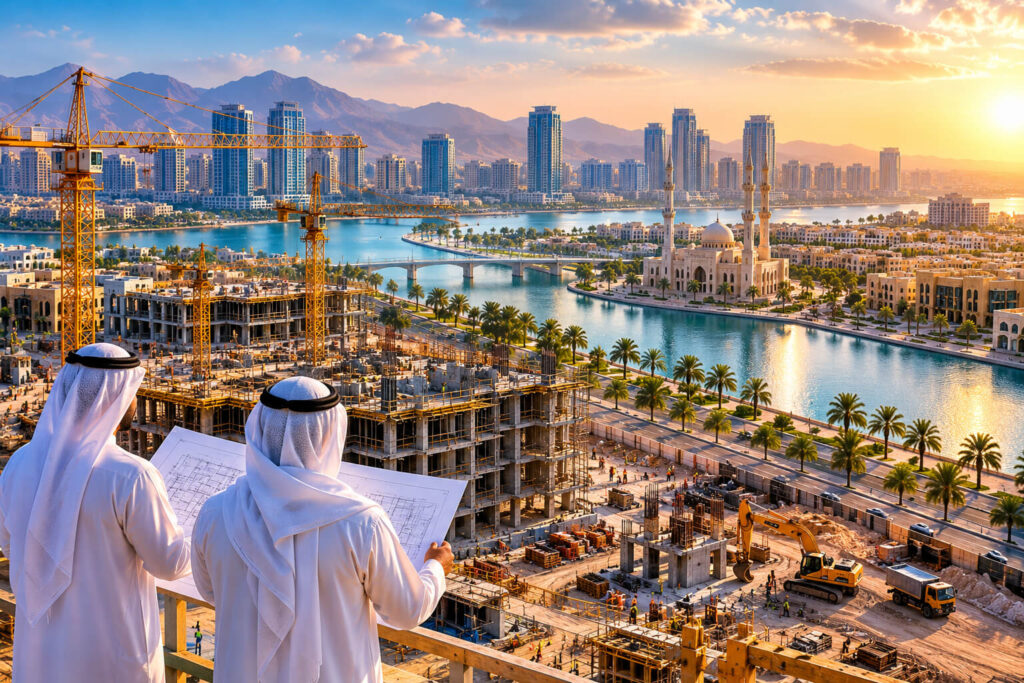
Sharjah is investing more than AED1.2 billion in development projects across its Eastern and Central regions in 2026, extending spending well beyond the emirate’s main urban centre.
The programme covers education, sports, government facilities, cultural projects, tourism infrastructure and public spaces. According to the Sharjah Department of Public Works, more than AED834 million is allocated to the Eastern Region, while investment in the Central Region exceeds AED386 million. The scale of the spending is significant, but its distribution is just as important.
Kalba Leads the Eastern Region’s Development Programme
Kalba accounts for the largest share of Sharjah’s Eastern Region investment, with projects worth around AED618 million. The spending covers several areas rather than a single large development, giving the programme a broad impact on education, government services, sports and community infrastructure.
The second phase of Victoria International School in Kalba, valued at AED184 million, has already been completed and handed over. Sharjah is also investing AED185 million in extensions to government buildings along the Kalba waterfront.
Sports infrastructure is another major component. A AED110 million sports complex at the University of Kalba is planned with two semi-Olympic swimming pools, training facilities, a football pitch and a running track.
Meanwhile, construction of the AED77 million Kalba Club for the Disabled is 76% complete. The AED38 million Rock Art Centre has reached 46% completion.
The result is a development programme that mixes public services with education, sport and cultural infrastructure.
Khorfakkan Expands Education and Public Facilities
Khorfakkan is receiving around AED188 million in development investment, with education accounting for a substantial part of the programme. The projects are designed to add capacity as the city continues to develop its residential and community infrastructure.
The second phase of Victoria International School Khorfakkan, worth AED140 million, has been completed and handed over. A new nursery in the Al Luluyah neighbourhood has also been completed.
Other projects remain under construction, including a civil defence centre and additional public facilities.
The investment adds another layer to Khorfakkan’s wider development story, where infrastructure, tourism and community facilities are developing alongside the city’s coastal economy.
Dibba Al Hisn Focuses on Community Infrastructure
Dibba Al Hisn is receiving more than AED29 million in projects aimed at strengthening community and recreational facilities. While the investment is smaller than the programmes in Kalba and Khorfakkan, it targets facilities that directly serve residents and visitors.
The programme includes a new nursery, waterfront amenities and facilities at the Sharjah Ladies Club beach park.
These projects are part of a wider approach to regional development in which public amenities are being expanded alongside larger infrastructure and economic projects.
Education Takes a Major Share of Central Region Investment
The Central Region is receiving more than AED386 million in development spending, with education representing one of the biggest areas of investment. The focus reflects Sharjah’s effort to expand institutional and community infrastructure as population and economic activity grow outside the main city.
Around AED312 million is allocated to education-related projects. One of the largest is Victoria International School Al Dhaid, valued at AED184 million.
The University of Al Dhaid is also receiving major facilities. An AED84 million theatre with capacity for up to 1,000 people is under development, alongside a new mosque valued at AED42 million.
Together, the projects strengthen the Central Region’s education and public-service infrastructure while adding facilities that can support the area’s longer-term growth.
Mleiha Adds Sports and Public Service Infrastructure
Development in the Central Region is not limited to schools and universities. Sports, emergency services, markets and public spaces are also included in Sharjah’s investment programme, giving the spending a wider community footprint.
An AED32 million equestrian club in Mleiha is under development. The facility will include stables for 40 horses, a racecourse and a training area.
The wider programme also includes a civil defence building in Al Bataeh and a camel market. More than AED25 million is being allocated to parks and green spaces across the Central Region.
It is a fairly broad mix of infrastructure, from emergency response facilities to recreation and community spaces.
Infrastructure Supports Sharjah’s Broader Economic Growth
Sharjah’s infrastructure spending comes as the emirate continues to attract investment into different sectors and locations. That makes public development increasingly important for areas outside the traditional commercial centre.
In 2025, Sharjah recorded 331 domestic and foreign investment projects worth AED12.8 billion, according to Invest in Sharjah. Those projects generated 11,898 jobs, while foreign direct investment projects accounted for AED7.74 billion in capital investment.
As new companies enter the emirate, infrastructure becomes part of the investment equation. Businesses need access to transport, skilled workers, schools, government services and commercial facilities. Residential communities need many of the same foundations.
That is where the current development programme becomes relevant to Sharjah’s wider economic ambitions.
What Sharjah’s Investment Means for Businesses
The impact of regional infrastructure investment is not confined to government facilities. New schools, public spaces, tourism assets and services can influence where workers live, where companies establish operations and where supporting businesses find new demand.
For businesses operating from Sharjah free zones, industrial areas and other commercial districts, regional population and infrastructure growth can create additional opportunities for logistics, professional services, retail, hospitality and other supporting sectors.
Sharjah has also been pursuing policies aimed at strengthening its investment environment and attracting more private-sector activity. Infrastructure development provides part of the physical foundation needed to support that strategy.
For investors, the important point is the geographic spread. Economic development is increasingly reaching communities across the emirate rather than remaining concentrated in Sharjah city.
Sharjah Continues Building Beyond the Main Urban Centre
The AED1.2 billion programme provides a snapshot of how Sharjah is approaching regional development in 2026. Kalba is receiving the largest Eastern Region allocation, while Khorfakkan continues expanding its education and public facilities. Dibba Al Hisn is adding community amenities, while the Central Region is receiving substantial investment in education, sports and public services.
Eng. Abdullah Al Tunaiji, Director of Branches at the Sharjah Department of Public Works, said the projects are part of efforts to expand public facilities in response to population growth and maintain the required standards for government infrastructure.
For Sharjah’s business community, the significance goes beyond the construction value.
Infrastructure changes the practical environment in which businesses operate. It can bring new residents, workers, services and commercial activity into areas that previously had less economic density.
That makes Sharjah’s regional development programme an important part of the emirate’s broader push to build a more distributed and connected economy.
Sources
- Emirates News Agency (WAM): Sharjah invests over AED1.2 billion in development projects across Eastern and Central regions
- Emirates News Agency (WAM): Sharjah records growth in investment projects
- Emirates News Agency (WAM): SEDD launches its 2026–2028 strategic plan