


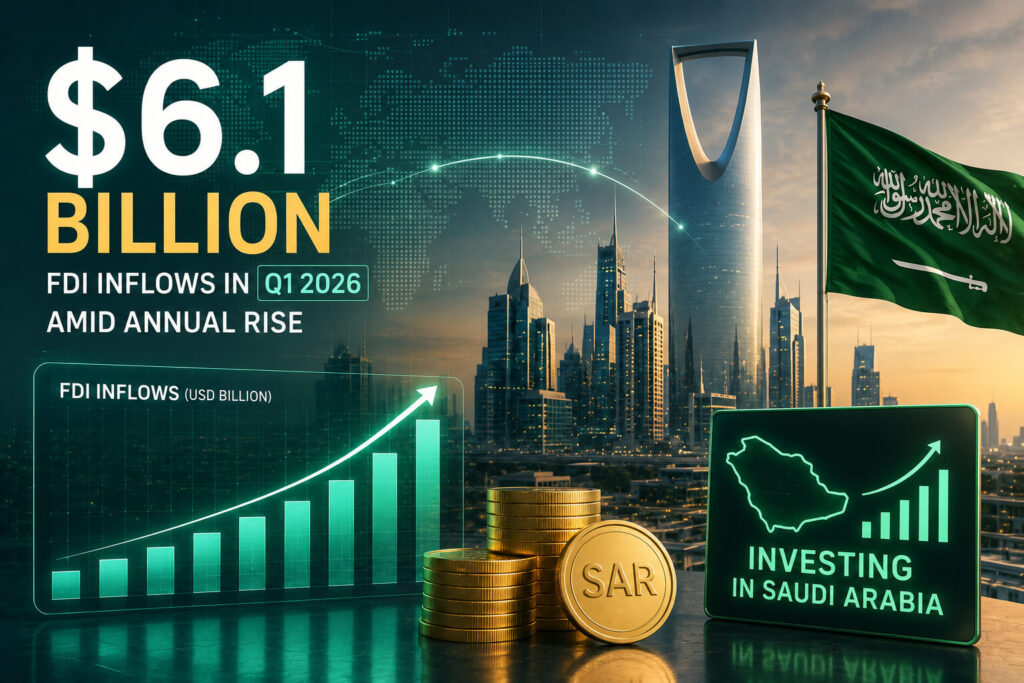
Saudi Arabia recorded $6.1 billion in foreign direct investment inflows in the first quarter of 2026, adding another signal that global investors are still watching the Kingdom closely. Not just watching, actually. Putting money in.
The figure matters because FDI is one of the clearest ways to read confidence in a market. Announcements are easy. Investor capital is harder. When foreign companies and institutions continue to place long-term money into an economy, it usually means they see more than a short-term opportunity.
For Saudi Arabia, this fits into a wider story that has been building for years. The Kingdom has been trying to move beyond oil dependence, open more sectors to private capital, attract global companies, and turn its big Vision 2030 plans into real business activity. Some parts are moving faster than others. Still, the direction is obvious.
Why the Q1 2026 FDI Number Matters
The Saudi Arabia FDI inflows figure for Q1 2026 is not just another quarterly data point. It shows that the Kingdom’s investment story has not gone quiet.
Foreign investors are looking at Saudi Arabia for several reasons. There is the scale of the domestic market. There is government spending. There are major projects. There is also the push into tourism, logistics, aviation, technology, advanced manufacturing, financial services, entertainment, and clean energy.
That mix is exactly what Saudi Arabia wants the world to notice. The country is not only selling itself as an oil economy anymore. It is trying to become a wider regional business platform.
And yes, that puts it in direct conversation with the UAE, especially Dubai and Abu Dhabi, where free zones, investor-friendly regulations, and global connectivity have shaped the region’s business map for decades.
A Bigger Gulf Investment Race
For Emirates Free Zone News, this Saudi FDI growth is worth watching because it sits inside a larger Gulf competition for capital.
The UAE has long been a magnet for foreign businesses through its free zones, tax advantages, logistics networks, and international lifestyle appeal. Saudi Arabia is now building its own version of that investment pull, but at a different scale and with different tools.
Riyadh is pushing headquarters relocation, sector-specific investment incentives, giga-projects, and reforms aimed at making the Kingdom easier to enter and operate in. It is not trying to copy the UAE exactly. It is trying to use its own market size as the hook.
That changes the regional investment conversation. Companies looking at the Gulf are no longer asking only where to set up. They are asking how to structure their presence across the UAE, Saudi Arabia, and the wider GCC.
Vision 2030 Still Needs Private Capital
Saudi Arabia’s Vision 2030 plan depends heavily on investment. Government spending can build momentum, but long-term transformation needs private capital, foreign expertise, multinational operators, and sector-level partnerships.
That is why FDI figures get so much attention. They show whether the outside world is buying into the Saudi growth story.
The Kingdom has made major moves to attract investors, from regulatory changes to sector openings and investment promotion campaigns. The challenge now is consistency. Investors want opportunity, but they also want clarity. They want scale, but they also want predictable rules. They want access, but they also want an operating environment that does not feel too complicated.
Saudi Arabia has made progress. The Q1 2026 inflow number suggests the market is still gaining traction.
What Investors Are Really Looking At
Behind the $6.1 billion figure is a more practical question: where is the money going?
Investors are not just chasing headlines. They are looking for sectors with real demand. Logistics is one. Tourism is another. Aviation, construction, mining, digital infrastructure, cloud services, fintech, renewable energy, and manufacturing are also part of the picture.
Saudi Arabia’s population, spending power, and national development pipeline give it a strong investment case. The country is building airports, destinations, cities, industrial zones, entertainment venues, and digital systems at the same time.
That creates opportunities. It also creates pressure.
The more ambitious the plan, the more important execution becomes. Investors will keep watching whether projects move on time, whether regulations remain stable, and whether private companies can make returns without being buried in complexity.
What This Means for UAE Free Zones
Saudi Arabia’s rising FDI does not weaken the UAE free zone story. It makes the regional picture more interesting.
Many companies will still choose UAE free zones for speed, ownership structures, global banking access, logistics, and regional management. Dubai, Abu Dhabi, Sharjah, Ras Al Khaimah, and other emirates have built strong investor ecosystems over many years.
But Saudi Arabia’s growth means companies may increasingly need a dual-market strategy. A UAE base for regional operations. A Saudi presence for market access. Maybe both. Maybe more.
This is where free zones can stay relevant by helping companies expand across the Gulf instead of thinking in one-country terms. The next wave of investment may not be about choosing UAE or Saudi Arabia. It may be about using the UAE as a launchpad while building serious commercial activity inside the Kingdom.
The Gulf Investment Story Is Getting Less Simple
The old Gulf business map was easier to describe. Dubai was the regional hub. Saudi Arabia was the big market. Abu Dhabi had capital and energy. Qatar had gas and high-value projects. Oman and Bahrain had their own strategic lanes.
Now the lines are blurrier.
Saudi Arabia wants to be a headquarters hub. The UAE wants to remain the region’s most flexible business platform. Abu Dhabi is pushing deeper into industry, AI, energy, and advanced technology. Free zones are competing harder. Investors have more options.
Saudi Arabia’s $6.1 billion FDI inflows in Q1 2026 show that this competition is not theoretical. Capital is moving. Companies are adjusting. Governments are trying to make their markets harder to ignore.
A Strong Signal, But Not the Whole Story
The Q1 2026 FDI figure is a positive sign for Saudi Arabia, but one quarter does not tell the whole story. Investment momentum has to be sustained. Projects have to convert into operating businesses. Reforms have to keep pace with investor expectations.
Still, the direction is clear enough.
Saudi Arabia is becoming a larger force in the Gulf investment landscape, and its ability to attract foreign capital will shape how companies plan their regional expansion. For UAE free zones, that is not a reason to panic. It is a reason to sharpen the offer.
Because the Gulf is no longer just competing for companies to arrive.
It is competing for where they stay, where they scale, and where they place their next serious investment.