


Ras Al Khaimah Economic Zone (RAKEZ) is putting greater attention on the emirate’s food and beverage manufacturing sector, highlighting its industrial infrastructure and business environment at the Future Food Summit 2026.
RAKEZ participated as a Silver Sponsor at the eighth edition of the summit, which brought together food manufacturers, investors, suppliers and other businesses from across the UAE’s food and beverage industry.
The event provided RAKEZ with an opportunity to present Ras Al Khaimah as a location for companies looking to establish manufacturing operations, expand production and build connections with regional markets.
RAKEZ Showcases Ras Al Khaimah as a Food Manufacturing Base
Ras Al Khaimah has been developing a broader industrial economy, and food manufacturing is becoming an increasingly visible part of that activity. At the Future Food Summit 2026, RAKEZ focused on the practical conditions that food and beverage companies need when establishing or expanding operations, including industrial facilities, business support and access to a wider manufacturing ecosystem.
RAKEZ Group CEO Ramy Jallad said the food and beverage sector remains an important contributor to the UAE’s industrial development. He also highlighted Ras Al Khaimah’s potential as a base for companies seeking to scale production and serve markets in the UAE and beyond.
The summit brought together businesses across different parts of the food value chain, giving RAKEZ an opportunity to connect directly with manufacturers, investors and industry stakeholders.
Sustainability Becomes Part of the Manufacturing Conversation
Sustainability is becoming a more practical issue for food manufacturers as companies examine energy consumption, water use, waste and the resources required to move products through increasingly complex supply chains. These pressures are pushing manufacturers to look beyond production output and consider how their facilities operate over the longer term.
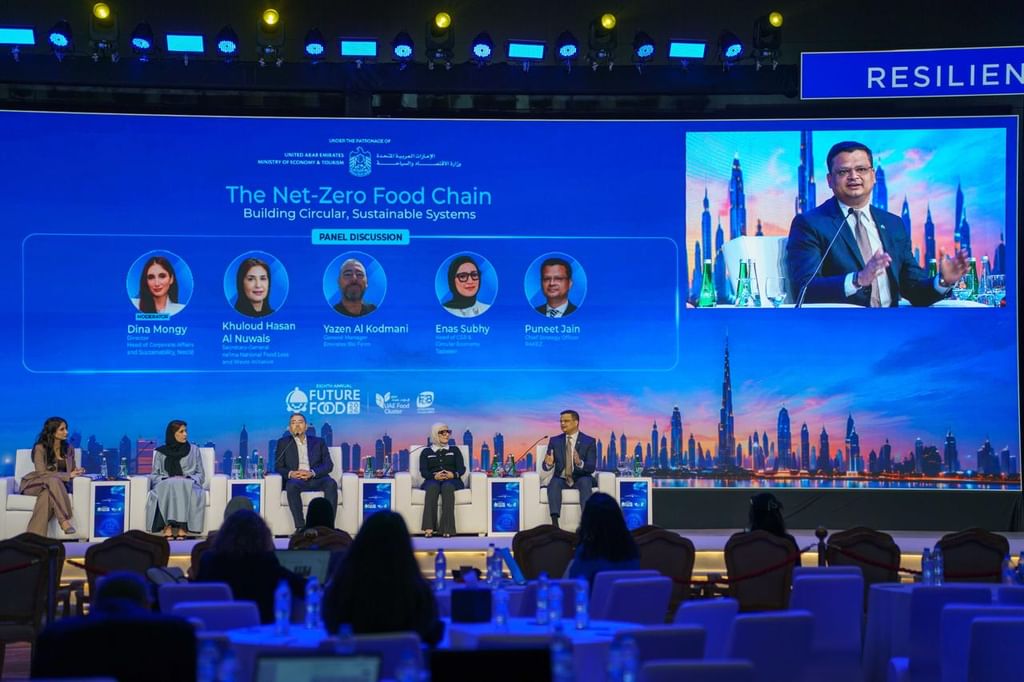
This issue featured prominently at the Future Food Summit, where Puneet Jain, Chief Strategy Officer at RAKEZ, joined a panel discussion titled “The Net-Zero Food Chain: Building Circular, Sustainable Systems.”
The discussion explored how food businesses can build more circular systems by reducing waste and making better use of resources. For industrial zones such as RAKEZ, this approach also creates opportunities for companies operating within the same ecosystem to collaborate on shared solutions.
Circular Systems Could Reshape Food Production
The idea of a circular food system goes beyond recycling finished packaging. It can involve recovering materials, reducing production waste, improving water efficiency and finding ways for resources from one industrial process to become useful inputs elsewhere.
That model is particularly relevant in manufacturing environments where several companies operate close to one another. Instead of treating every operation as an isolated facility, businesses can potentially share infrastructure, services and resource-recovery systems.
RAKEZ highlighted cleaner energy, water efficiency, waste management and resource recovery as areas where food manufacturers can pursue more sustainable operations while continuing to focus on commercial performance.
RAKEZ Builds a Wider Food and Beverage Ecosystem
Food manufacturing rarely depends on a single factory. Producers also need packaging, ingredients, equipment, transportation, warehousing and a range of professional and industrial services. A strong manufacturing location therefore needs to offer more than space for production.
RAKEZ has been developing an ecosystem that brings together companies from different parts of the food and beverage supply chain. The economic zone has previously highlighted a community of nearly 1,000 F&B companies, alongside a wider manufacturing base covering sectors such as packaging, construction, automotive and other industries.
For food manufacturers, that concentration can create opportunities to develop relationships with suppliers and supporting businesses without having to build every part of their operation independently.
Ras Al Khaimah’s Logistics Network Adds to Its Appeal
Manufacturing decisions are closely connected to logistics. Food products, ingredients, packaging and equipment all need to move efficiently, whether they are entering the UAE, moving between production facilities or heading toward export markets.
Ras Al Khaimah offers access to road connections as well as maritime and air transport infrastructure. That connectivity gives manufacturers another factor to consider when selecting a location for production or distribution operations.
For companies targeting markets across the UAE and the wider region, the ability to connect manufacturing activity with logistics and distribution networks can be particularly important.
Food Manufacturing Supports the UAE’s Food Security Agenda
The development of local food manufacturing also sits within the UAE’s wider effort to strengthen food security and supply-chain resilience. Increasing domestic production capacity can give businesses and consumers greater access to locally produced goods while reducing reliance on long and potentially vulnerable supply chains.
RAKEZ connected its participation at Future Food Summit 2026 with the objectives of the UAE National Food Security Strategy 2051, which aims to establish a more resilient and technology-enabled food system.
For businesses, the strategy provides a broader policy environment in which investments in food production, processing, logistics and resource efficiency can develop.
Why Ras Al Khaimah Is Attracting Food Manufacturers
The appeal of Ras Al Khaimah for food manufacturers comes down to the combination of industrial infrastructure, business support, logistics and an established manufacturing community. Companies entering the market need more than a licence and a physical facility. They need access to suppliers, supporting services and enough room to grow.
RAKEZ is positioning its economic zone around those practical requirements while also placing greater emphasis on sustainable manufacturing and circular production models.
The Future Food Summit reinforced that message. Food manufacturing in the UAE is increasingly being discussed not simply in terms of production capacity, but also around resource efficiency, supply-chain resilience and the ability of businesses to operate as part of a connected industrial ecosystem.
For Ras Al Khaimah, that creates another opportunity to strengthen its position as a manufacturing destination within the UAE.