

Dubai’s next phase of growth will not depend on infrastructure, investment and technology alone. Human capital remains a central part of the plan, and UAE human capital development will be key to long-term success.
His Highness Sheikh Mohammed bin Rashid Al Maktoum, Vice President and Prime Minister of the UAE and Ruler of Dubai, has underlined the importance of investing in education, knowledge and people as the UAE continues building a more competitive economy.
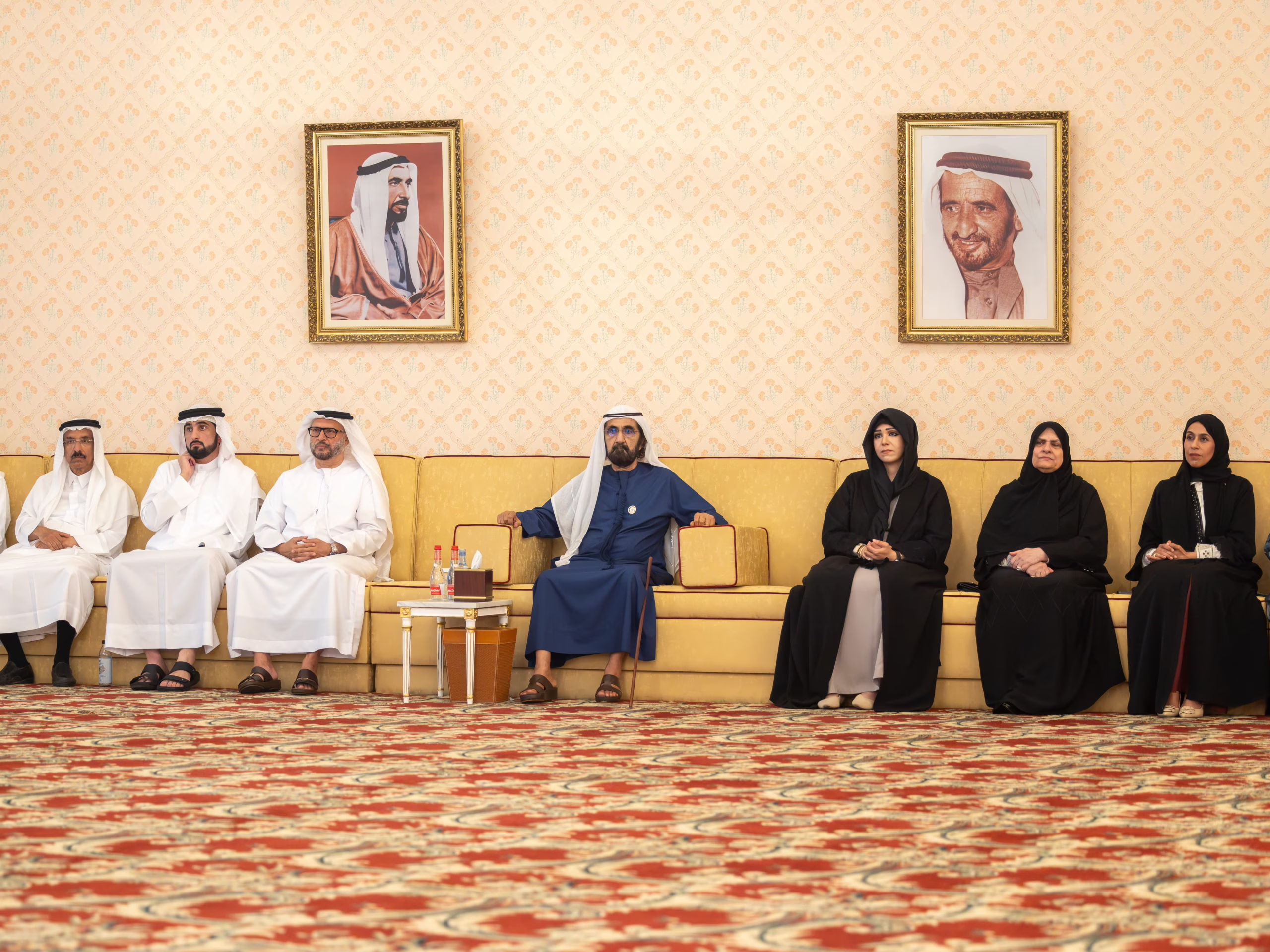
Speaking during a gathering at Union House in Dubai, Sheikh Mohammed said the country is focused on developing generations that can turn knowledge into achievement and excellence into meaningful national progress.
The message goes beyond education policy. For a country competing for global investors, entrepreneurs, companies and specialist talent, workforce development is becoming closely tied to long-term economic growth.
UAE Human Capital Moves Higher Up the Agenda
Sheikh Mohammed stressed the importance of preparing people who can respond to rapid changes taking place across industries and economies. That means developing skills that go beyond traditional academic qualifications and encouraging a culture where people continue learning throughout their careers. The UAE increasingly sees knowledge, adaptability and innovation as important economic assets, particularly as sectors such as artificial intelligence, finance, healthcare, aviation and advanced technology become more important to national growth.
This also matters for businesses operating in the country’s free zones. These zones attract companies through foreign ownership options, specialised ecosystems and relatively streamlined licensing structures, but access to qualified talent remains equally important. Companies may choose a location because of its business environment, yet their ability to grow often depends on whether they can find the right people.
Dubai Gathering Brings Government and Business Leaders Together
The Union House meeting brought together senior government officials, business figures and members of the wider community, reflecting the close relationship between public policy and economic development in Dubai. Among those attending were Sheikh Ahmed bin Mohammed bin Rashid Al Maktoum, Second Deputy Ruler of Dubai; Sheikh Ahmed bin Saeed Al Maktoum, President of the Dubai Civil Aviation Authority, Chairman of Dubai Airports and Chairman and Chief Executive of Emirates Airline and Group; and Sheikha Latifa bint Mohammed bin Rashid Al Maktoum, Chairperson of Dubai Culture and Arts Authority.
Ministers, senior officials, sheikhs, business leaders and local dignitaries were also present. The gathering highlighted a familiar feature of Dubai’s growth model, where government priorities, education, business policy, infrastructure and talent development often move in the same direction rather than operating as separate strategies.
More Than 830,000 Students Join Arab Reading Challenge
Education was also a major part of the gathering, with Sheikh Mohammed meeting UAE winners from the 10th edition of the Arab Reading Challenge. More than 830,000 students from across the country participated in the latest edition, marking a record level of participation.
The scale of that participation matters because reading is being treated as more than an academic activity. It is part of a wider effort to encourage curiosity, knowledge-building and independent thinking among younger generations. Sheikh Mohammed emphasised that reading and education can help create people who are capable of innovating and transforming what they learn into achievements that benefit society.
That approach fits neatly with the UAE’s wider economic ambitions. Industries built around artificial intelligence, medicine, financial technology, research and digital services require workers who can absorb new information quickly and adapt as technologies change. Developing that mindset early gives the country a stronger foundation for future economic growth.
MBRU Graduates Recognised for Academic Achievement
Sheikh Mohammed also met leading graduates from the Mohammed Bin Rashid University of Medicine and Health Sciences and congratulated them on their academic achievements. Their recognition added another layer to the discussion around human capital, particularly in a sector where specialist knowledge and professional expertise are critical.
Healthcare, life sciences and medical research are becoming increasingly important parts of the UAE’s knowledge economy. Dubai has been expanding specialised ecosystems around healthcare and innovation, and producing more highly qualified professionals locally could help strengthen those sectors over time. The graduates were encouraged to continue pursuing excellence through further specialisation, innovation and service to the community.
UAE Education Strategy Focuses on Flexibility and Quality
Minister of Education Sarah Al Amiri also presented the Ministry of Education’s strategy during the meeting. The strategy focuses on creating a more flexible, efficient and sustainable education system while improving learning outcomes and strengthening the UAE’s global position in education.
She also outlined preparations for the new academic year and measures aimed at maintaining education quality. The economic importance of this work is becoming harder to ignore. Employers across the UAE are looking for skills that are changing quickly, particularly as artificial intelligence and automation reshape roles in marketing, finance, logistics, healthcare and professional services.
A more flexible education system could help narrow the gap between what students learn and what companies actually need. That has direct implications for the private sector, especially in free zones that rely heavily on specialist and internationally competitive talent.
Why Talent Development Matters for UAE Free Zones
For the UAE’s free zone economy, Sheikh Mohammed’s comments point to something larger than education reform. Free zones compete internationally for startups, multinational companies, investors and entrepreneurs, and access to talent is becoming a stronger part of that competition.
Licensing costs, ownership rules, tax structures and office requirements remain important factors when companies choose where to establish themselves. Yet businesses also look at whether a market has the people needed to support expansion. A stronger domestic skills base gives companies access to a deeper pool of employees and could reduce dependence on recruiting every specialist role from overseas.
This becomes especially important in sectors such as technology, finance, aviation, media and healthcare, where much of the value comes from knowledge rather than physical assets. A free zone can make it easy for a business to enter the market, but a capable workforce helps make it easier for that company to stay and grow.
Knowledge Is Becoming Part of the UAE’s Economic Infrastructure
The broader message from the Union House gathering is that the UAE increasingly views people as part of its economic infrastructure. Dubai has spent decades developing airports, ports, financial centres, business districts and free zones. The next stage depends heavily on the knowledge and skills needed to operate increasingly sophisticated industries.
That work begins long before a company applies for a licence or hires its first employee. Reading, education, research, continuous learning and professional development all feed into the same long-term economic pipeline. The UAE is effectively trying to build talent at the same time as it builds industries.
For investors considering the country, that may become an increasingly important part of the UAE’s appeal. Infrastructure can attract businesses, but a well-developed talent base can help sustain them.
What This Means for the UAE’s Future Economy
Sheikh Mohammed’s focus on human capital reinforces the direction the UAE has been taking for years. The country wants to compete not only through infrastructure, location and investor-friendly policies, but through knowledge, skills and innovation.
That approach could have a direct impact on the future of the free zone sector. As more companies in advanced industries enter the UAE, they will need highly skilled employees who can work across technology, research, healthcare, finance and other specialist fields.
The stronger the country’s talent pipeline becomes, the stronger its overall business proposition is likely to be.
Sources
Government of Dubai Media Office — “Mohammed bin Rashid meets with senior officials and local dignitaries in Dubai,” 3 September 2026.
