


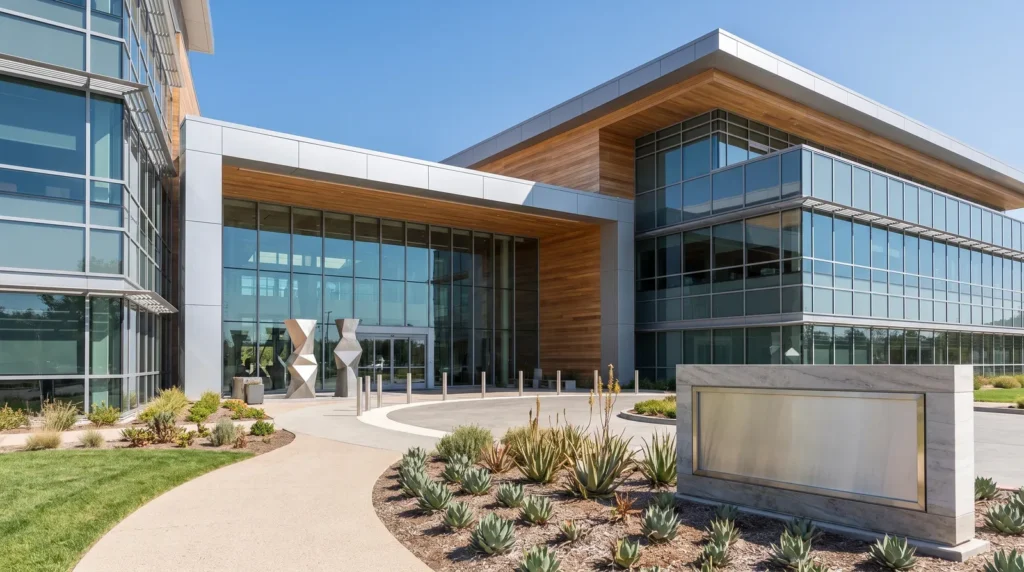
Dubai’s skyline keeps growing — and every glass facade, cladding panel, and high-rise exterior needs regular professional cleaning to meet municipal standards and owner expectations. This guide covers the market, licensing requirements, operational setup, and how to register an exterior building cleaning business under activity code 8129.01 via Meydan Free Zone.
Dubai’s Exterior Cleaning Market: Why the Opportunity Is Structural
The UAE’s construction pipeline is not slowing. Dubai alone continues to add residential towers, mixed-use developments, and government infrastructure at a pace that directly generates sustained demand for facade and exterior maintenance services. This is not discretionary spend — Dubai Municipality mandates regular building maintenance, making exterior cleaning a recurring contractual obligation for property owners and managers.
The market segments clearly: residential towers, commercial complexes, hospitality assets, and government facilities each carry distinct contracting cycles and service expectations. According to IMARC Group, the UAE facility management market is on a consistent growth trajectory, underpinned by the country’s expanding built environment and regulatory compliance requirements. Mordor Intelligence similarly identifies cleaning services as a high-growth sub-segment within regional facility management, driven by urban density and mandatory upkeep standards.
For an incoming operator, the structural nature of this demand — regulation-driven, property-stock-linked, and recurring — is the core commercial case.
Key Stats at a Glance
- UAE facility management market: consistent multi-billion dollar sector with cleaning as a core sub-segment (IMARC Group)
- Dubai Municipality mandates periodic exterior maintenance for all registered buildings
- Dubai’s real estate stock continues to grow, with thousands of towers requiring annual or bi-annual facade cleaning contracts
- VAT registration threshold: AED 375,000 annual turnover (Federal Tax Authority, UAE)
Key takeaway: Demand for exterior cleaning in Dubai is structurally embedded in regulation and property growth — not dependent on economic cycles alone.
Core Services, Equipment, and Target Customers
Activity code 8129.01 — Exterior Cleaning of Buildings — covers a defined scope of services: facade washing, rope access cleaning, water-fed pole systems, pressure washing, and post-construction exterior clean-up. Each method applies to different building heights, surface types, and client specifications.
Equipment requirements are capital-intensive from the outset. A properly equipped operation requires rope descent systems, suspended access cradles, water-fed pole rigs, commercial-grade pressure washers, and full personal protective equipment (PPE) for every operative. Budget accordingly before projecting early-stage margins.
Primary customers include property management companies, RERA-registered building owners, hospitality groups, and government facility operators. Contracts at the commercial and hospitality end are typically annual or bi-annual, creating a recurring revenue base once relationships are established. The sales cycle is longer than transactional cleaning — expect a procurement or tendering process with larger clients.
| Customer Segment | Typical Contract Type | Key Decision Maker |
|---|---|---|
| Residential Towers | Annual / bi-annual | Property manager / owners association |
| Commercial Complexes | Annual retainer | Facilities manager |
| Hospitality Groups | Scheduled programme | Engineering / operations director |
| Government Facilities | Tendered contract | Procurement / FM department |
Workforce and Safety Compliance
Rope access operatives working on high-rise structures must hold IRATA certification or an equivalent recognised qualification. This is non-negotiable — unqualified personnel on rope access or cradle systems expose the business to Civil Defence enforcement, contract termination, and liability claims.
The Ministry of Human Resources and Emiratisation (MOHRE) governs employment contracts, worker welfare standards, and wage protection compliance. All staff must be registered under a compliant employment contract before deployment on site.
Dubai Municipality and Dubai Civil Defence may inspect active worksites. A safety method statement and risk assessment are required for each project — prepare these as standard documentation, not project-by-project afterthoughts. Workmen’s compensation insurance and third-party liability cover must be in place before the first contract commences.
Key takeaway: Workforce certification and safety documentation are operational prerequisites, not administrative formalities. Non-compliance carries real enforcement risk.
Regulatory Requirements and Additional Approvals
The core trade license is issued under activity code 8129.01, classified within cleaning and facility services. Beyond the license itself, several additional approvals apply depending on the nature of work undertaken.
- Dubai Municipality: Approval required for chemical usage in cleaning operations and for wastewater disposal compliance — particularly relevant where chemical agents are used on facades or post-construction sites.
- Dubai Civil Defence: A No Objection Certificate (NOC) may be required for rope access and suspended cradle operations on high-rise structures. Confirm requirements per project with the relevant authority.
- Federal Tax Authority: VAT registration is mandatory once annual turnover exceeds AED 375,000. Review the registration process directly at tax.gov.ae.
- Free zone contracting structure: A Meydan Free Zone license permits B2B contracting. However, client sites are on the mainland — confirm the appropriate contractual and operational structure with Meydan’s registry team before committing to your setup.
If your services extend to internal building cleaning or specialised industrial cleaning, separate activity codes may apply. Verify the exact scope of 8129.01 with the registry at the point of application.
Key takeaway: The trade license is the starting point, not the finish line. Municipal, Civil Defence, and tax registrations each carry their own timelines and requirements.
Setting Up via Meydan Free Zone: Step-by-Step
Meydan Free Zone supports over 2,500 business activities, and the process for registering an exterior cleaning business is straightforward once documentation is in order. Use the Business Activities List to confirm that activity code 8129.01 is available and correctly named before proceeding.
- Select your activity: Confirm 8129.01 (Exterior Cleaning of Buildings) with the Meydan registry. If you plan to offer related services, check whether additional activity codes need to be included on the same license.
- Choose your legal structure: An FZ-LLC is the standard structure for service businesses with one or more shareholders. It provides limited liability and supports visa allocations for operational staff.
- Reserve your trade name: Submit your preferred company name for approval. Use the Company Name Check tool to verify availability before applying.
- Submit documentation: Passport copies for all shareholders and directors, and a business plan if requested by the registry.
- Receive initial approval and sign the license agreement: Pay the license and registration fees. Use the Cost Calculator to estimate your upfront costs before committing.
- Open a UAE corporate bank account: Required before operational commencement. Free zone companies can access business banking support through Meydan’s service partners.
- Obtain visa allocations: Secure visa quotas for operational staff and rope access technicians through Meydan’s visa quota process. Factor IRATA-certified technician headcount into your visa plan from the outset.
- Arrange insurance: Third-party liability and workmen’s compensation insurance must be secured before the first contract is executed.
- Register with MOHRE: All employment contracts must be filed and worker welfare standards documented before staff are deployed on site.
| Setup Stage | Responsible Party | Estimated Timeline |
|---|---|---|
| Activity confirmation and name reservation | Meydan Free Zone registry | 1–2 business days |
| License issuance | Meydan Free Zone | 3–5 business days |
| Corporate bank account opening | UAE bank / Meydan partner | 2–6 weeks |
| Visa processing (per employee) | Meydan / GDRFA | 2–4 weeks |
| MOHRE registration | Company / PRO | 1–2 weeks |
| Municipal and Civil Defence approvals | Company / approved consultant | Variable — confirm per activity |
Key takeaway: The license itself can be issued within days. The operational readiness timeline — banking, visas, insurance, and regulatory approvals — is what determines when you can execute your first contract.
Conclusion
Exterior building cleaning in Dubai is a regulated, capital-aware business with strong structural demand — driven by mandatory maintenance requirements, a growing property stock, and limited qualified operators at the high-rise end of the market. The barriers to entry are real: IRATA-certified staff, compliant safety systems, and multiple regulatory approvals sit between license issuance and first contract delivery. Those barriers also limit competition.
Speak with Meydan Free Zone directly to confirm activity code 8129.01 availability, current license fees, and visa quota allocations before committing to your setup structure. Confirm the contracting model for mainland client sites at the same time — it will shape your operational and legal framework from day one.