


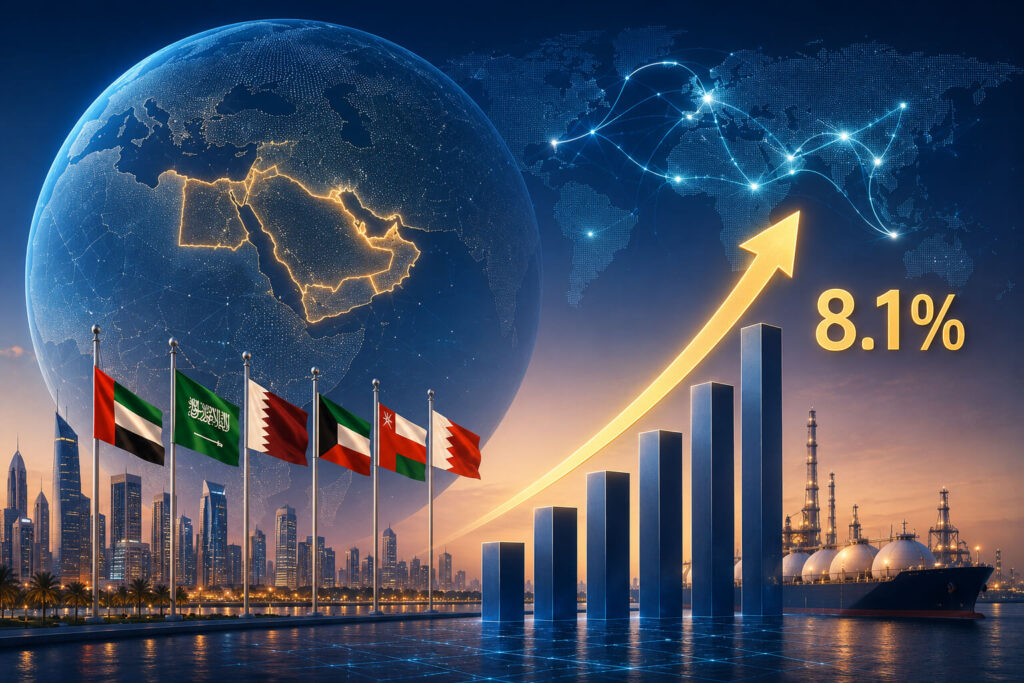
The Gulf Cooperation Council economy is expected to stage a strong recovery in 2027. The GCC GDP forecast 2027 projects regional GDP to grow by 8.1 percent as energy trade routes normalize, travel demand returns, and investor confidence begins to rebuild.
According to ICAEW’s latest Economic Insight: Middle East Q2 2026 report, produced in partnership with Oxford Economics, the rebound follows a challenging period for the region. The report forecasts GCC GDP to contract by 2.4 percent in 2026. This is a weaker outlook than previously expected. Disruption to energy production, shipping routes, tourism, and business sentiment weighs on economic activity.
GCC GDP Forecast Points to Strong 2027 Recovery
ICAEW expects the GCC economy to recover sharply in 2027. This will be driven largely by a normalization of oil and gas output after a steep decline in 2026. The region’s oil sector is forecast to shrink by 14.5 percent in 2026, marking one of the sharpest contractions in decades.
However, the report projects a 23.5 percent rebound in GCC oil sector output in 2027 as trade flows recover from a severely depressed base. This recovery is expected to support broader economic growth across the Gulf.
For businesses operating in free zones across the UAE and wider GCC, the outlook signals a potential return of stronger trade activity, improved logistics flows, and renewed investor appetite from 2027 onward.
Saudi Arabia and Oman Expected to Show Resilience
The report identifies Saudi Arabia and Oman as the least negatively affected GCC economies in 2026. Both countries are expected to continue expanding despite regional disruption.
Saudi Arabia and the UAE have also benefited from the ability to reroute some energy exports through alternative pipelines. Saudi Arabia’s East-West Pipeline and the UAE’s Habshan-Fujairah pipeline have helped reduce the impact of disruptions to traditional shipping routes.
This flexibility has supported energy exports and helped cushion both economies. This is in comparison with other GCC producers more directly exposed to regional shipping disruptions.
UAE Free Zones Could Benefit from Trade Normalization
The projected GCC recovery is particularly relevant for UAE free zones. These zones play a central role in regional logistics, re-export trade, manufacturing, technology, and professional services.
As energy routes stabilize and regional trade improves, free zone businesses may benefit from stronger cross-border demand, improved shipping confidence, and a more positive investment climate.
The UAE’s diversified economy, strong logistics infrastructure, and established free zone ecosystem could position it well to capture new opportunities. This may happen as regional business activity rebounds.
Tourism and Business Confidence Key to Non-Oil Growth
Beyond the energy sector, ICAEW expects a gradual recovery in travel, tourism, and non-oil business activity. The report notes that weaker travel sentiment and disruption to regional routes have affected tourism and hospitality. However, a return in visitor demand could help revive non-oil sectors.
Business confidence is also expected to improve as uncertainty eases. This could support investment, hiring, and expansion plans across sectors such as logistics, finance, real estate, trade, aviation, and business services.
For the UAE, where non-oil growth remains a major economic priority, stronger regional confidence could support the continued expansion of free zone companies and foreign direct investment.
GCC Outlook Remains Dependent on Stability
While the 2027 outlook is positive, ICAEW notes that near-term risks remain. The strength and pace of recovery will depend on how quickly regional trade routes, energy production, tourism flows, and investor sentiment return to normal.
A prolonged period of disruption could delay the rebound, while faster stabilization could accelerate growth across the GCC.
Conclusion
The GCC GDP forecast for 2027 points to a strong regional rebound, with ICAEW projecting 8.1 percent growth as energy trade routes normalize and confidence returns. Although 2026 is expected to be difficult, the medium-term outlook suggests renewed opportunities for businesses across the Gulf.
For UAE free zones, the recovery could strengthen trade, logistics, investment, and non-oil business activity. This would reinforce the country’s role as a regional hub for global companies and entrepreneurs.