


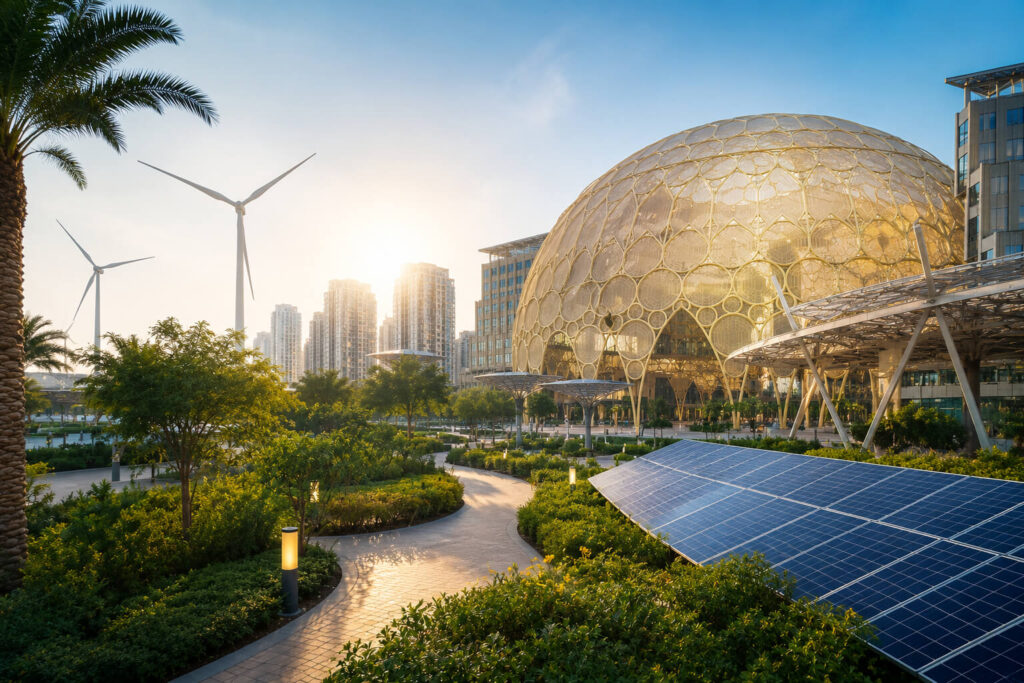
Expo City Dubai is putting numbers behind its sustainability ambitions. As part of this commitment, the Expo City Dubai decarbonisation roadmap outlines the steps being taken toward a greener future.
Its decarbonisation roadmap lays out a pathway towards net zero emissions by 2050, with interim targets for 2030 and 2040 and a separate push to tackle embodied carbon from construction and the wider built environment.
That distinction matters. Cities do not generate emissions only through the electricity their buildings consume. Materials, construction, transport, water use and everyday consumption all add to the carbon footprint.
Expo City’s plan attempts to deal with that wider picture rather than treating net zero as a distant 2050 promise.
Operational Carbon Cuts Start Well Before 2050
The headline target is net zero by 2050, but much of the work is supposed to happen earlier.
Expo City is targeting a 45% reduction in operational carbon by 2030, followed by an 80% reduction by 2040. These reductions are measured against the baseline defined under the Global Protocol for Community-Scale Greenhouse Gas Inventories, or GPC.
The roadmap is also aligned with relevant guidance from the Science Based Targets Network. The basic principle is straightforward: emissions need to be substantially reduced before carbon offsets are brought in to deal with what remains.
It makes the 2030 target particularly important. For businesses considering Expo City Dubai and its free zone ecosystem, the next few years are where changes in infrastructure, energy use, construction and operating practices should become increasingly visible.
Construction Carbon Is Getting Its Own Target
One of the more interesting parts of the Expo City Dubai decarbonisation roadmap is its treatment of embodied carbon.
These are emissions tied to the materials and construction processes behind buildings and infrastructure — emissions that can easily sit outside the usual discussion about electricity consumption.
Expo City aims to reduce embodied carbon in its built environment by 40% by 2030, followed by a 100% reduction and offset by 2050. Its embodied-carbon targets are aligned with those of the World Green Building Council.
That is a significant issue for a district that is still developing. Cutting emissions from an existing building is one challenge. Making lower-carbon decisions while an urban centre is actively expanding is another.
Expo City is effectively trying to do both.
The Strategy Is Reduce First, Then Remove and Offset
Expo City describes its approach as “reduce, remove and offset.”
Reduction comes first. The city plans to use energy and water efficiency measures, renewable energy, lower-carbon construction materials and circular economy principles. Its 15-minute-city planning model is also designed to make walking and micro-mobility more practical, reducing dependence on conventional vehicle journeys.
Removal is the next piece. Options outlined in the roadmap include sustainable soil management and the possible long-term use of carbon-capture technologies.
Offsets sit at the end rather than the beginning of the process. For emissions that cannot reasonably be eliminated, Expo City says it will look towards verified projects outside its boundary, including high-quality mangrove restoration initiatives. Projects delivering environmental benefits alongside social and economic value are expected to receive priority.
Renewable Energy Is Already Part of the Shift
The roadmap is not operating in isolation.
Expo City Dubai previously reached an agreement with Dubai Electricity and Water Authority (DEWA) to power the urban centre with renewable energy. DEWA described the agreement as making Expo City one of the largest urban centres in the region to be fully powered by renewable energy.
Dubai itself is pursuing a much wider energy transition. The Dubai Clean Energy Strategy aims for clean sources to meet 100% of the emirate’s energy requirements by 2050. Updated targets expect clean energy to account for around 36% of Dubai’s energy mix by 2030.
So the Expo City programme sits inside a much bigger shift in how Dubai expects future districts, infrastructure and businesses to operate.
Why This Matters for the UAE Free Zone Landscape
There is a business angle here that should not be overlooked.
Expo City Dubai is not simply a residential or events district. Its free zone is being positioned as a base for companies working across innovation, technology and sustainability.
That direction became even clearer with the launch of the UAE’s first Green Innovation District at Expo City Dubai. The initiative is intended to attract businesses working in clean energy, circular economy solutions and green technology, while providing an environment where companies can decarbonise as they grow.
For the UAE free zone sector, this points towards a slightly different kind of competition.
Location, ownership structures, licensing costs and access to markets remain important. Increasingly, however, the carbon performance of the surrounding infrastructure may become part of the proposition too — particularly for multinational companies with their own emissions targets and sustainability reporting requirements.
A free zone sitting inside a district pursuing measurable carbon reductions has a different story to tell prospective investors.
Expo City Fits Into the UAE’s Wider Net Zero Strategy
At the national level, the roadmap supports the UAE Net Zero 2050 Strategy, which covers power, industry, transport, buildings, waste and agriculture.
The federal strategy goes beyond emissions reduction alone. The UAE expects its net-zero transition to support economic development, potentially creating around 200,000 jobs across solar, battery and hydrogen industries while contributing roughly 3% to national GDP.
The UAE Energy Strategy 2050 adds another layer. The country aims to triple renewable energy’s contribution and mobilise between AED 150 billion and AED 200 billion in energy investment by 2030.
Expo City is one urban-scale example of what those national ambitions can look like on the ground.
A Test Case for Sustainable Urban Growth in Dubai
Perhaps the bigger question is not whether Expo City can hit a target written for 2050. It is what happens while the city grows.
Its master plan includes residential communities, commercial districts, green spaces and new business infrastructure. Sustainability performance is expected to be tracked through indicators covering areas such as biodiversity, energy use, economic growth and wellbeing.
Growth usually pushes emissions upwards. Expo City is attempting the harder version: expand the district while pushing its carbon trajectory down.
The 2030 and 2040 milestones will therefore tell much more than the 2050 headline does.
For companies watching the evolution of UAE free zones, Expo City Dubai is becoming an interesting case study — one where sustainability is moving away from being an extra feature and closer to becoming part of the infrastructure itself.
Sources
- Free Zones Gateway — Expo City decarbonisation roadmap: Raising the bar on responsible urban development and supporting UAE net zero goals
- Expo City Dubai — Expo City decarbonisation roadmap
- UAE Government — The UAE’s Net Zero 2050 Strategy
- UAE Government — Dubai Clean Energy Strategy
- Dubai Electricity and Water Authority — Expo City renewable energy agreement
- UAE Ministry of Economy and Tourism — UAE’s first Green Innovation District at Expo City Dubai