


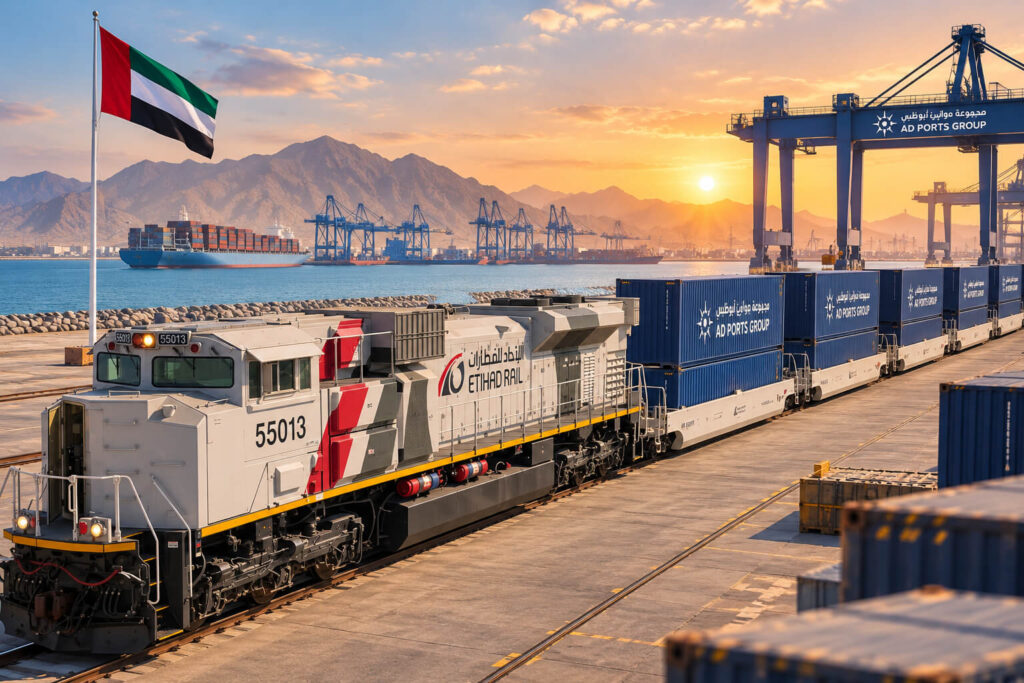
The UAE’s freight network has gained another direct connection between its ports and industrial centres. The new Etihad Rail Fujairah ICAD service marks a significant step forward in enhancing transport links in the region.
Etihad Rail and AD Ports Group have launched a dedicated rail freight service linking Fujairah Terminals with the Industrial City of Abu Dhabi, better known as ICAD. The route connects the UAE’s East Coast with one of Abu Dhabi’s major industrial areas through the national railway network.
It is more than a new freight route. The service combines rail transport with an inland cargo gateway where businesses can handle customs clearance, inspections and cargo release closer to their operations.
For manufacturers, importers and logistics companies in Abu Dhabi, that could remove a few steps from the usual journey between port and warehouse.
Direct Rail Connection Between Fujairah and ICAD
Cargo arriving at Fujairah Terminals can now travel directly by rail to ICAD, covering a distance of roughly 200 kilometres. Once the shipment reaches Abu Dhabi, customers can access customs and inspection services at the inland destination.
This setup effectively pushes some port-related processes farther inland. Instead of relying entirely on trucks to move containers from the coast to their final destination, businesses can use the railway for the main leg of the journey.
That matters in an industrial market where factories, warehouses and distribution centres often handle large volumes of cargo.
ICAD Gets Its Own International Logistics Code
One of the less flashy parts of the announcement may turn out to be one of the most useful.
ICAD has received its own United Nations Location Code, or UN LOCODE, AECAD. The designation gives the industrial city formal recognition as an international logistics location within global shipping and trade systems.
Shipping lines, freight forwarders and cargo owners can now book cargo directly to ICAD as both the destination and clearance point. Containers arriving through Fujairah can travel by rail to ICAD before undergoing inspection, clearance and release.
It sounds procedural, but the practical effect is straightforward: fewer unnecessary cargo movements and a potentially shorter route between the ship and the customer.
Freight Service Will Operate Three Times a Week
Etihad Rail plans to operate the dedicated Fujairah-ICAD freight service three times each week.
The scheduled service gives businesses another option for moving high-volume cargo between the East Coast and Abu Dhabi. Rail can also reduce dependence on long-distance trucking along the same corridor.
Etihad Rail and AD Ports Group expect the service to provide more predictable schedules, greater capacity for large cargo volumes and lower emissions compared with traditional long-haul road transport.
There is also a congestion angle. Shifting more freight onto rail could reduce the number of heavy trucks needed for long-distance cargo movements between Fujairah and Abu Dhabi.
What the New Route Means for Abu Dhabi Businesses
The service targets importers, exporters, manufacturers, distributors and logistics providers operating across Abu Dhabi.
Its biggest practical advantage is proximity. Cargo can move closer to warehouses, factories and distribution centres before businesses complete the customs and release process. That can reduce additional road movements after containers leave the port.
For companies operating within Abu Dhabi’s industrial ecosystem, logistics costs are not only about the ocean journey. Inland transport, handling, customs procedures and delays between different stages all add up.
A rail-linked inland clearance point gives companies another way to simplify that chain.
Etihad Rail Pushes Beyond Port-to-Port Freight
Etihad Rail Freight CEO Omar Alsebeyi described the Fujairah-ICAD service as another step toward making greater use of the UAE National Rail Network.
The important shift here is that the railway is not being treated simply as transport infrastructure. Etihad Rail and AD Ports Group are tying the physical rail connection to customs services and inland cargo handling.
That creates a more complete logistics product. Cargo arrives by sea, transfers to rail and moves inland to a location where businesses can complete key clearance processes closer to where the goods are actually needed.
For a national freight network, that kind of integration is where rail starts becoming more useful to everyday commercial operations.
Fujairah Terminals Extends Its Reach Inland
Fujairah Terminals already forms part of AD Ports Group’s broader logistics network. Its East Coast location gives it access to the Gulf of Oman and trade routes serving markets beyond the UAE.
The new rail connection extends that reach into Abu Dhabi’s industrial base rather than stopping at the terminal gate.
AD Ports Group says Fujairah Terminals supports supply chains connecting ports, industrial and free zones, logistics platforms and digital services. Its location also supports links with the GCC, India, the Red Sea and East Africa.
The Fujairah-ICAD route adds an inland piece to that network. For cargo owners, the value comes from having maritime, rail and customs infrastructure working as one journey rather than separate services.
Why This Matters for the UAE’s Free Zone and Industrial Economy
The launch has wider relevance for companies considering industrial or logistics operations in the UAE.
Ports get much of the attention, but the speed and cost of moving goods after they leave a vessel can have just as much impact on a company’s supply chain. Better links between maritime gateways and industrial areas can make locations more practical for manufacturers, distributors and international traders.
The Fujairah-ICAD connection also shows how the UAE is building links between different pieces of its trade infrastructure. Ports, railways, customs facilities, industrial zones and logistics centres increasingly work as parts of the same system.
That could be particularly useful for companies handling regular or high-volume shipments. Instead of adding more trucks as cargo volumes grow, businesses have a rail option built for larger freight movements.
UAE Logistics Network Becomes More Connected
The new service will not replace road freight, nor does it need to. Trucks remain essential for first- and last-mile delivery.
The bigger change is choice.
Businesses now have a scheduled rail corridor connecting Fujairah Terminals directly with an inland industrial and customs location in Abu Dhabi. That creates another route through the UAE for cargo arriving from international markets.
As Etihad Rail expands its role in freight transport, connections like Fujairah-ICAD show what the national network can look like when rail, ports and industrial infrastructure actually meet.
For the UAE’s industrial and free zone economy, that connection may prove more important than the railway line itself.
Sources
Emirates News Agency (WAM): “Etihad Rail, AD Ports Group launch integrated rail service connecting Fujairah Terminals with Industrial City of Abu Dhabi.” Published September 20, 2026. Read the WAM report
Abu Dhabi Media Office: “In partnership with AD Ports Group, Etihad Rail launches integrated rail service connecting Fujairah Terminals with Industrial City of Abu Dhabi (ICAD).” Published September 20, 2026. Read the Abu Dhabi Media Office announcement
Gulf Today: “Etihad Rail, AD Ports Group launch integrated rail service.” Published September 20, 2026. Read the Gulf Today report