


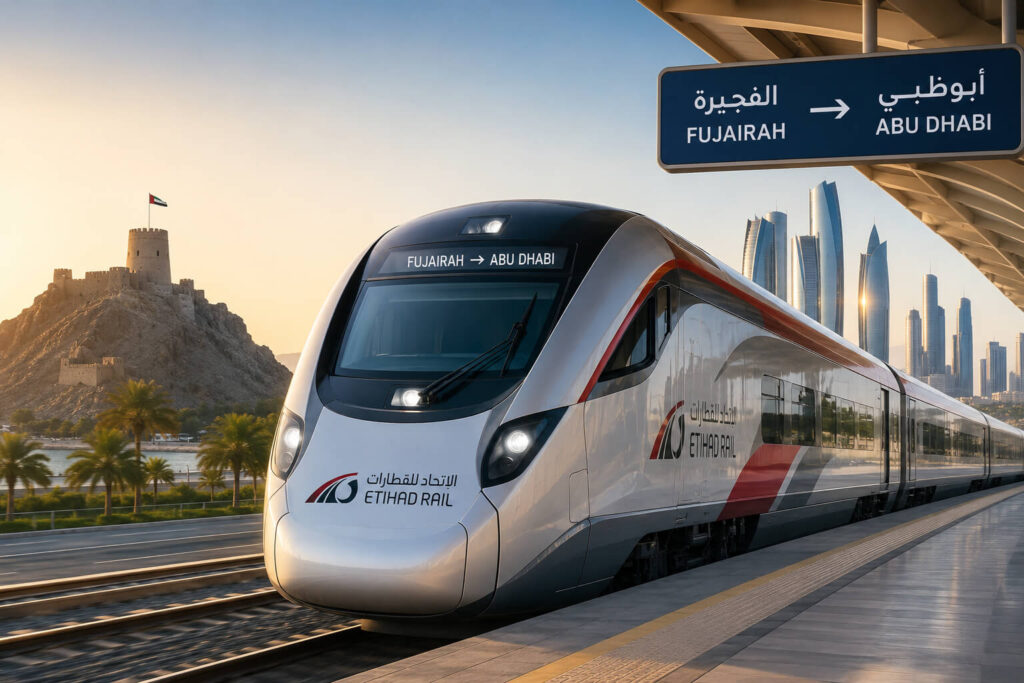
The UAE’s long-awaited Etihad Rail passenger service has taken a real step forward, with the first passenger train arriving in Abu Dhabi from Fujairah after completing the journey in around 105 minutes. It was not just another transport update. For the UAE, this was one of those infrastructure moments that people will probably look back on later and say, yes, that was when rail travel started to feel real.
The introductory passenger operation began from Fujairah and reached Abu Dhabi in about 1 hour and 45 minutes, connecting the east coast with the capital through the national railway network. Reports said the first train left Fujairah early in the morning and arrived in Abu Dhabi ahead of schedule, turning what used to be a long road trip into a much faster rail journey.
Fujairah Moves Closer to the Capital
For Fujairah, this is a big deal. The emirate has always had its own rhythm, shaped by mountains, coastline, ports, tourism, and industry. Now, with passenger rail linking it directly to Abu Dhabi, that distance feels smaller.
The new service gives residents, visitors, and business travelers another way to move across the country without relying only on highways. That may sound simple, but it changes the way people think about commuting, weekend travel, tourism, logistics, and even where they might choose to live or work.
The route also gives Fujairah a stronger place in the UAE’s wider mobility map. The emirate is no longer just a destination at the end of a road journey. It is becoming part of a connected national rail system.
Why This Matters for Free Zones and Business
For free zones, investors, and companies operating across the UAE, the arrival of passenger rail is more than a convenience story. Better transport creates better movement of people. Better movement of people supports business activity.
Employees can travel more easily between emirates. Visitors can reach industrial and commercial hubs faster. Investors looking at Fujairah, Abu Dhabi, and future connected destinations may start to see the UAE as one even more integrated business environment.
This is especially relevant for sectors tied to logistics, tourism, trade, manufacturing, aviation, ports, hospitality, and regional headquarters. Rail does not replace roads. It adds another layer. And in a country built around speed, access, and infrastructure, another layer matters.
Comfort, Speed, and a Different Kind of Journey
The first service also showed what Etihad Rail wants the passenger experience to feel like. The Abu Dhabi to Fujairah route is expected to take about 105 minutes, with trains capable of reaching speeds of up to 200 km/h and carrying up to 400 passengers.
That combination is important. The UAE does not only need transport that works. It usually expects transport that feels polished. Passenger rail will be judged not only by speed, but also by comfort, booking experience, station access, onboard service, reliability, and how easily it connects with the rest of daily life.
Early reports also pointed to strong public interest, with more than 10,000 tickets reportedly sold around the launch period. That says something. People are curious, yes, but they are also ready to try a different way of moving between emirates.
The Bigger UAE Rail Picture
This first journey is not the full story. It is the opening move.
Etihad Rail’s passenger rollout is expected to expand in phases, with wider connections planned across key UAE destinations. Public reporting has pointed to future links involving Abu Dhabi, Dubai, Sharjah, Fujairah, Al Dhaid, and Al Dhafra as the network develops further.
Once more stations and routes come online, the national rail network could reshape daily travel patterns. A trip between emirates may become less about traffic timing and more about station access and train schedules. That sounds ordinary in countries with mature rail systems, but in the UAE, it marks a major shift.
Tourism Gets a New Route
The tourism angle should not be ignored. Fujairah has beaches, mountains, resorts, heritage sites, and a different landscape from the country’s major city centers. A direct train connection makes that easier to package, promote, and experience.
For Abu Dhabi residents, Fujairah becomes more accessible. For visitors landing in the capital, the east coast becomes easier to reach. For hotels and tourism operators, rail could open up new travel behavior, especially for short breaks, family trips, and scenic routes.
There is something else too. Trains create a different kind of travel mood. Less driving. More looking out the window. More movement through the country instead of around it.
Infrastructure That Changes Daily Life
The UAE has built airports, ports, roads, metros, and logistics corridors at a pace that has shaped its global position. Etihad Rail now adds another piece to that infrastructure story.
The first Fujairah to Abu Dhabi passenger journey may feel ceremonial today, but its impact could become very practical. It could affect how people commute, where businesses expand, how tourists move, and how free zones position themselves inside a more connected national economy.
This is why the launch matters. Not because one train arrived. Because it showed what the next transport layer of the UAE could look like.
The Etihad Rail passenger service is no longer just a future promise. It has started moving.