


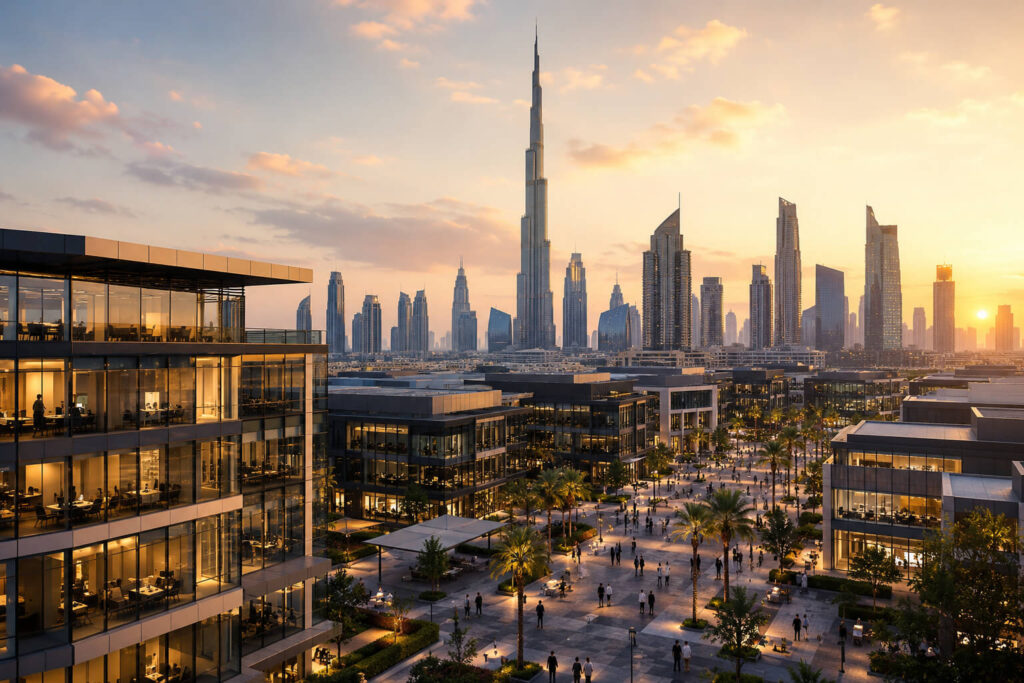
Dubai’s free zone market is running close to capacity.
Economic zones managed by the Dubai Integrated Economic Zones Authority (DIEZ) recorded an average occupancy rate of 96% during the first half of 2026, while the number of companies operating across the ecosystem increased by 13%. The workforce expanded even faster, climbing 24% during the period, according to figures reported by Arabian Business.
The numbers matter beyond office space. More companies are entering the zones, existing businesses are expanding their teams, and available capacity is being absorbed at a pace that points to continued demand for Dubai as a regional business base.
DIEZ Free Zones Reach 96% Occupancy
A 96% occupancy rate leaves relatively little unused space across the DIEZ portfolio. The authority oversees Dubai Airport Freezone, Dubai Silicon Oasis and Dubai CommerCity, three zones serving very different parts of the economy, from technology and digital commerce to aviation-linked businesses and international trade.
High occupancy is not entirely new for the group. Investment Corporation of Dubai’s 2024 annual report also recorded average occupancy of 96% across the DIEZ portfolio, alongside 33.1 million square feet of gross leasable area.
What stands out in H1 2026 is that occupancy has remained at that level while the business population continues to grow. Company numbers rose 13% during the period, suggesting demand is not simply coming from existing tenants holding onto space.
Workforce Growth Is Moving Even Faster
The 24% jump in the workforce is arguably the more interesting figure.
A rise in registered companies shows that businesses are choosing the zones. A much larger increase in employees suggests that activity inside those companies is expanding as well. That can translate into demand beyond commercial leases, including housing, transport, retail, professional services and other parts of Dubai’s wider business ecosystem.
There was already evidence of that trend before 2026. DIEZ reported that its workforce reached 106,359 employees at the end of 2025, a 26.2% increase from the previous year. Registered companies had risen by 24.6% over the same period.
The latest H1 figures indicate that the momentum has carried into 2026 rather than fading after a particularly strong year.
Dubai’s Free Zones Are Competing for Growing Business Demand
DIEZ is only one part of Dubai’s much larger free zone landscape. The emirate has more than 20 specialised free zones covering sectors ranging from technology and finance to logistics, media, healthcare and commodities.
That makes the occupancy figures more notable. Companies setting up in Dubai have plenty of alternatives, yet space across the DIEZ economic zones remains heavily occupied.
Other business districts are seeing similar pressure. TECOM Group, which operates 10 specialised business districts in Dubai, reported portfolio occupancy of 97% during H1 2026. Commercial occupancy stood at 96%, while industrial assets reached 98%.
This is starting to look less like an isolated free zone story and more like broad demand for commercial and industrial space across Dubai.
Dubai Silicon Oasis Is Preparing for the Next Wave
Near-full occupancy eventually creates a straightforward problem: where does the next round of growth go?
Dubai Silicon Oasis is already being expanded. In January 2026, Dubai announced AED12.8 billion worth of strategic expansion projects for the zone, including District IO and Block 14.
District IO alone carries an AED11 billion investment and is expected to accommodate more than 6,500 global companies. Its focus is firmly on emerging industries, including artificial intelligence, robotics, smart mobility, quantum computing, Web3 and other advanced technology sectors. The project is expected to generate more than 70,000 direct and indirect jobs over the coming decade.
There are other signs of where DIEZ sees future demand. In April, the authority announced a partnership with VOLT UAE to develop AI-ready data centre infrastructure at Dubai Silicon Oasis, adding another layer to the zone’s technology ambitions.
Business Support Measures Continue Alongside Expansion
DIEZ has also been adjusting the cost environment for companies already operating within its zones.
Measures announced in April included rental-rate stability upon contract renewal, monthly rent payment options without instalment fees, waivers on selected administrative charges and temporary deferrals for certain company amendment fees. The package applies across Dubai Airport Freezone, Dubai Silicon Oasis and Dubai CommerCity.
That becomes more relevant when occupancy is sitting at 96%. Keeping existing businesses is just as important as attracting new ones when available space is tight.
It also points to a slightly different phase in Dubai’s free zone story. The pitch is no longer only about getting international companies through the door. Retention, expansion and giving established businesses room to scale are becoming a bigger part of the equation.
What 96% Occupancy Means for Dubai’s Free Zone Market
For businesses considering a UAE free zone setup, high occupancy cuts both ways.
It is a strong signal that Dubai’s economic zones remain attractive to companies and investors. At the same time, businesses looking for particular office sizes, locations or specialised facilities may find that availability becomes more important when choosing between zones.
For Dubai, the bigger question is capacity. Company numbers are still increasing. Employment is growing faster. Occupancy is already close to full.
That puts the spotlight on new developments and infrastructure coming online over the next several years. Dubai Silicon Oasis’ expansion is one response. More capacity will almost certainly matter if the current pace of business formation and workforce growth continues.
For now, the H1 2026 numbers tell a fairly simple story: Dubai’s free zones are not struggling to fill space. They are working out how to accommodate what comes next.
Sources
- Arabian Business — Dubai free zones hit 96% occupancy as company numbers rise 13% and workforce jumps 24%
- Government of Dubai Media Office — DIEZ reports 19.4% increase in revenue and 17.8% rise in net profit in 2025
- Government of Dubai Media Office — DIEZ launches economic measures to strengthen business resilience
- Invest in Dubai — Free Zones in Dubai
- Government of Dubai — AED12.8 billion strategic expansion projects for Dubai Silicon Oasis