


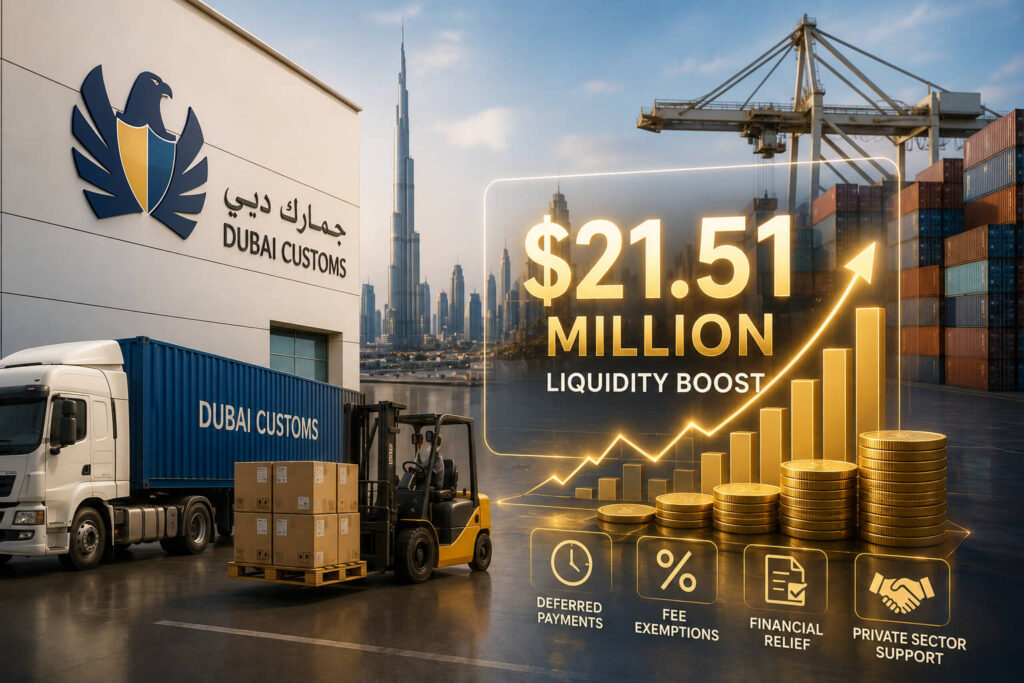
Dubai Customs has quietly put serious breathing room back into the private sector.
Its economic support packages have provided more than AED79 million, or about $21.51 million, in liquidity to businesses. At the same time, the measures helped support trade flows worth AED33.9 billion, or around $9.23 billion, between March 1 and June 30, 2026.
That is not a small administrative update. For companies moving goods through Dubai, especially those dealing with cash pressure, shipping delays, customs costs, or tighter margins, this kind of support matters in very practical ways.
Money stays inside the business longer. Goods move faster. Supply chains get a bit less tense.
Dubai Customs Support Comes at a Critical Time for Trade
The measures were introduced under economic support packages approved by Sheikh Hamdan bin Mohammed bin Rashid Al Maktoum, Crown Prince of Dubai, Deputy Prime Minister, Minister of Defence and Chairman of The Executive Council of Dubai.
The goal was simple enough: help businesses keep operating without letting trade slow down.
According to Economy Middle East, Dubai Customs’ facilitation measures supported business continuity for thousands of companies and strengthened supply chain resilience during the March-to-June period. The support also helped reinforce confidence among private sector firms that rely on Dubai’s customs and logistics systems to keep goods moving.
Not every business needs a grand rescue plan. Sometimes, faster clearance, better flexibility, and reduced cash strain are what keep operations alive.
The Green Corridor Kept Goods Moving
One of the most important parts of the package was the Green Corridor.
Between March 1 and June 30, 2026, the Green Corridor facilitated the movement of more than 203,242 containers and over 3.16 million tonnes of goods from 188 countries. The total value of those goods exceeded AED33.9 billion.
That number says a lot.
Dubai is not only trying to attract trade. It is trying to make trade less painful once it arrives. The Green Corridor helped businesses move large volumes of cargo through customs channels more smoothly, which is especially important for traders, logistics operators, free zone companies, importers, exporters, and manufacturers.
A delayed container can disrupt more than one shipment. It can affect warehouse planning, retail stock, production schedules, customer commitments, and cash flow.
Dubai Customs knows that.
More Liquidity Means More Room for Businesses
The AED79 million liquidity support gave private companies more room to manage operations.
That liquidity can help companies pay suppliers, clear shipments, manage working capital, and stay active during uncertain market conditions. For smaller and mid-sized firms, even a short delay in customs costs or cash recovery can create pressure.
Dubai’s approach here feels very targeted. It is not only announcing support from above. It is using customs policy as an economic tool.
That is where the free zone angle becomes important.
Many Dubai free zone companies depend on fast logistics, customs efficiency, and cross-border movement. If customs procedures become easier, the effect can move across the whole business ecosystem, from port operators and freight forwarders to distributors and re-export firms.
Dubai Keeps Strengthening Its Logistics Hub Position
Dubai has spent years building itself into a trade and logistics hub. Ports, airports, free zones, customs systems, warehousing, re-export channels, and digital services all sit inside that strategy.
The latest Dubai Customs figures show why that model still matters.
Trade is not only about signing deals. It is also about whether goods can actually move across borders without unnecessary friction. For Dubai, customs efficiency is part of its economic identity.
The emirate wants companies to see it as a place where trade can move quickly and predictably. That predictability is often what businesses value most.
A company can plan around cost. It can plan around taxes. It can even plan around competition.
But uncertainty at the border? That is harder.
Why This Matters for Free Zone Companies
Free zone businesses should pay attention to this development because customs flexibility can directly affect their operations.
Companies in logistics, e-commerce, manufacturing, food trading, electronics, auto parts, construction materials, and general trading all depend on smooth movement of goods. When Dubai Customs improves clearance pathways or eases certain financial pressures, the benefits can show up quickly.
More liquidity can help firms restock faster. Faster movement can reduce storage pressure. Better customs facilitation can make Dubai more attractive for regional distribution.
That is exactly the kind of environment free zones want to promote.
Dubai’s free zones do not operate in isolation. They depend on customs systems, ports, airports, and trade corridors working together. When that wider ecosystem improves, free zone companies become more competitive.
A Practical Signal to Investors and Traders
Dubai Customs’ support packages send a clear message to the market: Dubai wants trade to keep moving, even when businesses are under pressure.
That sounds obvious, but it is not always easy to deliver.
Customs authorities sit at the center of trade. They can slow things down or speed things up. In this case, Dubai Customs is trying to use its role to support private sector stability, not just regulate movement.
For investors, traders, and free zone operators, that matters.
It shows that Dubai is still treating logistics and trade facilitation as core parts of its economic strategy. Not side issues. Not paperwork. Core infrastructure.
Dubai’s Trade Model Is Still About Speed
The bigger story here is not only the $21.51 million liquidity figure. It is the way Dubai keeps using speed as a competitive advantage. Fast customs. Fast licensing. Fast cargo movement. Fast access to regional and global markets.
That is the offer. And for businesses operating in or around Dubai’s free zones, the latest Dubai Customs package adds another reason to see the emirate as a serious trade base. Not perfect. Not cheap in every case. But fast, connected, and very deliberate about keeping commerce moving.