

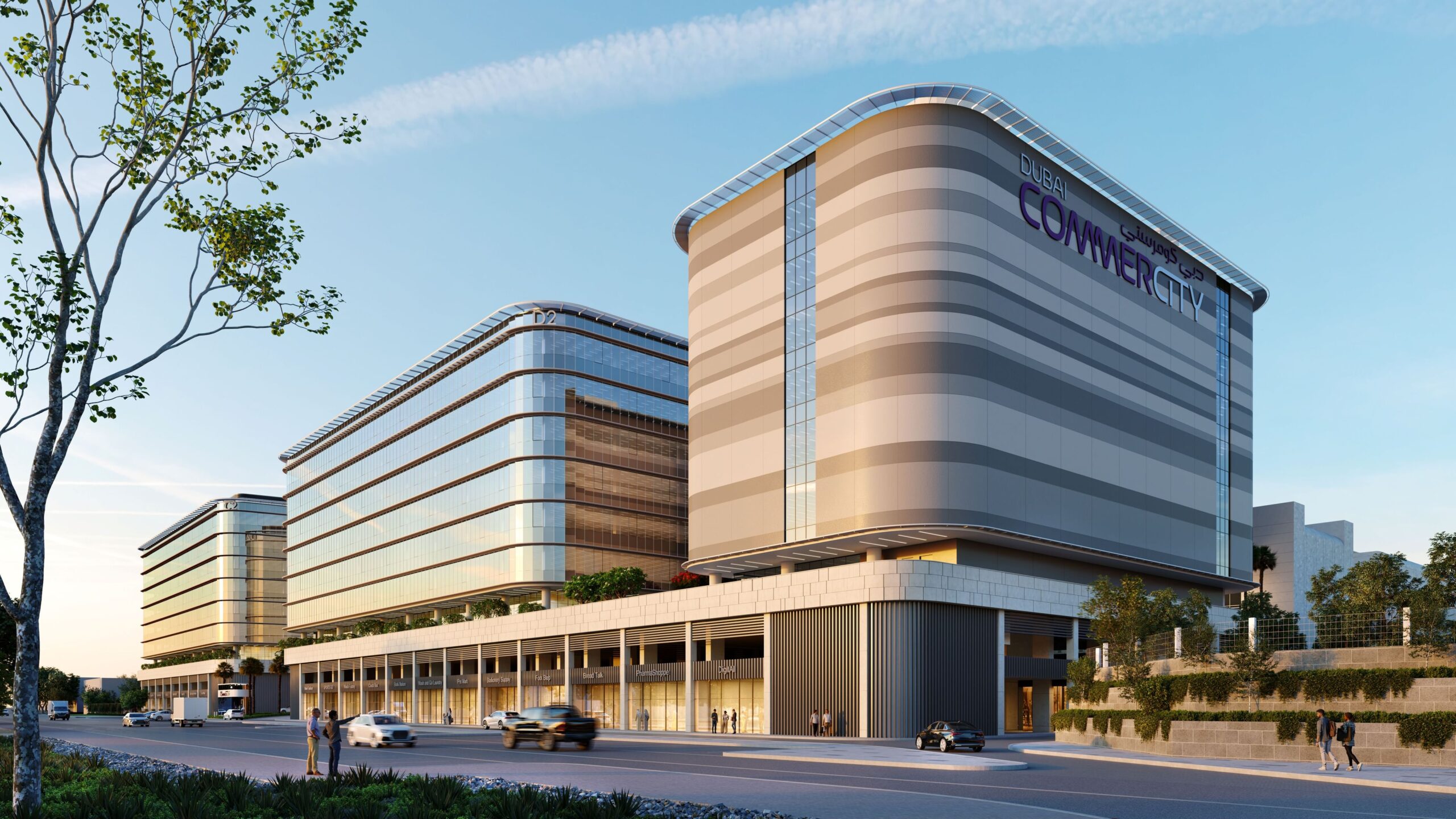
Dubai CommerCity is expanding its footprint with an investment of more than AED 1.8 billion. This expansion adds new business, logistics and commercial facilities as Dubai pushes deeper into the digital economy.
The second phase will add more than 91,000 square metres of space across the Business, Logistics and Social Clusters. Construction and delivery are expected to take place between the first quarter of 2027 and the fourth quarter of 2028.
The expansion comes as demand for space inside the digital commerce-focused free zone continues to rise. Dubai CommerCity reports occupancy of nearly 96% across its office, logistics and retail facilities.
Dubai CommerCity Expands as Demand for Digital Commerce Space Rises
The AED 1.8 billion investment reflects the growing demand for infrastructure that supports e-commerce and technology businesses in Dubai. Digital companies increasingly need more than conventional office space. They require fulfilment facilities, logistics services, warehousing, last-mile delivery and business support in the same operating environment.
Dubai CommerCity was created around that model. The free zone brings together business, logistics and digital commerce infrastructure. It gives companies a platform for establishing and scaling regional operations.
The development is a joint venture between the Dubai Integrated Economic Zones Authority (DIEZ) and Wasl Group.
With existing facilities approaching full occupancy, the second phase gives Dubai CommerCity additional capacity. It does this while keeping its focus on companies involved in digital commerce and related industries.
New Business Buildings Will Add Flexible Office Space
The expansion will introduce six new buildings in the Business Cluster, creating additional space for companies at different stages of growth. The buildings will include shell-and-core offices, fully fitted offices and plug-and-play workspaces. Therefore, businesses will have more flexibility when establishing or expanding their operations.
The first set of buildings is scheduled for delivery in the first quarter of 2027. Additionally, another group is expected in the first quarter of 2028.
This approach is particularly relevant to companies entering the UAE market. A multinational establishing a regional headquarters has different requirements from a growing e-commerce company or technology startup. Offering several office formats allows Dubai CommerCity to serve those businesses without relying on a single model.
The additional office capacity also strengthens the free zone’s role as a base for companies targeting Dubai and wider regional markets.
Business and Social Clusters Will Add 86,000 Square Metres
The Business and Social Clusters will account for approximately 86,000 square metres of the new development. This creates more room for companies while also expanding the services available within the free-zone environment.
The Social Cluster will include additional restaurants, cafés, retail outlets and other commercial services. These facilities are intended to support the growing population of businesses and workers operating within Dubai CommerCity.
For a modern business district, that surrounding infrastructure matters. Companies are not only looking for office space. Employees, clients and visitors also need places to meet, eat and access everyday services.
The expansion therefore adds another layer to Dubai CommerCity’s development as a broader commercial destination. It goes beyond simply being an office and logistics complex.
The Hive Introduces Flexible Logistics Space for E-Commerce Businesses
A major part of the Logistics Cluster expansion will be The Hive, a 5,600-square-metre logistics facility designed around flexible storage and fulfilment requirements.
The facility will contain 181 units starting from five square metres, allowing smaller businesses and e-commerce operators to access logistics space. This is possible without committing to a large warehouse.
The Hive will also feature 24/7 climate-controlled fulfilment areas, digitally managed loading and unloading zones and dedicated last-mile delivery facilities.
That combination addresses one of the practical challenges facing growing online businesses. Sales can increase quickly, but companies still need somewhere to store products, prepare orders and move shipments to customers.
By placing these capabilities within Dubai CommerCity, the facility is designed to shorten the distance between digital commerce operations and physical fulfilment.
E-Commerce Parcel Volumes Rise 152%
The expansion follows a sharp increase in activity across Dubai CommerCity’s logistics operations. The free zone said e-commerce parcel volumes increased by 152% over the past year. Meanwhile, cargo volumes processed through its DCC Way transit platform rose by 14% during 2025.
Those numbers provide a useful explanation for the additional logistics capacity.
E-commerce growth creates pressure well beyond websites and payment systems. Every additional order eventually has to be stored, processed, cleared and delivered. As online businesses expand across borders, the logistics network supporting those transactions becomes just as important as the technology behind the sale.
Dubai CommerCity has also been developing its digital trade infrastructure. The free zone has worked with Dubai Customs, Dubai Municipality and NAQEL Express to enhance its cross-border e-commerce platform. This platform connects processes such as order placement, customs clearance and final delivery.
Dubai CommerCity Strengthens Its Position as a Digital Commerce Hub
The expansion also fits into Dubai’s wider strategy of attracting technology-driven businesses and strengthening the emirate’s position as a global commercial hub.
DIEZ reported 96% occupancy across its economic zones during the first half of 2026. This happened alongside growth in both the number of companies operating within its zones and the size of the workforce. Dubai CommerCity forms part of the DIEZ ecosystem alongside Dubai Airport Freezone and Dubai Silicon Oasis.
For companies considering a UAE free zone, this broader ecosystem creates another advantage. Businesses can access specialised environments for technology, logistics and international trade while remaining connected to Dubai’s wider infrastructure.
Dubai CommerCity’s focus is narrower, but that can also be its strength. The free zone is built specifically around digital commerce rather than trying to serve every type of business.
What the AED 1.8 Billion Expansion Means for Investors
For investors and international companies, the expansion adds more capacity to one of Dubai’s specialised free-zone developments. This comes at a time when e-commerce and digital trade continue to grow.
The combination of offices, logistics facilities, fulfilment infrastructure and commercial services gives businesses several components of their operation within the same development.
That matters for companies entering the UAE with regional ambitions. Dubai is already a major gateway between Asia, Europe, Africa and the Middle East. Moreover, digital commerce businesses increasingly need infrastructure capable of supporting transactions across those markets.
Dubai CommerCity’s second phase is therefore about more than adding buildings.
It is an attempt to build out the physical infrastructure behind Dubai’s digital economy.
With AED 1.8 billion in investment, more than 91,000 square metres of additional space and a logistics network responding to rapidly rising parcel volumes, the expansion gives the free zone a larger platform for its next stage of growth.
Sources
- Emirates News Agency (WAM): Dubai CommerCity launches AED1.8 billion expansion to accelerate future commerce, digital economy growth
- Dubai CommerCity: Dubai CommerCity enhances cross-border e-commerce platform with key partners
- Dubai Media Office: DIEZ posts exceptional growth in H1 2026
