


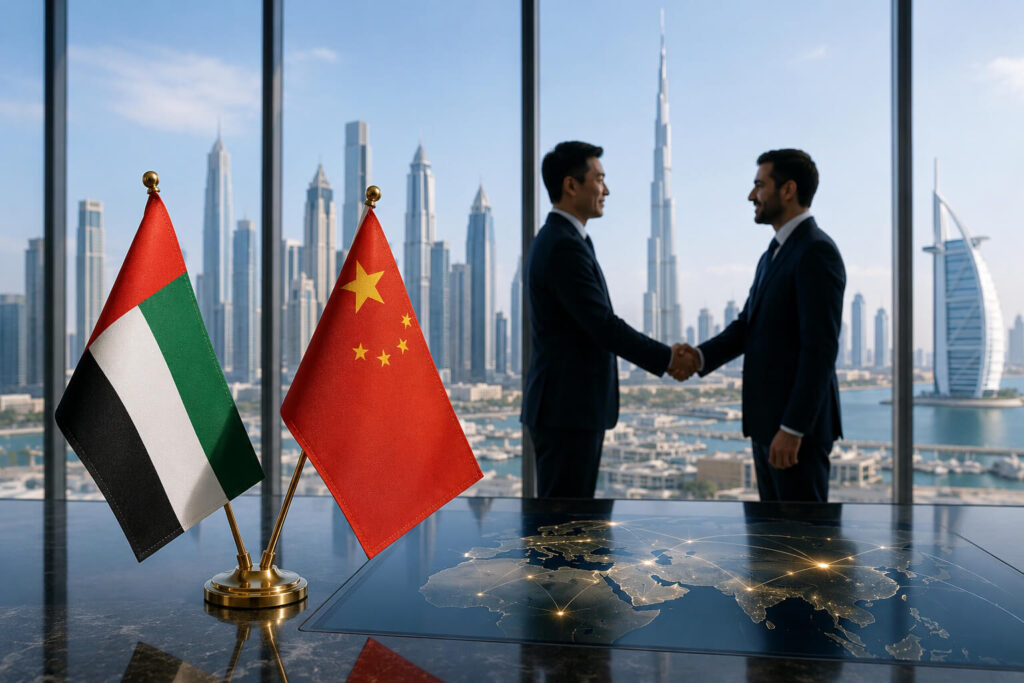
Dubai’s business relationship with China is moving well beyond traditional trade. Dubai Chambers China business partnerships are playing a key role in driving this evolving cooperation.
With Chinese technology companies increasingly using the emirate as a launch point for regional expansion, Dubai Chambers is preparing to take that relationship directly to one of China’s biggest technology and commercial centres.
The Dubai Business Forum – China is scheduled to take place in Shenzhen on 14 October 2026, bringing together government officials, investors and private-sector leaders from both markets.
The bigger story, though, is already taking shape in Dubai.
Chinese companies working in flying vehicles, drone delivery and cross-border payments are building operations around the emirate, drawn by its regulatory environment, infrastructure and access to markets across the Gulf, Africa and Asia.
Dubai Business Forum – China Heads to Shenzhen
Dubai Chambers is organising the Shenzhen forum under the theme “Momentum at Scale: Accelerating Shared Success.” The event is designed to open more conversations around investment, trade and business partnerships between Dubai and China. Rather than simply promoting Dubai as an investment destination, the forum is expected to focus heavily on how Chinese companies can use the city as a base for international expansion.
That fits with a broader shift in the relationship. Chinese companies are not only selling into the UAE anymore. Some are testing technology in Dubai, building regional partnerships here and using a UAE presence to reach customers elsewhere.
ARIDGE Uses Dubai as a Base for Flying Car Expansion
One of the more unusual examples is ARIDGE, formerly known as XPENG AEROHT.
The Chinese advanced air mobility company has chosen Dubai as an important base for its international growth. In October 2025, the company carried out a public manned flight demonstration of its Land Aircraft Carrier in Dubai as it pushed its flying vehicle technology further into overseas markets.
ARIDGE also announced purchase agreements covering 600 units with partners across the Middle East, including organisations in the UAE, Qatar and Kuwait. The company described the agreements as its largest overseas order at the time.
For ARIDGE, Dubai offers something more useful than visibility alone. The emirate gives the company proximity to Gulf buyers, aviation regulators, tourism operators and investors while also providing an environment where emerging transport technology can be demonstrated and eventually commercialised.
Dubai Chambers also supported the company during its initial market entry, helping it navigate local commercial and regulatory requirements and connect with relevant authorities and business stakeholders.
Dubai’s Future Mobility Push Gives Chinese Aviation Firms Room to Test
Dubai has spent years positioning itself around autonomous transport, smart-city infrastructure and future aviation. This makes the city especially interesting for companies trying to commercialise electric vertical take-off and landing technology, commonly known as eVTOL.
For companies such as ARIDGE, the local operating environment matters. They need to work with low-altitude airspace, aviation authorities and potential commercial partners. In many ways, that matters almost as much as the aircraft technology itself.
A commercial market is also forming around premium transport. Business travel, luxury tourism, sightseeing services and short-distance passenger routes could all become part of Dubai’s advanced air mobility market. This would give companies several ways to operate, rather than relying on one use case.
ARIDGE has also pointed to Dubai’s geographic position. A large share of the world’s population can be reached from the emirate within a relatively short flight. That makes Dubai useful as both a demonstration market and a regional headquarters.
Keeta Drone Expands Dubai Delivery Operations
The Chinese connection is also appearing in the skies through Keeta Drone, the drone delivery division of Meituan.
Keeta Drone has been expanding its presence in Dubai as the city develops a commercial aerial logistics network. In December 2024, the company received what WAM described as the UAE’s first Beyond Visual Line of Sight commercial licence from the Dubai Civil Aviation Authority.
That licence is particularly important for delivery businesses because BVLOS operations allow drones to travel beyond the direct visual range of an operator, making larger-scale delivery networks more practical.
Keeta Drone has been working with regulators, developers, government bodies and commercial partners to assess routes around residential communities, universities, public spaces, parks and beaches.
The company has highlighted Dubai’s relatively direct cooperation between government and private companies as one of the reasons for expanding in the emirate.
For drone delivery, that kind of cooperation is difficult to separate from the business model. New aerial delivery networks need access to airspace, suitable infrastructure and regulators willing to work with operators while the technology is still developing.
Dubai Offers Chinese Tech Firms a Faster Route to Commercial Deployment
There is a reason advanced mobility companies keep showing up in this story.
Dubai has become a place where technology can move from demonstration to real-world deployment relatively quickly compared with markets where regulatory processes are more fragmented.
That does not mean every new technology will immediately become mainstream. Flying vehicles and large-scale drone delivery still face technical, commercial and regulatory hurdles globally.
What Dubai offers is a comparatively concentrated ecosystem.
Government entities, regulators, investors, infrastructure providers and potential customers are often located within the same market. For companies entering the Middle East for the first time, that can shorten the process of finding partners and understanding how the local system works.
PingPong Sees Dubai as a Payments Gateway Between China and New Markets
The relationship is not limited to aviation.
Chinese-headquartered global payments company PingPong has also chosen Dubai as it responds to growing payment flows between China, the Middle East and Africa.
Its model illustrates another side of Dubai’s appeal.
A Chinese exporter may have customers across several markets in Africa, South Asia and the Gulf. Managing separate payment infrastructure for every country can become complicated quickly. A UAE-based operation can help connect several of those commercial corridors from one regional base.
PingPong Co-Founder Aaron Lu has described Dubai as more of a gateway than an end destination, reflecting the role the emirate plays in moving both goods and money between Chinese suppliers and customers across surrounding regions.
That distinction matters.
Dubai benefits from domestic business activity, but much of its commercial strength comes from transactions that begin somewhere else and continue into another market.
UAE Digital Infrastructure Strengthens Dubai’s Payments Proposition
Payments companies are also benefiting from the UAE’s investment in financial and digital infrastructure.
WAM highlighted areas including ISO 20022 financial messaging standards, Al Etihad Payments’ Aani instant payment platform and UAE Pass, which is widely used as a digital identity system for government and private-sector services.
For international fintech companies, infrastructure of that kind reduces some of the friction involved in authentication, payments and digital service delivery.
It also makes Dubai more attractive as a regional financial operations centre at a time when China-Middle East trade connections are becoming more sophisticated.
The physical movement of products is only one part of cross-border trade. Payments, verification and financial infrastructure have to move with it.
China-Dubai Business Relations Are Becoming More Technology-Led
The presence of ARIDGE, Keeta Drone and PingPong points to a more technology-heavy phase in Dubai-China business relations.
Earlier commercial ties between China and the UAE were often discussed around logistics, construction, energy and goods trade. Those sectors remain important, but newer activity increasingly involves advanced mobility, fintech, artificial intelligence, digital infrastructure and automated logistics.
Dubai’s attraction to these companies is not based on one factor.
Its location helps. Regulation matters. So does access to capital, international talent and large regional business networks.
Perhaps more importantly, companies can use Dubai to test whether a product designed in China can work commercially across a very different group of markets.
Shenzhen Forum Could Bring the Next Wave of Chinese Companies to Dubai
The Dubai Business Forum – China will give Dubai Chambers another opportunity to make that case directly to Chinese executives and investors.
Shenzhen is an obvious place to do it. The city is one of China’s major technology, manufacturing and innovation centres, with businesses working across electronics, electric vehicles, drones, telecommunications, financial technology and advanced manufacturing.
Dubai does not need every company attending the forum to relocate.
Even a relatively small number of regional headquarters, joint ventures, investment agreements or market-entry projects could add another layer to the economic relationship between the UAE and China.
The companies already operating in Dubai give the pitch more substance.
Instead of discussing Dubai purely as a future opportunity, Dubai Chambers can point to businesses already using the emirate to test products, build regional networks and reach customers far beyond the UAE.
That is likely to be one of the strongest messages heading into Shenzhen in October.