
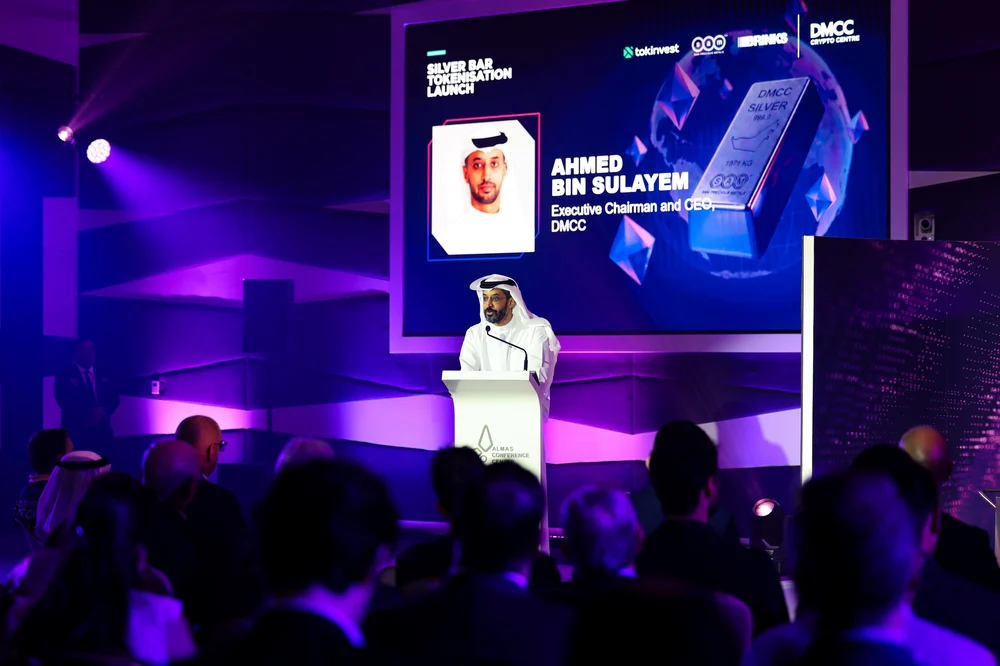
Dubai has moved a rather unusual piece of precious metal into the digital economy. DMCC has formally launched the world’s largest silver bar as the first tokenised commodity asset. This asset is issued under its framework with Dubai’s Virtual Assets Regulatory Authority, or VARA.
The 1,971kg silver bar, already recognised by Guinness World Records, can now be accessed through fractional digital interests by eligible investors. What started as a record-breaking physical commodity has now become a live example. This shows how Dubai is trying to connect traditional asset ownership with regulated blockchain infrastructure.
A 1,971kg Silver Bar Moves Onto the Blockchain
The silver bar weighs 1,971kg and was manufactured in the UAE by SAM Precious Metals using 99.9% pure silver. Its weight was deliberately chosen to represent 1971, the year the United Arab Emirates was founded. Therefore, the asset has both symbolic and commercial significance.
DMCC first unveiled the bar at the Dubai Precious Metals Conference in November 2025 after it secured Guinness World Records recognition. At that stage, tokenisation was already part of the plan. The latest launch moves the project beyond an announcement. Now it becomes an operational structure that eligible investors can actually access.
Investors Can Access Fractional Digital Interests
The physical size of the bar makes direct ownership impractical for most investors. That is where tokenisation changes the picture. Instead of requiring one buyer to acquire the entire asset, the structure allows investors to gain fractional digital exposure. This exposure is linked to the underlying silver.
Tokinvest, a Dubai-based virtual asset platform regulated by VARA, is issuing digital interests linked to the silver as an Asset-Referenced Virtual Asset. The tokens are deployed on BNB Chain and became available to eligible investors from September 7. Moreover, regulated secondary-market trading is expected to follow subject to the relevant rules and platform requirements.
DMCC Tradeflow Connects the Digital Asset to Physical Silver
One of the central questions around real-world asset tokenisation is whether the digital instrument can be clearly linked to a verifiable physical asset. In this project, that connection is handled through DMCC Tradeflow. This system registers and verifies commodity ownership and possession within UAE-based facilities.
The physical bar remains securely held rather than existing only as a digital representation. Brink’s provides custody and logistics, while DMCC Tradeflow supports the registration framework. As a result, the tokenised asset has a physical reference point and creates a structure. This structure ensures that digital ownership interests remain tied to an identifiable commodity.
Dubai Turns Commodity Tokenisation Into a Live Market Product
Tokenisation has been discussed for years across blockchain and financial markets. However, much of the conversation has focused on potential rather than practical deployment. The DMCC silver project stands out because several pieces of the process are already working together.
The project combines commodity registration, institutional custody, blockchain issuance and virtual asset regulation within one structure. Because of this, it is a useful demonstration of how tokenised real-world assets could operate inside an established commercial environment. Rather than as a purely experimental crypto product, this project proves real possibilities.
Why the DMCC-VARA Framework Matters
DMCC and VARA have been building a broader framework around commodity tokenisation rather than treating the silver bar as a one-off initiative. Their collaboration is intended to create a regulated environment where physical commodities can be represented digitally. Furthermore, this approach maintains safeguards around custody, ownership and investor access.
The framework could eventually support tokenisation across other asset classes including gold, diamonds and additional commodities. That possibility matters for Dubai because the emirate already has a significant presence in precious metals, trade finance, logistics and digital assets. Bringing these sectors closer together could open new commercial models. This would have been previously difficult to structure.
DMCC’s Precious Metals and Technology Ecosystems Are Converging
DMCC already operates one of the region’s largest commodity and technology business communities, which gives it an existing base for this type of project. Its gold and precious metals ecosystem includes more than 1,500 companies. Additionally, its wider technology community has grown beyond 4,000 businesses.
That overlap creates an unusual advantage. Companies involved in commodities, blockchain, custody, fintech and digital infrastructure can potentially operate within the same broader ecosystem. The tokenised silver bar shows how those previously separate areas can start to converge around real-world asset products.
Tokenised Assets Could Create New Opportunities for Dubai Businesses
The silver project may be the first live commodity asset under the framework, but its wider significance lies in what could follow. If tokenisation can be applied to other commodities, businesses may gain new ways to structure investment, ownership, financing and trading. These activities would be centered around physical assets.
For free zone companies, this could create opportunities across blockchain development, compliance, custody, brokerage, digital finance and trade infrastructure. It also strengthens Dubai’s appeal to companies working in real-world asset tokenisation. This is because the city already has established commodity markets rather than having to build those markets from scratch.
Regulation Remains Central to the Model
Tokenisation does not remove the need for regulation, verification or secure custody. In many ways, it makes those areas more important. Investors need confidence that a digital interest is properly linked to the underlying asset.
The DMCC-VARA model reflects that reality by combining regulated issuance with physical custody and formal commodity registration. Access remains subject to investor eligibility and platform requirements, while secondary trading must operate within the relevant regulatory framework. That structure is likely to matter more as tokenised assets move from niche experiments into broader financial markets.
From Guinness World Record to Tokenised Investment Asset
When the 1,971kg silver bar was first unveiled, the Guinness World Record naturally attracted most of the attention. The more important development, however, may be what happened afterward.
The bar has now moved from being a symbolic physical asset to becoming part of a regulated digital investment structure. The silver itself remains in secure custody. However, investors can gain fractional exposure through blockchain-based digital interests connected to the underlying commodity.
For Dubai, that is the bigger story. The project shows how physical trade infrastructure and digital finance can begin to operate within the same system. This is different from operating as completely separate markets.
Sources
DMCC — First Tokenised Commodity Asset Launched Under DMCC-VARA Framework with World-Record Silver Bar
https://dmcc.ae/latest-news/first-tokenised-commodity-asset-launched-under-dmcc-vara-framework-with-world-record-silver-bar
Emirates News Agency — DMCC Launches Tokenised World-Record 1,971kg Silver Bar Under VARA Framework
https://www.wam.ae/en/article/c24l2bp-dmcc-launches-tokenised-world-record-1971kg-silver
