

Dubai is strengthening its reputation as a destination for international businesses seeking reliable legal protection and effective commercial dispute resolution. The Dubai International Financial Centre (DIFC) Courts reinforced that position during Dubai Arbitration Week 2026. In particular, they highlighted the growing role of arbitration, mediation, and judicial cooperation in resolving complex business disputes.
The discussions reflected a broader shift in how companies approach commercial disagreements. Rather than relying exclusively on lengthy court proceedings, businesses increasingly seek flexible legal mechanisms. These mechanisms offer efficiency, confidentiality, and enforceable outcomes.
For Dubai, developing these capabilities is closely tied to its ambition to remain a competitive global financial and investment centre.
DIFC Courts Promote Integrated Commercial Dispute Resolution
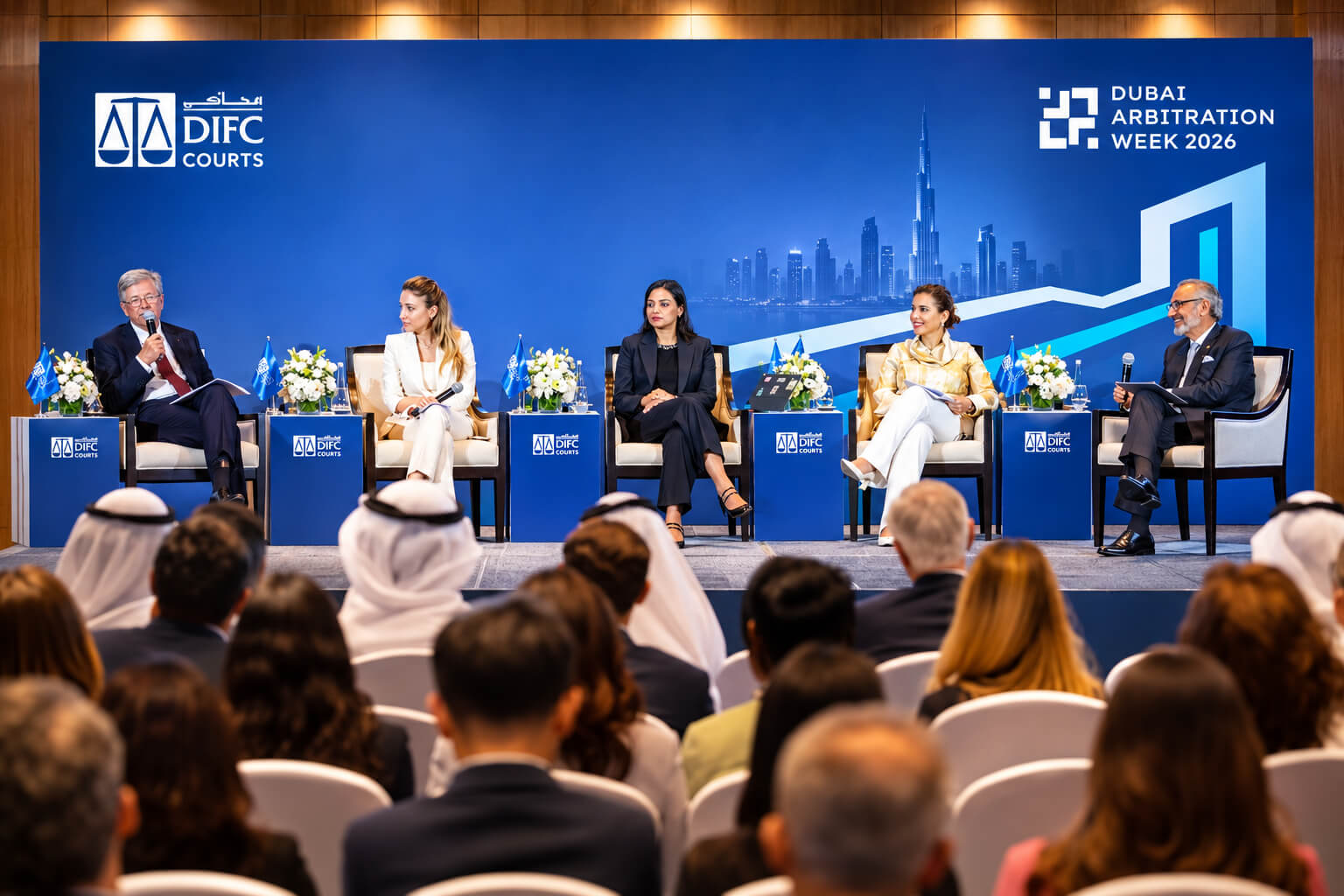
The DIFC Courts hosted a panel discussion titled “The Evolving Relationship Between Arbitration, Mediation and the Courts: Strategic Pathways to Resolution” during Dubai Arbitration Week 2026. The session explored how different dispute resolution mechanisms can complement one another. This is particularly important when handling international commercial cases involving multiple jurisdictions.
Chief Justice Wayne Martin joined legal professionals and industry representatives to discuss the practical relationship between arbitration, mediation, and judicial proceedings. Participants included Rozana ALTayyar, Founder and Managing Director of Taswea; Noradèle Radjai, Partner at LALIVE; and Rima Hadid, General Counsel of the Emirates Investment Authority. Furthermore, Justice Michael Black, a DIFC Courts Court of Appeal Judge and Judge in Charge of the Digital Economy Court, moderated the discussion.
The conversation highlighted the importance of giving businesses access to several legal pathways rather than forcing every dispute through a single process. Mediation can encourage negotiated settlements. On the other hand, arbitration provides an alternative to conventional litigation, and courts can offer judicial oversight and enforcement where required.
Arbitration and Mediation Become Essential for International Businesses
Commercial disputes involving international companies often present challenges that extend beyond contractual disagreements. Different legal systems, enforcement requirements, and jurisdictional issues can complicate proceedings. As a result, the availability of reliable dispute resolution services is particularly important.
The DIFC Courts have developed services that allow businesses to pursue mediation while retaining access to arbitration-related judicial support. Their Mediation Service Centre provides confidential dispute resolution through physical meetings and digital channels. This gives companies opportunities to reach mutually acceptable settlements without immediately pursuing formal litigation.
The Arbitration Division, established in 2020, supports arbitration proceedings through judicial functions. These include applications for interim measures and injunctive relief. This framework gives businesses additional legal options when disputes require urgent intervention or court assistance.
For companies operating across the UAE and international markets, the combination offers greater flexibility in managing commercial risks. It also allows for maintaining access to established legal procedures.
DIFC Courts Register AED 3.2 Billion in Arbitration Claims
The financial significance of arbitration-related proceedings became particularly evident in the DIFC Courts’ performance during the first half of 2026. The Arbitration Division registered 37 claims with a combined value of approximately AED 3.2 billion. This reflects the substantial commercial matters being brought before the division.
For comparison, the total value of arbitration-related claims recorded throughout 2025 reached AED 4.95 billion. The first-half 2026 figure therefore represented approximately 65% of the previous year’s annual claim value. However, the figures alone do not establish a comparable increase in case volumes.
These figures demonstrate the scale of commercial matters requiring arbitration-related judicial assistance in Dubai. They also highlight the importance of maintaining institutions capable of handling high-value disputes involving international businesses, investors, and financial institutions.
Dubai’s Legal Framework Supports Economic Agenda D33
Dubai’s efforts to strengthen commercial dispute resolution are closely connected to its wider economic ambitions under the Dubai Economic Agenda D33. The strategy aims to expand the emirate’s global economic influence. At the same time, it seeks to create an increasingly attractive environment for international investment and business expansion.
Justice Omar Al Mheiri, Director of the DIFC Courts, emphasized the importance of effective dispute resolution mechanisms in supporting Dubai’s competitiveness as an international commercial centre. Reliable legal institutions play a significant role in building investor confidence. This is particularly true when companies enter unfamiliar markets or establish cross-border partnerships.
The DIFC Courts are also advancing digital services to improve accessibility and accommodate modern commercial activities. These developments support businesses that require legal processes capable of operating across geographical boundaries while maintaining procedural certainty.
As Dubai continues attracting multinational companies and financial institutions, the availability of established judicial and alternative dispute resolution services remains an important component of its business environment.
Stronger Dispute Resolution Services Benefit DIFC Companies and Investors
For companies establishing operations within the Dubai International Financial Centre, access to internationally oriented legal services can influence decisions involving investment structures, contractual arrangements, and commercial partnerships. Businesses entering the UAE market often need assurance that disagreements can be addressed through transparent procedures. They also require assurance that applicable decisions can be enforced.
The DIFC Courts provide a legal framework designed to support these requirements, particularly for commercial disputes involving international parties. Arbitration-related judicial assistance, mediation services, and formal court proceedings give companies different options depending on the circumstances of a dispute.
These services can be especially relevant to financial institutions, technology companies, professional services firms, and multinational businesses operating within the DIFC. Commercial relationships increasingly involve multiple jurisdictions. Therefore, legal certainty is an important consideration when negotiating agreements or expanding operations.
A stronger dispute resolution environment also contributes to Dubai’s broader investment appeal. Companies are more likely to commit resources to markets where contractual rights are supported by credible legal institutions. Accessible enforcement mechanisms are also important.
Dubai Arbitration Week Highlights Growing International Legal Influence
Since its establishment in 2011, Dubai Arbitration Week has developed into an annual gathering for arbitration specialists, legal practitioners, and commercial dispute resolution professionals. The event provides a platform for examining emerging legal challenges. It also encourages dialogue between judicial institutions and the international business community.
The DIFC Courts’ participation in the 2026 edition reflected Dubai’s continued efforts to position itself as a centre for resolving international commercial disputes. Discussions surrounding arbitration, mediation, and judicial cooperation highlighted how legal institutions are adapting to increasingly complex business relationships.
Rather than treating arbitration, mediation, and litigation as competing approaches, the discussions emphasized how these mechanisms can operate together. This provides businesses with more practical solutions.
For Dubai, the objective extends beyond handling individual disputes. A dependable legal environment supports international investment, strengthens commercial confidence, and reinforces the emirate’s position within global financial markets.
As cross-border business activity continues expanding, the DIFC Courts’ evolving approach to dispute resolution is expected to remain an important part of Dubai’s wider economic development strategy.
Sources
- Emirates News Agency (WAM): DIFC Courts reinforce Dubai’s position as global dispute resolution hub at Dubai Arbitration Week 2026
- DIFC Courts: Official Website
- Dubai International Financial Centre: Official Website
