


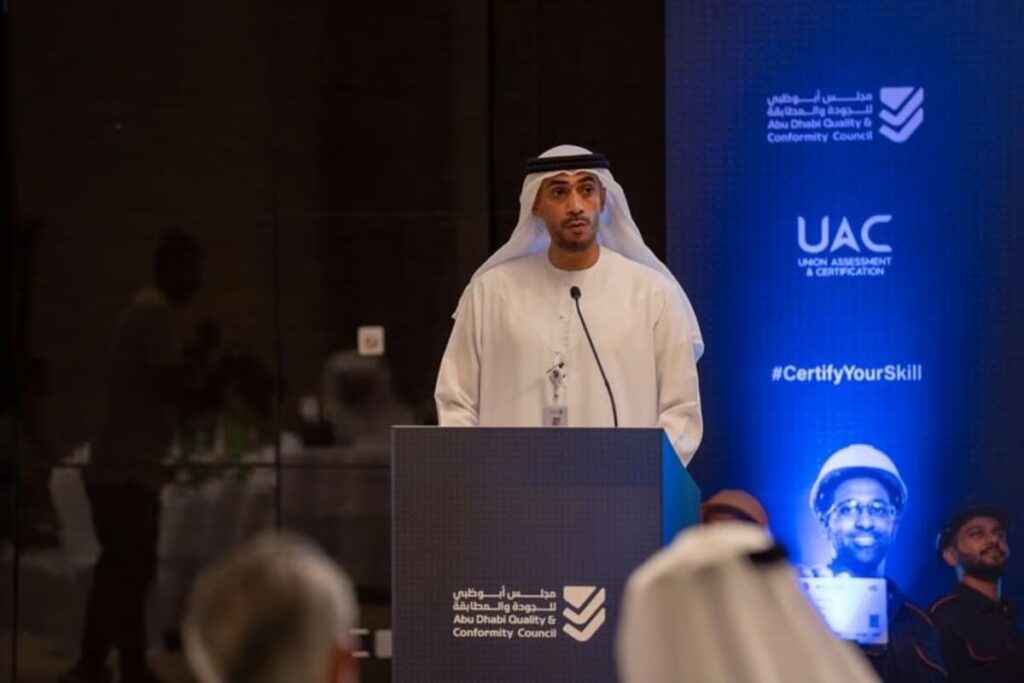
Abu Dhabi has introduced a new way for professionals to prove their qualifications without relying entirely on paper certificates or lengthy manual checks.
The Abu Dhabi Quality and Conformity Council, working with Union Assessment and Quality Accreditation, has launched what it describes as the Gulf region’s first blockchain-authenticated Digital Skills Card. The system gives professionals a secure digital record of verified skills and allows employers and regulators to check those credentials through a QR code.
For companies hiring internationally or managing technical workforces, the idea is simple. Instead of chasing documents across different organisations, employers can verify whether a qualification is genuine through a digital system designed around trusted records.
What Is Abu Dhabi’s Digital Skills Card?
The Digital Skills Card acts as a digital record of professional certifications and competencies. Each card is linked to credentials awarded through recognised personnel conformity programmes, giving employers and regulators a faster way to confirm whether those qualifications are valid.
The card includes a QR code that can be scanned to verify the information attached to it. That means the system is more than a digital copy of a certificate stored on a phone. The verification happens through blockchain infrastructure, which helps confirm that the credential has not been altered or falsified.
The technology behind the system is ADI Chain, developed by the ADI Foundation. Its role is to provide the secure verification layer that supports the card.
Blockchain Moves Into Workforce Verification
Blockchain has spent years closely tied to cryptocurrency, digital assets and financial applications. Abu Dhabi’s Digital Skills Card shows how the technology can serve a much more practical purpose.
The Digital Skills Card uses blockchain to address a simple but important business challenge: verifying qualifications. Employers can confirm that an applicant genuinely holds the credentials they claim, while regulators can maintain trustworthy records for industries that require specific certifications before professionals can perform certain types of work.
This approach turns blockchain into a practical verification tool rather than another financial technology. It gives employers faster access to trusted credential information and helps regulators protect professional standards without relying heavily on manual checks or paper records.
A blockchain-backed system can make those records harder to tamper with while making verification more direct. For workers, that could also mean fewer situations where they have to repeatedly submit the same documents to different employers or authorities.
Employers Can Check Credentials Through a QR Code
One of the most practical parts of the Digital Skills Card is the QR code attached to each verified credential. Employers can scan it and check whether the professional certification linked to the card is authentic.
That may sound like a small change, but credential verification can become time-consuming when companies are hiring at scale. Human resources teams may need to contact certification providers, request copies of documents or wait for third-party checks to confirm whether a qualification is valid.
A direct digital verification system could reduce some of that friction. It could be particularly useful for employers in technical industries, engineering, construction, professional services and other sectors where recognised qualifications form part of the hiring process.
The Abu Dhabi Quality and Conformity Council has positioned the initiative as part of a wider effort to strengthen trust in accredited professional skills while improving the way companies and authorities access verified information.
The Digital Credential Can Move With the Worker
Another important part of the initiative is portability. Professionals often change employers, move between industries or relocate between countries, yet their qualifications do not always move with them smoothly.
A worker may have a valid certification but still need to prove it again when joining another company. Different organisations may also use different systems to check the same credential.
The Digital Skills Card is intended to make verified qualifications easier to carry between employers and potentially across borders. Union Assessment and Quality Accreditation has indicated that the system could expand over time to include more certifications, qualifications and professional achievements.
If that happens, the card could gradually become a broader digital professional record rather than a tool tied to only a limited group of certifications.
Why This Matters for Abu Dhabi Businesses
For businesses in Abu Dhabi, the launch fits into the emirate’s wider push toward digital services, trusted data and more efficient government and business processes.
Companies operating in the emirate often recruit talent from several countries. That is particularly common in sectors such as construction, technology, professional services, manufacturing and energy. Every international hire can bring another layer of document checking, especially when technical qualifications or regulated credentials are involved.
A blockchain-authenticated skills record could make one part of that process easier. Employers would still need to follow existing recruitment, licensing and immigration requirements, but verifying professional qualifications could become faster and more transparent.
That difference matters because administrative delays can affect hiring decisions, onboarding timelines and compliance processes.
What It Could Mean for UAE Free Zone Companies
The Digital Skills Card could also become relevant to companies operating inside Abu Dhabi’s free zones and economic hubs.
Free zone businesses often attract international entrepreneurs, specialists and technical professionals. Many of those companies need to build teams quickly while still meeting local employment and regulatory requirements.
A trusted digital credential system could give employers another tool for checking whether candidates hold the qualifications they claim to have. It may prove especially useful for companies hiring across borders, where confirming certificates can sometimes involve several organisations or jurisdictions.
The Digital Skills Card does not replace employment visas, work permits or professional licences. Its role is narrower. It focuses on helping organisations verify professional skills and qualifications.
Abu Dhabi Continues to Build a Digital Business Environment
The launch also says something about the direction of Abu Dhabi’s wider digital economy.
Digital transformation is no longer limited to putting government forms online or allowing companies to register electronically. The next stage increasingly involves making the information inside those systems easier to trust and verify.
That includes professional qualifications.
A digital hiring process still creates problems if employers cannot confirm whether a candidate’s credentials are genuine. By adding blockchain-based verification, Abu Dhabi is trying to make that information more dependable while keeping the user experience simple.
The QR code sits at the front of the process. The blockchain infrastructure works behind it.
A Small Launch With Wider Regional Potential
The Digital Skills Card is still an early initiative, so its long-term impact will depend on how widely employers, regulators and certification organisations use it.
Its potential becomes much bigger if additional qualifications are added and if employers across the UAE or wider Gulf start recognising the same verification system.
That could support greater workforce mobility by allowing professionals to carry trusted digital credentials between companies and potentially between markets.
For now, Abu Dhabi has taken a practical first step. Instead of using blockchain as a headline technology, it is applying it to something businesses deal with every day: proving that a person actually holds the skills and qualifications listed on their record.
What Businesses Should Watch Next
Businesses in Abu Dhabi should watch how quickly the Digital Skills Card expands beyond its initial certifications and whether more government bodies, employers and professional organisations begin accepting it.
The bigger opportunity lies in integration. If digital skills records eventually connect with recruitment systems, professional licensing platforms or other government services, credential checking could become considerably faster.
For free zone companies, that could mean fewer manual checks during recruitment and a smoother path when hiring qualified international staff.
The immediate impact may be limited, but the direction is clear. Abu Dhabi is moving toward a business environment where professional credentials are not only digital, but directly verifiable.
Sources
Economy Middle East — Abu Dhabi launches region’s first blockchain-authenticated Digital Skills Card
https://economymiddleeast.com/news/abu-dhabi-launches-regions-first-blockchain-authenticated-digital-skills-card/
Emirates News Agency — Abu Dhabi launches region’s first blockchain-authenticated Digital Skills Card
https://www.wam.ae/en/article/c24l25t-abu-dhabi-launches-region%E2%80%99s-first